Episode 6
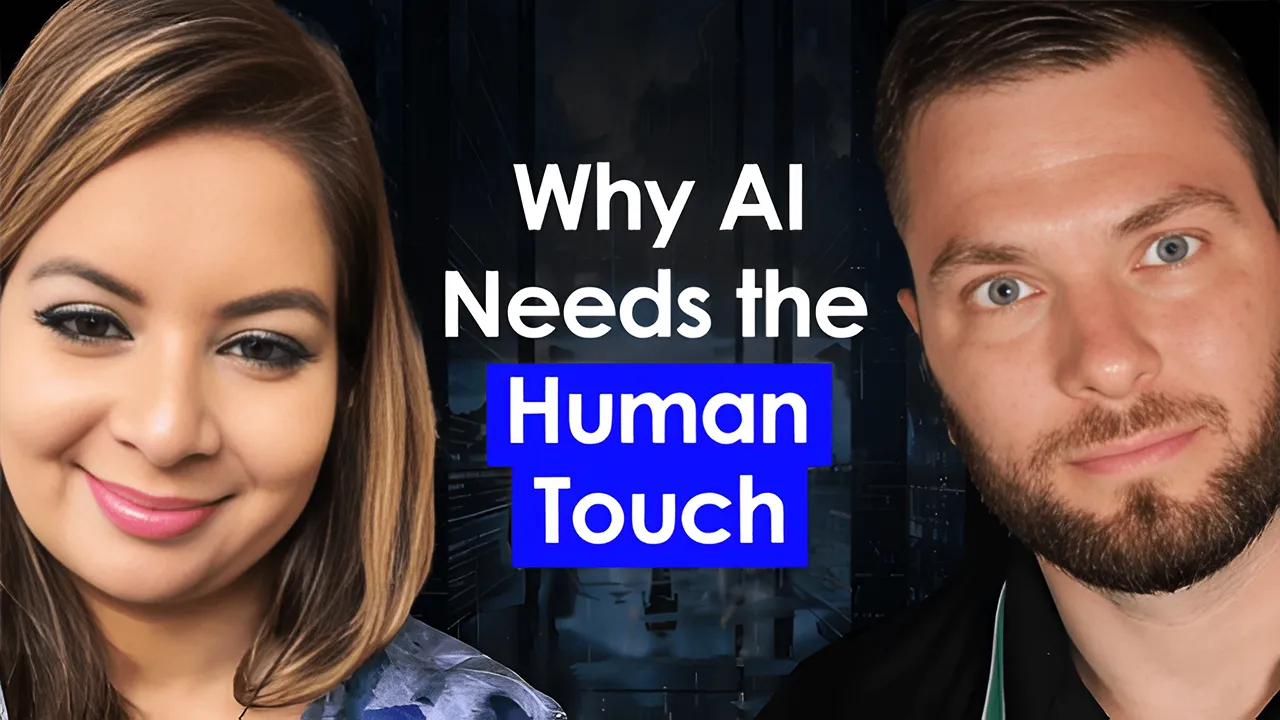
The Truth About AI, Data, and Human Connection

Dona Sarkar · Chief Troublemaker, Microsoft
Share:
Show Notes
Samuel sits down with Dona Sarkar — Chief Troublemaker at Microsoft, global AI & accessibility leader, entrepreneur, author, and fashion designer — to explore why human connection is still the most valuable asset in the AI era.
They talk about the limits of automation, why data quality can make or break AI projects, and how leaders can adopt AI without losing their unique voice. Dona shares candid stories from running offline businesses, busts common AI myths, and reveals how to experiment your way to success.
Key Takeaways
- How Dona manages a wine bar, fashion label, and AI at Microsoft
- Three lessons from running real-world businesses with AI
- Why experimenting is the only way to succeed with AI
- The truth about AI agents, memory, and the human in the loop
- A roadmap for adopting AI: start with Copilot, then scale up
- Designing responsible AI agents and fixing accessibility gaps
Resources
MicrosoftHuman ConnectionData QualityAI AdoptionAccessibility
Narrator
The AI Frontier Playbook.
Narrator
Mastering AI with the experts.
Narrator
Guest: Dona Sarkar.
Samuel Boulanger
So, let's make sure to stay tuned until the end. Now, let's jump in.
Samuel Boulanger
Hello, Dona. Thank you so much for joining us today on the podcast. I'm really glad you've been able to find time to join us.
Dona Sarkar
Thank you so much for having me. I know this has been an adventure getting it scheduled and dealing with our tech issues.
Samuel Boulanger
I researched preparing for this podcast, and honestly, I was amazed to find that you run a wine bar, you run a fashion label. By the way, my wife is totally in love with your dress. You write books, and on top of that, you lead global work at Microsoft in AI and in accessibility. Now, how do you find the time to juggle between all those projects?
Samuel Boulanger
I will assume that part of it is AI.
Dona Sarkar
Well, I think the main thing is that it's so important for people to get clear that you don't do them all at once. Um, so for example, the year I was working on opening a wine bar, I was not also writing a book. So, in terms of me, I'm always doing two things, but I'm never doing more than two things. So I am working on AI right now and I am running a wine bar. Next, I will be actually doing a master's program in something related to human minds, but I won't be also running a wine bar at the same time. It'll be in maintenance mode, but I won't be starting anything. So I think it's important that people don't try to start too many things at once because they do split their attention, and then they get stressed and overwhelmed and they feel guilty. So it's all about the seasons. I'm a huge fan of seasons. Like for the next three months, I'm going to go deep on this one thing. And then the next three months after that, I'm going to go deep on this other thing, because maintaining is easy. Starting is hard. And that one is a very important lesson that I learned the hard way.
Samuel Boulanger
I really like that because it can totally apply to myself. I'm trying to run all those projects at the same time. And I agree. I love the concept of, you know, having a season.
Dona Sarkar
Yeah. Yeah. Just lean into seasons. They're there for a reason, right? We do it at work, so we should do it for our personal lives as well.
Samuel Boulanger
Are all those offline, real-world businesses changing the way you think about AI and how you apply it? How can it reflect in the workplace as well? I mean, I assume you've learned a lot being directly on the field running those businesses, and then you have this clear view of how AI can help you.
Dona Sarkar
I will say the most important things, there's probably three main lessons I've learned from running offline businesses. The first one is your data is not just the most important part of AI, it's the most important part of your business. Um, the reason we cannot AI most things in the world is because our data is not in order and our data has no plan to stay up to date. A lot of people say, "Oh, I got my data in order and I introduced a Copilot." Like, cool. What are you doing to keep it up to date? Because keeping data up to date is like a daily activity. So for example, say you create just a report of your earnings from yesterday, and you need to name them correctly. And then you can't name them all earnings July. It has to be earnings July this day, earnings July that day, earnings July this day. But Samuel, you do a lot of presentations. How many presentations do you have that say presentation to customer X final, presentation to customer X final final, customer presentation to customer X final final? But for real though, right? So AI is going to reason over all those, all of them, because they're in the same folder. We keep them in the exact same folder, and then we're getting out-of-date information. We're confused about why. We're like, why am I getting out-of-date information? Like, because it's your fault. Because you did it. People are like, "Oh, AI's made up stuff from my data." I'm like, "Yeah, but it's your data." So that is probably the most important thing, is getting data up to date, getting data cleaned, but also staying up to date has to be someone's job. It cannot be, oh, it'll just happen on its own. No, it has to be someone's pretty much full-time job. The second one is it's very important to identify where AI should be used and where a human touch should be used. So I have a principle that AI never touches my customer ever. No customer service agent, no automated email response, nothing. No, because my customer touch points are where I personally learn the most about what is good about my product and what's bad about my product. So, I don't like automated ordering. I don't like any of that process. We actually had done an experiment with the wine bar where we said, "Okay, I wonder if people can just order through the app." It turns out no one liked ordering through the app, and no one actually did order through the app, and sales plummeted because what they want to do is come in and be heard and be seen and have someone guide them and try new things. And AI is not going to do that. Sure, your AI agent can kind of, you know, be a little bit of a psychopath and say, "Hm, what a great choice. Do this, right?" Versus a bartender saying, "Ah, I don't really love that one much. I love a Sylvaner, but this one's not good. I recommend this other one." Then people walk away more educated with a personal connection. So that's the second thing. The third thing is probably the most important: people need to change their behavior around AI. If you introduce a new AI tool, but they keep using the old way, the AI tool is never going to be useful. Um, it's going to suck at the beginning, and that is okay. But only with use does the AI tool become useful. But I will say I'm seeing like a tiny micro version of probably every company in the world experiencing these exact same three issues.
Samuel Boulanger
Interesting. So data governance is something I see so much. Like how many customers ask me, you have 10,000 documents, want to ask questions about it. The first question I'm asking: how many versions of the same documents do you have out there? Because AI is powerful, it's not magic. It doesn't know which one it should use, right? And if you have contradictory information in one document and another one, it doesn't know which one to take.
Dona Sarkar
And that's every company. Every company. That's why I don't believe the demos. People are like, "Oh, look at my folder." And then AI is giving me answers. I'm like, "That folder is pristine, clean, invented yesterday, full of demo data, but where's like your friend's folder that has the exact same document that they downloaded offline to work on it?" Because, you know, that happened. Um, where's the version that's gotten forked and now you have three versions of the same document that we're all working on? And where's the version that you've got with the latest data from over here, right? And which thing links to it? So the real world is messy and it will never be not messy. So getting AI to work in the real world versus trying to make the real world work with AI, you know, it's an ongoing challenge we're all going to have forever. Honestly, we are.
Samuel Boulanger
Yeah. I love it. And I also like the fact you're mentioning the human touch. You know, when I first started to try using ChatGPT at the time, now Copilot, to build my YouTube video or build my podcast questions, I quickly realized it was losing my touch. It was losing my voice.
Dona Sarkar
Yes.
Samuel Boulanger
And I stopped doing that, right. Actually, I'm using it for research to find the right sources of information, but then I read through them by myself. I learn from it. And yeah, it really resonates with me, because if you want to have this connection with others, you need to understand where they came from. You need to understand them, and you can't do that just using AI.
Dona Sarkar
No, because it becomes generic slop, and you can tell right away. Um, you know, Sam, a crazy thing I just heard recently was, you know, there's job postings open up, and when someone posts a job posting, they get probably a thousand résumés in an hour. And hiring managers are saying there's not even a point to posting jobs anymore. Um, because those thousand résumés just all look exactly the same, and we don't even know what's real and what's not real anymore. So, hiring managers are saying, "I just send my job posting out to my close-knit community and ask them to send me real introductions between me and a person. I don't even care about the résumé anymore. Um, I want like a phone call. I want some sort of a real back-and-forth chat session with this person to see if they're a real person within like the first five minutes." Um, because they just don't believe anything anymore. We don't. And now I'm seeing people who are looking to get jobs, and the only people who are getting jobs pretty quickly are the ones who have a warm introduction to the actual hiring manager. We're back to face-to-face, like old school.
Samuel Boulanger
This is almost scary at some point. I mean, and I don't see what's the point of applying for a role you don't have the competencies to have success in it. I just don't understand.
Dona Sarkar
But I don't either. But people do it. They'll just say, "Oh, please generate me a résumé that matches this job description." And they will. And they all look the same. The fact that everyone uses the same prompt is hilarious to me.
Samuel Boulanger
Great. Yeah. You can notice. I mean, you and me, we're really in the center of the storm, right? In the eye of the storm. And I don't know about you, but I can tell if an image is made by AI. I can tell if a post is made by AI. Like there's some easy-to-identify factors, like the overuse of that kind of stuff that can tell you it's generated by AI.
Dona Sarkar
Yeah. Yeah. You can tell. You can tell in a second. I don't like those LinkedIn posts that are all generated by AI. Like I went to an event recently, and every single LinkedIn post talking about the event was the same prompt. And there was like, so honored to be part of blah. Here's three things I learned. Exact same three things. Huge thank you to the organizers and the same six hashtags. I'm like, "Wow, that's really bad, guys." But because this is your way to really stand out and talk about something insightful about the event and use it to build your personal reputation, but using the exact same AI thing. The fact that I saw I think 25 exact same LinkedIn posts was wild to me. I look at so much AI, so I can tell right away. I can tell in one second if something is AI generated. So, it's interesting. We're losing our human touch. But I think it'll swing back the other way because the AI-generated things will get kind of down and the obviously human things will go up. But it's like, do you remember when social media first came out, we used those tools to auto-schedule stuff and a bunch of them got blocked, and they never got visibility? The people who kind of spammed links, those got down on the algorithm, and the only ones that really showed up were the ones that were obviously human with the high engagement. So, I think we're about to see the same thing in the AI-verse, but it's the pendulum. We're like this way, that way, this way. So, no, it's not new, but it's annoying.
Samuel Boulanger
I've noticed on LinkedIn, I made a post recently, and I just generated an image using Copilot. The post was from me, but the image was from Copilot. And I noticed that LinkedIn put this little CR tag on top of the image saying it was generated by AI. So, I think we will adapt, like you said. Now we're at one side of the spectrum. Everybody's experiencing, everybody's getting used to AI and trying to use it everywhere and anywhere. At some point, we will go to the other side of the panel.
Dona Sarkar
Yeah.
Samuel Boulanger
Talking of LinkedIn, you recently posted about the AI bot factor that basically you can use to help teams understand how ready they are to adopt AI. So can you expand a bit on it, or what is it? How do you use it?
Dona Sarkar
So I think what's really important is that people are really confused about their own readiness. And I think before people get too far along this path, they have to understand where they're at as a human or as an organization, right? And so much of it is saying, do you have scenarios that you would like to try AI on? Um, and I've got, you know, a bit of a, not a framework per se, but I have a mindset around this whole concept. Um, the first one is you want to really meet people where they are in their work, whether that's you or whether your colleagues who you're working with. And once you're there, you say, "What does your day-to-day look like? Step one, step two, step three." I wind up doing this over and over. Then you ask them, "Okay, here's your day-to-day. How often do these activities happen? How often? Let's see if AI can help you with some of these more repetitive activities that do not touch other people, that more help you, but you can tell in one second if it's wrong or right." So, how can you use AI to do those things first? Gauge the score and say, okay, AI actually did a good job here, three out of three. Yay. Or AI did a terrible job, one out of three. Or AI did kind of okay, I would try it again. But I think we have to get sciency. We have to write it down and say, let's go out there and try AI for lots of things. And of course my hundred bad ideas is go out there and try it for a hundred different things. Some of them will work, some of them won't work. But the way to be good at something is to do it a lot. And I think people miss the boat on that. They were like, "Oh, I'm not good at this yet." I said, "Did you do it a lot?" They said, "No, I just did it twice and I'm bad at it." I said, "Of course you are. You're going to suck at something that you've done twice. That's normal. You sucked at riding a bicycle when you'd done it twice. Until you rode like a hundred hours, you didn't actually know how to ride a bike." So, I tell everyone you have to do a lot of experiments, a lot of iterations. Like Taylor Swift writes probably a thousand songs. We probably hear 20 a year. Um, whoever, who was it? Was it Beethoven? I think he wrote a hundred thousand symphonies. We only knew like a hundred, right?
Samuel Boulanger
Much? Wow.
Dona Sarkar
Yeah. Da Vinci painted probably millions of paintings. We only saw X many. So to do something well, you have to do it a lot, and out of it comes some diamonds in the rough, and say, okay, these are the ones that worked. But I believe the people who lead in the AI-verse are the ones who do it a lot, who use it a lot, and they're able to say these are good, these are bad, and take the ones that are good and make them even better.
Samuel Boulanger
We come from a world where 20 years ago, I think we had to learn how to Google, basically how to do web searches, and basically people expect AI to be like web searches and they don't necessarily persist. They're trying a couple of keywords, didn't get the result they were expecting, and as you mentioned, just say, "Hey, I'm bad at it. Like, let's forget. I'll go back to the old ways of doing things and doing a web search." Being told if you spend two minutes, three minutes on the prompt, and it reads through all those web sources, summarizes it for you, versus if you don't do that and do the web search yourself and go through the sources, where you'll spend an hour instead of two minutes. So for me, it's obvious that you should put the effort, and it's worth doing the effort because these tools will get easier at some point.
Dona Sarkar
But ultimately, right now, eventually we're not all going to have to become like prompt engineer, whatever the crazy title everyone wants to use is. These tools will get better. They really will get better. But I believe the ones who get into the tools now will understand why things work, and they're going to be leaders in the AI-verse much more than followers, much more than receivers. And they're also going to be the ones who are going to decide how their job will look in the next five years. They also will say this is what my job looks like. Here are the tools that we, as in my industry, are going to use as the industry standard and the industry norm. They're going to set the tone, set the framework, set the guardrails for their industry because they've had their hands on the tools the longest. So my advice to everybody is go and try it excessively. Do not worry that you're bad at it, but document. Document your adventures. I have the most boring spreadsheet you've ever seen, which is here's a thing I need to do. Here's a problem. Here's a tool. Here's a prompt. Here's my score. One, two, three. Would I do it again? Yes or no? And when I have to do that thing again, I go back to my prompt and say, "Okay, Dona, let's try the prompt. It was two last time. Can I make it a three this time?" And I just challenge myself to it. And honestly, I have automated so much of my job. The parts of my job not automated, of course, are these things where I'm talking to you, talking to customers, talking to my teammates, but every other part I use AI for excessively. Excessively. But that didn't happen overnight. It took three years of me using it pretty much every single day. Not pretty much, every single day.
Samuel Boulanger
That's a muscle that needs to be built. How do you think memory will impact the need of being a good prompt engineer? Like I've read all over LinkedIn recently that memory will make prompt engineering obsolete. I'm not convinced personally, but I'd like to have your opinion on that.
Dona Sarkar
Memory and context will make prompt engineering easier, but for the short term it will not do things for you. So for example right now, ChatGPT, Copilot, they've got memory functionality, okay, but which memory to use for what context? We have context and we have memory. Say I'm Dona writing a paper about the future, and this is the real thing, my team and I are writing a paper about what the future of IT admins look like, right, just based on what our jobs look like and what our customers' jobs look like. The context we have is here are a whole bunch of IT tools we all use. Here's a bunch of skill sets we have, and we want to write a paper based on this. So, the context is here's a bunch of documentation. The memory is the three of us are writing this paper. Here's where we're at. Here's a conversation we had in a Teams meeting. We've got this document we're collaborating on, and we're continuing with this discussion. Okay, Copilot knows this information. Then I'm switching and working on a paper on what agents look like in the finance industry. Do I really need the memories from the IT discussion? Not really. So I have to say ignore the memories from the IT discussion in my prompt, because I have to guide the memory. So the human still starts having to orchestrate this conversation and pluck out the right memory for the right thing. So it's like saying, "Oh, we're not going to need humans to do web searches anymore because web will just know what we want." Like that has never happened. That has not happened in 25 years. So no, the human will always need to be in the loop to correct and say, "Yeah, I wanted this. No, I didn't want that. Less of this, more of that." Right? We're going to become a lot of recommendation engine. Less of this, more of that. Less of this, more of that. Just like we did with Netflix. Occasionally, Netflix will be like, "You'll be interested in these shows." And they're right, but sometimes it's like, "Where did you get this from? Have you lost your mind?" Or, "I'm no longer interested in this genre. I was really into murder stuff for a while, but then I got scared. So now I'm not into murder stuff anymore." So computing is binary. The thing you teach it, it's going to give back to you. It does not have the, you know, high-intensity human emotions, our moods and fancies. And we need to continue to train it with more of this, less of that. Even with AI, we always have to have a human in the loop. So I love how everyone thinks agents are the solution to the universe. I'm like, guys, agents are AI with automation, context, and memory. That is what agents are. They have context, they have memory baked in, and they have tools. So, they can take actions on your behalf with guardrails. But agents are not going to solve your problems. So, I'll give you my spell check example. Once upon a time, and you, Samuel, might be too young to remember, we used to open a Word document, write a paper, and we used to go to the edit menu and choose spell check, and then a spell check agent would pop up and it would highlight each word that was spelled wrong, and you'd have to choose what spelling you want. We had to summon it to do work. Then people figured out, wait, you shouldn't have to summon spell check. Let's put a red squiggly under all the words that are wrong. Then you'd right-click on those. You didn't have to summon. It's telling you, it's prompting you now. Like, yo, something's wrong. Yo, something's wrong. Yo, something's wrong. Um, first you prompted it, then it prompted you. Okay, you right-click, right-click, right-click, accept, accept, accept, accept. It makes suggestions. Now, you spell things wrong, it fixes it in real time for you. You don't even notice that you can't spell. Like, we don't know we can't spell anymore because spell check just kind of does it for us. Now all the systems are still there. We still have guardrails saying, no, my last name really is spelled like that, add it to the library, right? And no, I am in fact writing in French Canadian, so please switch the language. No, all these words are not wrong. So technically, the job of spelling, we don't need to learn spelling anymore technically, right? We haven't needed to know spelling in our lifetime. But sure as heck, we still have spelling bees. Sure as heck, people learn spelling in schools, because at the end of the day, we still have to show up as human, knowing how to be literate. So, I don't agree that agents are going to take away all of our problems. It's going to make it easier, but, like we were talking about, AI is not going to write a good paper for us. It's actually going to be pretty terrible. And we still need to have the core building blocks on how to do basic activities and let AI augment us, like hardcore augment us. But I really don't think agents are just going to solve all of our problems the way we love for things to come along and solve all of our problems. Agents are going to continue to not solve all of our problems.
Samuel Boulanger
You know, I love this perspective because sometimes you just read things on LinkedIn basically telling us that we're doomed, and we all will be out of a job in the next 10 years because we have agents. I agree with you. It's basic automation. It's powerful, but it's not, it won't solve it all. You still need a human in the loop. You still need someone to take the decision and to, you know, bring the agent on the right path. Because right now, by experience, I know it's not always the case. It is very powerful, but it's some use cases, not everywhere.
Dona Sarkar
What makes me mad are these CEOs who go out there and say insane, and excuse my language, but it's just basic things that we know are lies. So Marc Benioff went out there on CNBC, I think last week, a few weeks ago, and said AI is doing, or agents are doing, 50% of the work at Salesforce. Like, which work? If we call recording meetings work, sure. If we call writing papers work, sure, people are using AI to do those things. I believe that. But agents in isolation are not doing 50% of the work at Salesforce because Salesforce is still 500,000 people, and they're not getting 500,000 times more benefit. So that's just not true. Um, so I always push down on it when people say these things. I'm like, which work? Which agent? What does it do? So whenever anyone says, "Oh, we have X many agents doing stuff," I'm like, "I've not seen one, so I don't know what we're talking about exactly." Um, so I think people are out there sensationalizing AI because they need to justify the amount of time and money they've spent on it, which is okay. I don't mind that. But I always go to the heart of the matter and I say, "Why are you talking about this? What is your motivation? What motivates you to go out and tell the world this? What are you selling? Right? What are you selling me? And do you have a case study of not you that proves that this is true or not?" Right? So I am naturally extremely suspicious because I'm a dev, you know, that's what we do. People are like, "This is working." I'm like, "No, it's not. No, it's not. Works on my machine does not work here in this case. No, no, no." So these executives who go out there and spread things that just are not true to me are hilarious, because like, guys, we are not stupid. We've worked for a long time. Anytime someone says a thing is going to come along and change the industry in a year, I'm like, 20 years, yes. One year, nope. Nothing has ever changed the industry in one year.
Samuel Boulanger
You think this is super confusing for our customers out there and CIOs, or whoever is thinking of learning about AI? It's going so fast, there's so much noise that some people just give up trying to learn all those stuff because they're telling themselves, hey, anyway I'm out of a job in five years. Why should I even care? So yeah, that's what I've seen and noticed as well. It scares people away almost.
Dona Sarkar
Sometimes it does, because people get stressed. They're saying the message we're putting out there into the world that I really don't like is, if you are not using AI, you're falling behind. And I don't like that, Samuel. That makes me mad because we're saying you're already out of the club, and that is not healthy. Instead, I think it's much better to say, if you're not using AI, that's absolutely fine given all the misinformation out there. But you can get started, and the way to start is use a free tool to do something in your life that you already know how to do very well. You don't need to go transform your entire business process with AI. Just use it to plan like your vacation or something, or your long weekend. Use it to do something very low stakes that you can say, eh, that's not so good, but just get hands-on with the tools and write down good scenarios and bad scenarios and really just science-project it yourself. But I really don't like this dividing the world into two categories, those who AI and those who don't use AI. A lot of CEOs say AI won't take your job. Someone with AI will take your job. And I'm like, that is a ridiculous thing to say to everyone, because we are all people with AI. Um, if you recorded a meeting in a while, you're a person with AI. If you've, you know, used Editor in Word in a while, you're a person with AI. So, we are all people with AI. Uh, but like spell check, it's not going to be a thing we have to proactively choose all the time. It's just going to be something that's done for us. Uh, so I don't buy that. I will always argue about that, and I laugh at people, like, don't fearmonger. Don't do it. Pull people in, don't push them out.
Samuel Boulanger
A lot of organizations out there don't have any single agent. Like, let's be real.
Dona Sarkar
No, they don't. Most of the organizations out there.
Samuel Boulanger
So for an organization that wants to start building agents, you said on LinkedIn that leaders should start with simple M365 agents, which is the equivalent of a GPT in chat. So I think a lot of people know more about GPTs. So why is that? And when should they move to the more powerful version, like Copilot Studio, and build more advanced agents?
Dona Sarkar
I think one of the issues that people have run into is they go to building their own AI agent when they don't know what AI agents can do, and then they get frustrated that their AI agent is not good. We're like, "Mhm, that's right." Because again, back to our initial convo, the first order of business is your data. And they're like, "My AI agent sucks. It's not able to give me any good answers." We're like, "Right, where's your data?" They're like, "In my SharePoint." What SharePoint? This one over here? All of them? We're like, "Okay, no SharePoint's any good. I don't know." Okay. Um, I said, "Why don't you just use M365 Copilot agents, the researcher and the analyst agent?" They're like, "Oh, no. They don't give me what I want." I'm like, "What do you want?" We're back to this conversation. So, I tell everybody before you go to build the car, maybe learn to drive, right? So, learn what AI is. Learn what it can do, what it's good for, what it's bad for, what kind of data do you need. If M365 is giving you terrible results, your data is probably not that good. Um, so maybe you should lean into that and, you know, play with some of the settings like restricted SharePoint or getting rid of this from AI results, or all of those tools that are there. Purview, there's so many tools that exist to help you make your M365 experience better. And of course, it's not the most end-all, be-all tool on the planet, but it's probably the best starter tool out there because first, you got your guardrails. You're not going to leak data anywhere strange. You're not going to do anything weird with tools. A lot of people like to jam tools into their AI like, "Oh, I want to write to a database." No, no, no, no, no, no. You will not write to a database through AI until you know what you're doing. People have overwritten their entire ADO by being creative, right? We're like, are you ready to overwrite your ADO? But it's like, you know, the great power, great responsibility thing. You need to learn great responsibility before you start exercising this great power that you have. So I tell leaders, get hands-on with M365 Copilot because the guardrails are already there. It's very, very hard to mess this up and to do anything terrible to your enterprise because it is an internal tool by design. Nothing will be pasted on the internet from your M365 Copilot by accident. Copilot Studio, one step less guardrails, where yes, you can build a Copilot reasoning over your internal data, but you are not going to post that Copilot externally because you can't. Like, you have to do some admin rigmarole to be able to do it. If you've got external data, then you can post externally. You've got internal data, you post internally. Makes sense. So you've got a little more freedom, but still guardrails, and then the content moderation is done for you. So you don't need to sit around, think all day like, hm, should I say low on violence? You don't need to overthink this. But once you start using more advanced tools like Azure AI Foundry, that's when you probably need a dev. I say you're probably going to want a dev. You're probably going to want what I call a responsible AI expert to be able to go and just put a framework in place around what are you using this for? Oh, finance data. Okay, you're going to need a lot more responsibility, guardrails around this because this is a very regulated industry. This is not a place where you can have a lot of creativity in your results. So security, accuracy of answers winds up being a lot more important. But I truly believe adopt, get familiar with that, and then build, and then build more. That's probably the framework that people should be following.
Samuel Boulanger
Talking of framework, you came with this workflow homework, I'll call it a framework, which was like four steps and identifying where you can use AI. And let's say I'm a finance manager and I want to apply this framework, how would that look like in practice?
Dona Sarkar
So I actually recommend that. I learned the framework from Amy Hood's team, by the way.
Samuel Boulanger
Yes. So Amy Hood, for listeners, Amy Hood is the CFO of Microsoft, and she was one of the first adopters of AI across the company.
Dona Sarkar
And she said, what is this thing that we're investing a lot of money in, and let's get our hands in it, because Amy is a woman who wants to know, right? She's extremely technical and really wants to know what's up. So she assigned a, think of it like a mini chief AI officer for her organization. Her name is MJ, and MJ's job was to set up this AI program, and they had a really, really, they have a very good program. They said, we're going to roll out M365 Copilot. We are going to have an AI champion per discipline in finance. So the financial analysts, the financial projectors, the people who put together earnings reports, these other jobs, each one of these jobs, pony up an AI champion, and I'm going to gather the AI champions every week. And with those AI champions, we're going to talk about what are some scenarios that are very common for you. And please use M365 to try to automate some of the middle parts of this job you've got, like grab the earnings results from last quarter and use them to make new earnings reports. That didn't work. Why? Let's look at why. So it was really working with those champions to create a prompt library for each of those specific roles. So they said, this is a prompt for finance people, analysts, projectors, blah. And then they had demo days. So they would have demo days to executives and they would say, hey, we are going to demo how to automate this part of our job using AI on every other Friday for 30 minutes, and we always want a new person coming and demoing, and dear executive, you have to demo too. So that was what I found to be quite magical. And then I've adopted that same method with a bunch of variations for all of the customers who I wind up working with and all the organizations, which is to get really, really tactical about getting hands-on together as a group. So I worked in what we called CELA, our legal department, in accessibility, and I drove AI for the accessibility team for about a year and a half when I worked there. That was actually when Copilot was introduced. So I said, we need to get hands-on in this. So I had lunch and learns all the time, first talking about what is AI, how does it work? Let's actually use just the sandbox tool and change the various things around, like temperature high, temperature low, prompt here, prompt there, so people stop being afraid of the tool. It stopped being this weird black box everyone's afraid of. Then it's like, let's try prompts as a group. So in our lunch and learn, it's everyone type in the little box, how do you, you know, help me write a contract, help me draft an email, help me process these applications, um, etc., etc. We actually had like hands-on lunch and learn time. But I think the only way to drive AI adoption is, this sounds bad, but by force. You have to make it part of people's jobs, and you have to do it kind of as a group. Those are the ones I've seen work all the time. The ones where everyone says, oh, I run my company, go learn it, they won't.
Samuel Boulanger
And how do you assess if it's actually helping? I've seen so many use cases. I run some, we call promptathons, people trying to find ways of using AI. Sometimes super good ideas, but then when we ask about the ROI, it's like, oh, I'm saving an hour a month. Maybe it's not AI in that case.
Dona Sarkar
Yeah, nothing. Do you have a framework too? Yeah. ROI is a terrible metric because we're all trying to measure ROI of yesterday's problems. It's less about, oh, I saved an hour a week. It's more about, do I feel like I have energy to solve the problems that have not been solved yet? Do I feel like my time is being wasted on the same thing I've done for 20 years for no reason whatsoever? So I'll give you a real example. A core place I use AI is to write peer feedback via Perspectives tool, right? So I am very good at writing perspectives. So I took a previous one that I'd written for someone, and I just saved that as a template. And going forward, whenever someone asks me for perspective, I say, using my template, my format, based on all of my conversations with this person via Teams phone calls, write me a perspective highlighting the good, which are one, two, three, highlighting the area that I feel like maybe we can work on together, which is this one thing, and then anything else going forward. And Copilot generates me a really solid perspective, and then I go and modify it because I want it to be personal. I want it to be real, but I also want it to sound like me and I want it to be robust. So in that way, what is the ROI of that? How many hours did it save me? I don't know how many hours I spent writing perspectives. People don't know how much time they spend doing things, right? Our baseline is wrong. We just have a wrong, wrong baseline. If you ask me, Samuel, in one quarter, how many hours do you spend writing perspectives? I'm like, I don't know, one, seven, 35, like who knows? Because you also spend time thinking about it, and we're not lawyers. We're not good at this. We're not good at billing for the time we spent thinking about it. We just bill for the time that we actually put hands on keyboard. But when AI does a lot of that pulling out the data for us, then we end up saving, I believe, like probably an hour a perspective, right? So I think the ROI trap is, we cannot fall into it. And I know business leaders need it because they're like, "Oh, without ROI, we have no reason to justify spending time on this." We're like, "Yeah, but we didn't measure ROI moving to the cloud. It was just a thing we should do." We didn't say, why should we migrate from on-prem to Azure? Like, well, when there's an outage, you need to plan for, well, what if there isn't an outage? I think the global pandemic proved we have the biggest outage in the whole world, right? It's more about future prepping than about just putting Band-Aids on current solutions. But when leaders get stuck on ROI, I'm like, forget ROI, work on something you've never been able to solve before. There's your ROI. Work you've never been able to solve it in your entire life because you can't. You don't have time. You don't have energy. You have no idea how to do it. Find some person who's never tackled this before. Get them on it. Give them, I don't know, three weeks, six weeks, three months, some number of days to go solve it with AI. Like go. Anyway, you're not going to solve it because you've not solved it. So go for it and do a future thing.
Samuel Boulanger
That's great. If I go back to your example now, I assume you improved the quality, right, of the perspective.
Dona Sarkar
Yes, it was much better. Yeah.
Samuel Boulanger
It would have took you some time to do research and then read through it and come up with the perspective. So quality might be a good indicator of, you should use AI not only the time you've saved. Are there other factors that come to mind, like improving quality, quality of life, I suppose?
Dona Sarkar
It's quality, quality of life, reducing burnout I think is important, because I used to dread the season, not because I didn't love giving my colleagues feedback, but because it felt so annoying in the formal process. If a colleague called me on the phone and says, Dona, do you like working with me? I'd be like, yes, why? And I tell them blah, blah, blah, blah, blah, blah, blah. There's my weird little hack, by the way, to write perspectives. I said, "Can I call you?" They're like, "Okay, weirdo." I said, "15-minute call. I want to tell you why I like you." They're like, "Okay." So, I call them and I say, "What I like about working with you: blah, blah, blah, blah, blah, blah, blah." They're like, "Oh, wow. Thank you." I'm like, "I'm putting that in your perspective so your boss can see it, too. Appreciate you. Bye. Done." Right.
Samuel Boulanger
That's a good idea. Love it.
Dona Sarkar
Weird hack, but works because they get it. They get it from me. They're not like, this is some AI-generated slop. They got to hear it from me. We have a beautiful conversation. When was the last time, Samuel, you called someone and told them how much you like working with them, and you just gave it to them straight for 15 minutes, and then you jam that meeting recap into a perspective, or you tell Copilot, make a perspective out of this, and jam that in the tool, and their boss is like, wow, that's really nice, and they know it's real, right? They know it's real. Do that. Do that.
Samuel Boulanger
Yeah, I will. I will actually. It's interesting because you keep the human touch, still using AI. That's great.
Dona Sarkar
I'm a big fan of the human touch. I believe the human touch is going to have a premium price tag because so much of this, air quotes, AI slop will take over our world. We won't believe anything anymore that's written down. We won't believe anything on a screen. So the human touch, I believe, is going to carry a premium price tag going forward.
Samuel Boulanger
That's what I think as well. You know, I was worried at some point like, oh, I have my YouTube channel. Now AI can do podcasts. I'm like, no. Where will I be in 10 years? Will I still be relevant? But personally, I'm not that interested in a podcast between two AIs except if it's to learn a certain subject very fast while I'm transiting. But other than that, I still want to have the emotion. I still want to, you know, the mistakes that you can make during a podcast.
Dona Sarkar
Yeah. I want to know this person's a real person, right? I want to know I can run into them on the street. So, I'll give you the example of why I don't think we're going to be entertained by AI doing stuff with AI. Um, was it 1997 that IBM's Deep Blue beat Garry Kasparov in chess? Do you remember? That was 30-something years ago, almost 30 years ago. We still watch chess. Like chess champions are a thing. Wasn't there an epic fight on Twitter about two chess champions like last month? We're obsessed with chess. People love to learn chess. Kids have seven-year-olds learning chess. Why, if AI can do it better than us, why do we even bother? It's because no one cares about watching AI play AI. Like, we don't care. We do not care at all. Because we love human drama. And no AI is going to replace human drama. That's just not happening.
Samuel Boulanger
You created design checklist when creating agents that goes transparency, control, consistency. Yes, the design principles. What does that mean in business terms, like for a BDM out there who wants to start building agents? How do you apply this framework?
Dona Sarkar
Well, the big thing is it can be summarized into just three basic things that they should remember. One, the person should know that this is an AI agent that they are dealing with. As soon as we get into the business of saying, "Hello, this is a person. Please talk to me about your issues," and it's not, you're breaking the most important responsible AI principle of all, which is disclosure and transparency that this is an AI agent that you're dealing with. So, that's probably the first one is transparency that this is an AI agent. Here's what the agent can do. Here's what the agent cannot do. And here is how you should interact with the agent. So that's one, called transparency. Second one, control. How do I control the results or the outcome or whatever it is? Do I have any control at all? So you can say, "Please talk to me only in Spanish." That's control. Please delete everything I ask you. That's control. Um, please remember this conversation for next time. That's control. So you have to be so clear on what control the user has and what control the user does not have with this AI agent. And I do believe that we should have more control over AI agents that work within a company rather than it just being a one-size-fits-all. But be very clear over what control the user does have. And the third one is basic design, which is don't make it weird. A lot of people try to get clever. They're like, I'm going to have the upload button be, I don't know, a starfish. Like, why? Just have it be the little arrow with the box that it's always been for 20 years. I'm going to have the save icon. Paper clips are so last year, or attach, what is it? The floppy drive icon is so 35 years ago. I want the save icon to be the moon. Like, why? Why? No one knows what that means. Just stick to the design principles that have been around since the beginning of computing that people are like, "Oh, the youth don't know what a save icon is." I'm like, "Every youth knows what a save icon is." Every youth, five-year-olds know what a save icon is because it's not intrinsic. It's just a learned design principle. So mine is, in the era of AI, you don't need to get overly creative with your bad self and we need to change all the design principles. Saying that, the way we're going to interact with AI and agents will be different. I believe we're going to have more adaptive UX. So for example, some scenarios will be more talking to, and some scenarios will be seeing, and some scenarios will be typing. But it won't be all. I won't be yelling at a screen all the time. I'm not doing that at work. But I'm also not going to be typing as I drive, and I'm also not going to be, you know, doing eye gaze for many things. So UX will adapt for the scenario, but also for us. And that's where accessibility matters because I want people to have more control over how they interact with technology just based on their specific needs and the way the world is designed. So it's old-school inclusive design principles, but in the era of AI, I think we have such an opportunity because AI can do so many things. We can improve design, but again put it back in the human's hands, human's control, and say, how do you want to deal with your AI? So, as we design things, it's so important to make sure everyone knows how to use it, but also give them the choice to use it the way they choose.
Samuel Boulanger
Just the voice capabilities nowadays is just incredibly powerful. I mean, it's incredible. Like five years ago, it was okay, but it was, you know, now anybody basically that can't use a keyboard can leverage AI, which is very, very powerful.
Dona Sarkar
Absolutely. Yeah. The problem is most AI tools are not accessible. So they're not accessible yet because most developers have never learned accessibility. They've never learned to put the right tags and labels on various elements to make them clickable by voice tools or by screen readers. And that was what I learned in accessibility. Accessibility is not a human problem. It's a tech problem. It's that we don't teach devs how to write accessible code. And by the way, all these automatic code writers like GitHub Copilot, Cursor, whatever, they write horribly inaccessible code.
Samuel Boulanger
Because it's trained on...
Dona Sarkar
Of course. Why? Because it's trained on inaccessible code. We're back to data. We're back to data.
Samuel Boulanger
I was looking recently, can it read images inside of PDF? And the answer was yes, if there's alt text, right? And guess how many PDFs have alt text?
Dona Sarkar
Nope. Not much. Nope. Nope. Nope. Nope. Nope. Nope. I know. I'm like, "Guys, if you think AI is going to solve accessibility without us being involved, no. The data is not there. We haven't done the good job with the data yet. We haven't."
Samuel Boulanger
Yeah. It's like the fact that, you know, those LLMs are totally biased on the data they've been trained on, right?
Dona Sarkar
Exactly. Everyone's like, "Oh, AI is biased." I'm like, "So are you." They were like, "Hey." Like, "No, you are. You are. It's your fault. Why are you blaming LLM? It's your fault."
Samuel Boulanger
Which one of those points, like transparency, control, and consistency, do you think are skipped the most often? And what does it break when it does?
Dona Sarkar
I think transparency is the most broken. That's where all of these, that's why people don't trust AI, because we lie so much. Oh gosh, we lie. We lie over what AI can do more, right? We go out there and claim AI can do all those things. And it might work in isolation in a demo environment, but let me get my hands on that for a week with real data, and AI will not do that thing very well. Right now, we're in a phase of the industry where everyone is claiming AI is much better than it is. And that to me breaks transparency, because when you claim that and people try it and they don't see it, one of two things happens. One, they feel stupid that they can't get the same result, which I don't want. Or the second, they say everything about AI is a lie. I'm never going to use this again. You're like, no, because the truth is always somewhere in the middle, right? AI was good for it in these scenarios, but it was quite terrible in these other scenarios. And that is okay. So, I think transparency is broken the most. And until we get right with that and start fixing it as an industry, people aren't going to believe us. They really are not, because many people have been burned by it. And the other ones are like, I got sold a hill of beans. People say, "Oh, this AI will solve all my problems," and it has not solved any. I'm like, shouldn't have told them that. So we've done this to ourselves, Samuel. We have. This is our own fault.
Samuel Boulanger
This is something I see from the field. There are so many conversations I have to have with my customers, tell them, I know we're presenting X or Y or Z, but honestly it will be available or it will be good in a year, but right now it doesn't work. Like, don't focus on that. We have so many other things that work well. Focus on them, and then the field will evolve. But we're creating so much noise that everybody's confused.
Dona Sarkar
They're confused because we'll roll out something insane-sounding, like we as an industry, not just Microsoft. Every company's doing it. They'll say this agent can replace all of your lawyers. Like, now you're going to need a lawyer for when you have lawsuits, right, with this problem. And we're like, AI has not managed to replace anything. Maybe translator, something basic, like some basic translator, not even like a real translator who helps you in social situations. It makes me really mad when people say AI is going to replace like some sort of a support human for people, like, oh, deaf people don't need a sign interpreter anymore because AI will just do it. Like, "Have you ever met a deaf person?" Because they don't like to have a conversation with a thing in their face and you the whole time translating what you're saying between the screen and this. That's the kind of whiplash and the overload is too much. The sign interpreter is there to help them have the conversation with humans. We could have solved this problem with, you know, sign language on a screen like years ago. That's not the problem. It's trying to solve a problem for audiences you do not belong to. That's why I think it's more important for everyone in the world to get more involved in the creating of AI rather than just the consuming. Because if we rely on basically like tech bros to do creating, the world's going to be set up for tech bros, not for everybody in the world.
Samuel Boulanger
Interesting. I was listening to a podcast with Sam Altman recently where he was covering a lot of those aspects, but was mentioning that people are using ChatGPT as their therapist, but there's no legal protection on those conversations.
Dona Sarkar
So mine is like, okay, you tell them, yes, you should go back to meth. Now what? Whose fault is this? Right, we're back to the human accountability problem. Okay, whose fault is it? If someone who's recovering from being a drug addict was advised to use meth with ChatGPT, whose fault is it? Is it theirs? Is it ChatGPT's fault? Is it OpenAI's fault? Is it Microsoft's fault? Is it the therapist who did human-in-the-loop stuff's fault? We don't know. Is it Nvidia's fault for providing the GPUs? The finger-pointing, Samuel, has just started, right? It's just starting.
Samuel Boulanger
Yeah, just starting.
Dona Sarkar
But we've been here before. We've been here before. We went through this with the cloud stuff. We had a cloud outage. Whose fault is it? The company who didn't know how to do migration correctly? Is it Azure's fault? Is it the country who owns the data center land? Is it the electrical grid? Whose fault is it? I don't know. Ten levels of fault, but ultimately, what are you going to do to harden this so it doesn't happen again? I think fixating on fault is useless because it's everyone's fault, no one's. Instead, how do you harden this? Build resiliency in so it does not happen again more than pointing fingers, because there's no simple answer. I think in AI everyone expects a silver bullet solution, but given the problem is not a werewolf, there's no silver bullet. It's an everyone problem.
Samuel Boulanger
Love it. Um, we're almost at the end of our time. I had a lot more questions, but I'll start wrapping up with a new segment. So you're my first guest to experience the segment, which I call One Tip, One Vision, where I'd like you to share your number one productivity tip, like the one you couldn't live without using AI, obviously, in your own work, and then telling us how you think AI will affect us in the next 10 years. How do you think it will change the way we live and we work? So, let's start with your number one productivity tip.
Dona Sarkar
My number one productivity tip is to write down your activities over a course of a day. Like, legitly sit down and say, "I'm doing this." Write it down. "I'm doing this." Write it down. And then figure out how to augment one-third of those activities with AI. And give yourself that challenge. And then document what's going well and what's not going well. Because the only person who can tell you how to use AI in your work is you, because no two people's workflows are the same. So I believe that every one of us should become the AI power user, the AI super user of our own life first before getting creative with trying to change the world with AI. So I have become AI super user of my life. It took me six months. It was not me who knew every tool. It took me six months to automate one-third of my life with AI. But now I actually cannot live without it because, back to your initial conversation, how do you manage to run a wine bar and do all this? Because I have augmented so many parts of my day-to-day work with AI, I'm able to have more time to do these things. So that's my first productivity tip. The second thing, how do you think AI is going to change how we live and work? I am a non-doomer. So I believe AI is actually going to bring us closer together as humans. Because if you think, Samuel, 20 minutes ago when we were kids, we're like, "Ooh, can we have more screen time? If we behaved ourselves, we'd get more screen time." Now, if I behaved myself, can I have less screen time? Can I get away from screens this weekend? I went on vacation last week and I told everybody, "This is a screenless vacation. I'm not going to be in front of my computer even once." And everyone's like, "Oh god, you were so lucky." So I think in the future we're going to have AI-free zones and AI-free time, where we're like, this is 100% human-to-human conference, 100% human-to-human generated content, human created, human curated, will have a premium price tag.
Samuel Boulanger
Love it. Thank you so much for your transparency. This is honestly so refreshing. I mean, we've said that there's a lot of noise out there, and you're being very transparent about the state of the art right now, what you see, where you see the future. So, thank you for all those tips, for your time. Uh, of course, and maybe in episode two at some point.
Dona Sarkar
Of course. Thank you so much, Samuel.
Samuel Boulanger
Thanks. Bye, everyone. Thank you, Dona.
Narrator
All right, that's a wrap on this episode of Mastering AI with the experts. A huge thanks to Dona for joining us. Her take on seasons of focus, the myth of AI replacing humans, and why transparency matters more than hype was exactly the kind of grounded insights we need right now. If this sparked ideas for you, share it with someone who's navigating AI in their own work. And don't forget to check out the newsletter, Mastering AI for Productivity on Substack. It's where I go deeper on the stuff that actually works. Thanks for listening, and I'll catch you in the next one. See you.
The AI Frontier Playbook.
Narrator
Mastering AI with the experts.
Narrator
Guest: Dona Sarkar.
Samuel Boulanger
So, let's make sure to stay tuned until the end. Now, let's jump in.
Samuel Boulanger
Hello, Dona. Thank you so much for joining us today on the podcast. I'm really glad you've been able to find time to join us.
Dona Sarkar
Thank you so much for having me. I know this has been an adventure getting it scheduled and dealing with our tech issues.
Samuel Boulanger
I researched preparing for this podcast, and honestly, I was amazed to find that you run a wine bar, you run a fashion label. By the way, my wife is totally in love with your dress. You write books, and on top of that, you lead global work at Microsoft in AI and in accessibility. Now, how do you find the time to juggle between all those projects?
Samuel Boulanger
I will assume that part of it is AI.
Dona Sarkar
Well, I think the main thing is that it's so important for people to get clear that you don't do them all at once. Um, so for example, the year I was working on opening a wine bar, I was not also writing a book. So, in terms of me, I'm always doing two things, but I'm never doing more than two things. So I am working on AI right now and I am running a wine bar. Next, I will be actually doing a master's program in something related to human minds, but I won't be also running a wine bar at the same time. It'll be in maintenance mode, but I won't be starting anything. So I think it's important that people don't try to start too many things at once because they do split their attention, and then they get stressed and overwhelmed and they feel guilty. So it's all about the seasons. I'm a huge fan of seasons. Like for the next three months, I'm going to go deep on this one thing. And then the next three months after that, I'm going to go deep on this other thing, because maintaining is easy. Starting is hard. And that one is a very important lesson that I learned the hard way.
Samuel Boulanger
I really like that because it can totally apply to myself. I'm trying to run all those projects at the same time. And I agree. I love the concept of, you know, having a season.
Dona Sarkar
Yeah. Yeah. Just lean into seasons. They're there for a reason, right? We do it at work, so we should do it for our personal lives as well.
Samuel Boulanger
Are all those offline, real-world businesses changing the way you think about AI and how you apply it? How can it reflect in the workplace as well? I mean, I assume you've learned a lot being directly on the field running those businesses, and then you have this clear view of how AI can help you.
Dona Sarkar
I will say the most important things, there's probably three main lessons I've learned from running offline businesses. The first one is your data is not just the most important part of AI, it's the most important part of your business. Um, the reason we cannot AI most things in the world is because our data is not in order and our data has no plan to stay up to date. A lot of people say, "Oh, I got my data in order and I introduced a Copilot." Like, cool. What are you doing to keep it up to date? Because keeping data up to date is like a daily activity. So for example, say you create just a report of your earnings from yesterday, and you need to name them correctly. And then you can't name them all earnings July. It has to be earnings July this day, earnings July that day, earnings July this day. But Samuel, you do a lot of presentations. How many presentations do you have that say presentation to customer X final, presentation to customer X final final, customer presentation to customer X final final? But for real though, right? So AI is going to reason over all those, all of them, because they're in the same folder. We keep them in the exact same folder, and then we're getting out-of-date information. We're confused about why. We're like, why am I getting out-of-date information? Like, because it's your fault. Because you did it. People are like, "Oh, AI's made up stuff from my data." I'm like, "Yeah, but it's your data." So that is probably the most important thing, is getting data up to date, getting data cleaned, but also staying up to date has to be someone's job. It cannot be, oh, it'll just happen on its own. No, it has to be someone's pretty much full-time job. The second one is it's very important to identify where AI should be used and where a human touch should be used. So I have a principle that AI never touches my customer ever. No customer service agent, no automated email response, nothing. No, because my customer touch points are where I personally learn the most about what is good about my product and what's bad about my product. So, I don't like automated ordering. I don't like any of that process. We actually had done an experiment with the wine bar where we said, "Okay, I wonder if people can just order through the app." It turns out no one liked ordering through the app, and no one actually did order through the app, and sales plummeted because what they want to do is come in and be heard and be seen and have someone guide them and try new things. And AI is not going to do that. Sure, your AI agent can kind of, you know, be a little bit of a psychopath and say, "Hm, what a great choice. Do this, right?" Versus a bartender saying, "Ah, I don't really love that one much. I love a Sylvaner, but this one's not good. I recommend this other one." Then people walk away more educated with a personal connection. So that's the second thing. The third thing is probably the most important: people need to change their behavior around AI. If you introduce a new AI tool, but they keep using the old way, the AI tool is never going to be useful. Um, it's going to suck at the beginning, and that is okay. But only with use does the AI tool become useful. But I will say I'm seeing like a tiny micro version of probably every company in the world experiencing these exact same three issues.
Samuel Boulanger
Interesting. So data governance is something I see so much. Like how many customers ask me, you have 10,000 documents, want to ask questions about it. The first question I'm asking: how many versions of the same documents do you have out there? Because AI is powerful, it's not magic. It doesn't know which one it should use, right? And if you have contradictory information in one document and another one, it doesn't know which one to take.
Dona Sarkar
And that's every company. Every company. That's why I don't believe the demos. People are like, "Oh, look at my folder." And then AI is giving me answers. I'm like, "That folder is pristine, clean, invented yesterday, full of demo data, but where's like your friend's folder that has the exact same document that they downloaded offline to work on it?" Because, you know, that happened. Um, where's the version that's gotten forked and now you have three versions of the same document that we're all working on? And where's the version that you've got with the latest data from over here, right? And which thing links to it? So the real world is messy and it will never be not messy. So getting AI to work in the real world versus trying to make the real world work with AI, you know, it's an ongoing challenge we're all going to have forever. Honestly, we are.
Samuel Boulanger
Yeah. I love it. And I also like the fact you're mentioning the human touch. You know, when I first started to try using ChatGPT at the time, now Copilot, to build my YouTube video or build my podcast questions, I quickly realized it was losing my touch. It was losing my voice.
Dona Sarkar
Yes.
Samuel Boulanger
And I stopped doing that, right. Actually, I'm using it for research to find the right sources of information, but then I read through them by myself. I learn from it. And yeah, it really resonates with me, because if you want to have this connection with others, you need to understand where they came from. You need to understand them, and you can't do that just using AI.
Dona Sarkar
No, because it becomes generic slop, and you can tell right away. Um, you know, Sam, a crazy thing I just heard recently was, you know, there's job postings open up, and when someone posts a job posting, they get probably a thousand résumés in an hour. And hiring managers are saying there's not even a point to posting jobs anymore. Um, because those thousand résumés just all look exactly the same, and we don't even know what's real and what's not real anymore. So, hiring managers are saying, "I just send my job posting out to my close-knit community and ask them to send me real introductions between me and a person. I don't even care about the résumé anymore. Um, I want like a phone call. I want some sort of a real back-and-forth chat session with this person to see if they're a real person within like the first five minutes." Um, because they just don't believe anything anymore. We don't. And now I'm seeing people who are looking to get jobs, and the only people who are getting jobs pretty quickly are the ones who have a warm introduction to the actual hiring manager. We're back to face-to-face, like old school.
Samuel Boulanger
This is almost scary at some point. I mean, and I don't see what's the point of applying for a role you don't have the competencies to have success in it. I just don't understand.
Dona Sarkar
But I don't either. But people do it. They'll just say, "Oh, please generate me a résumé that matches this job description." And they will. And they all look the same. The fact that everyone uses the same prompt is hilarious to me.
Samuel Boulanger
Great. Yeah. You can notice. I mean, you and me, we're really in the center of the storm, right? In the eye of the storm. And I don't know about you, but I can tell if an image is made by AI. I can tell if a post is made by AI. Like there's some easy-to-identify factors, like the overuse of that kind of stuff that can tell you it's generated by AI.
Dona Sarkar
Yeah. Yeah. You can tell. You can tell in a second. I don't like those LinkedIn posts that are all generated by AI. Like I went to an event recently, and every single LinkedIn post talking about the event was the same prompt. And there was like, so honored to be part of blah. Here's three things I learned. Exact same three things. Huge thank you to the organizers and the same six hashtags. I'm like, "Wow, that's really bad, guys." But because this is your way to really stand out and talk about something insightful about the event and use it to build your personal reputation, but using the exact same AI thing. The fact that I saw I think 25 exact same LinkedIn posts was wild to me. I look at so much AI, so I can tell right away. I can tell in one second if something is AI generated. So, it's interesting. We're losing our human touch. But I think it'll swing back the other way because the AI-generated things will get kind of down and the obviously human things will go up. But it's like, do you remember when social media first came out, we used those tools to auto-schedule stuff and a bunch of them got blocked, and they never got visibility? The people who kind of spammed links, those got down on the algorithm, and the only ones that really showed up were the ones that were obviously human with the high engagement. So, I think we're about to see the same thing in the AI-verse, but it's the pendulum. We're like this way, that way, this way. So, no, it's not new, but it's annoying.
Samuel Boulanger
I've noticed on LinkedIn, I made a post recently, and I just generated an image using Copilot. The post was from me, but the image was from Copilot. And I noticed that LinkedIn put this little CR tag on top of the image saying it was generated by AI. So, I think we will adapt, like you said. Now we're at one side of the spectrum. Everybody's experiencing, everybody's getting used to AI and trying to use it everywhere and anywhere. At some point, we will go to the other side of the panel.
Dona Sarkar
Yeah.
Samuel Boulanger
Talking of LinkedIn, you recently posted about the AI bot factor that basically you can use to help teams understand how ready they are to adopt AI. So can you expand a bit on it, or what is it? How do you use it?
Dona Sarkar
So I think what's really important is that people are really confused about their own readiness. And I think before people get too far along this path, they have to understand where they're at as a human or as an organization, right? And so much of it is saying, do you have scenarios that you would like to try AI on? Um, and I've got, you know, a bit of a, not a framework per se, but I have a mindset around this whole concept. Um, the first one is you want to really meet people where they are in their work, whether that's you or whether your colleagues who you're working with. And once you're there, you say, "What does your day-to-day look like? Step one, step two, step three." I wind up doing this over and over. Then you ask them, "Okay, here's your day-to-day. How often do these activities happen? How often? Let's see if AI can help you with some of these more repetitive activities that do not touch other people, that more help you, but you can tell in one second if it's wrong or right." So, how can you use AI to do those things first? Gauge the score and say, okay, AI actually did a good job here, three out of three. Yay. Or AI did a terrible job, one out of three. Or AI did kind of okay, I would try it again. But I think we have to get sciency. We have to write it down and say, let's go out there and try AI for lots of things. And of course my hundred bad ideas is go out there and try it for a hundred different things. Some of them will work, some of them won't work. But the way to be good at something is to do it a lot. And I think people miss the boat on that. They were like, "Oh, I'm not good at this yet." I said, "Did you do it a lot?" They said, "No, I just did it twice and I'm bad at it." I said, "Of course you are. You're going to suck at something that you've done twice. That's normal. You sucked at riding a bicycle when you'd done it twice. Until you rode like a hundred hours, you didn't actually know how to ride a bike." So, I tell everyone you have to do a lot of experiments, a lot of iterations. Like Taylor Swift writes probably a thousand songs. We probably hear 20 a year. Um, whoever, who was it? Was it Beethoven? I think he wrote a hundred thousand symphonies. We only knew like a hundred, right?
Samuel Boulanger
Much? Wow.
Dona Sarkar
Yeah. Da Vinci painted probably millions of paintings. We only saw X many. So to do something well, you have to do it a lot, and out of it comes some diamonds in the rough, and say, okay, these are the ones that worked. But I believe the people who lead in the AI-verse are the ones who do it a lot, who use it a lot, and they're able to say these are good, these are bad, and take the ones that are good and make them even better.
Samuel Boulanger
We come from a world where 20 years ago, I think we had to learn how to Google, basically how to do web searches, and basically people expect AI to be like web searches and they don't necessarily persist. They're trying a couple of keywords, didn't get the result they were expecting, and as you mentioned, just say, "Hey, I'm bad at it. Like, let's forget. I'll go back to the old ways of doing things and doing a web search." Being told if you spend two minutes, three minutes on the prompt, and it reads through all those web sources, summarizes it for you, versus if you don't do that and do the web search yourself and go through the sources, where you'll spend an hour instead of two minutes. So for me, it's obvious that you should put the effort, and it's worth doing the effort because these tools will get easier at some point.
Dona Sarkar
But ultimately, right now, eventually we're not all going to have to become like prompt engineer, whatever the crazy title everyone wants to use is. These tools will get better. They really will get better. But I believe the ones who get into the tools now will understand why things work, and they're going to be leaders in the AI-verse much more than followers, much more than receivers. And they're also going to be the ones who are going to decide how their job will look in the next five years. They also will say this is what my job looks like. Here are the tools that we, as in my industry, are going to use as the industry standard and the industry norm. They're going to set the tone, set the framework, set the guardrails for their industry because they've had their hands on the tools the longest. So my advice to everybody is go and try it excessively. Do not worry that you're bad at it, but document. Document your adventures. I have the most boring spreadsheet you've ever seen, which is here's a thing I need to do. Here's a problem. Here's a tool. Here's a prompt. Here's my score. One, two, three. Would I do it again? Yes or no? And when I have to do that thing again, I go back to my prompt and say, "Okay, Dona, let's try the prompt. It was two last time. Can I make it a three this time?" And I just challenge myself to it. And honestly, I have automated so much of my job. The parts of my job not automated, of course, are these things where I'm talking to you, talking to customers, talking to my teammates, but every other part I use AI for excessively. Excessively. But that didn't happen overnight. It took three years of me using it pretty much every single day. Not pretty much, every single day.
Samuel Boulanger
That's a muscle that needs to be built. How do you think memory will impact the need of being a good prompt engineer? Like I've read all over LinkedIn recently that memory will make prompt engineering obsolete. I'm not convinced personally, but I'd like to have your opinion on that.
Dona Sarkar
Memory and context will make prompt engineering easier, but for the short term it will not do things for you. So for example right now, ChatGPT, Copilot, they've got memory functionality, okay, but which memory to use for what context? We have context and we have memory. Say I'm Dona writing a paper about the future, and this is the real thing, my team and I are writing a paper about what the future of IT admins look like, right, just based on what our jobs look like and what our customers' jobs look like. The context we have is here are a whole bunch of IT tools we all use. Here's a bunch of skill sets we have, and we want to write a paper based on this. So, the context is here's a bunch of documentation. The memory is the three of us are writing this paper. Here's where we're at. Here's a conversation we had in a Teams meeting. We've got this document we're collaborating on, and we're continuing with this discussion. Okay, Copilot knows this information. Then I'm switching and working on a paper on what agents look like in the finance industry. Do I really need the memories from the IT discussion? Not really. So I have to say ignore the memories from the IT discussion in my prompt, because I have to guide the memory. So the human still starts having to orchestrate this conversation and pluck out the right memory for the right thing. So it's like saying, "Oh, we're not going to need humans to do web searches anymore because web will just know what we want." Like that has never happened. That has not happened in 25 years. So no, the human will always need to be in the loop to correct and say, "Yeah, I wanted this. No, I didn't want that. Less of this, more of that." Right? We're going to become a lot of recommendation engine. Less of this, more of that. Less of this, more of that. Just like we did with Netflix. Occasionally, Netflix will be like, "You'll be interested in these shows." And they're right, but sometimes it's like, "Where did you get this from? Have you lost your mind?" Or, "I'm no longer interested in this genre. I was really into murder stuff for a while, but then I got scared. So now I'm not into murder stuff anymore." So computing is binary. The thing you teach it, it's going to give back to you. It does not have the, you know, high-intensity human emotions, our moods and fancies. And we need to continue to train it with more of this, less of that. Even with AI, we always have to have a human in the loop. So I love how everyone thinks agents are the solution to the universe. I'm like, guys, agents are AI with automation, context, and memory. That is what agents are. They have context, they have memory baked in, and they have tools. So, they can take actions on your behalf with guardrails. But agents are not going to solve your problems. So, I'll give you my spell check example. Once upon a time, and you, Samuel, might be too young to remember, we used to open a Word document, write a paper, and we used to go to the edit menu and choose spell check, and then a spell check agent would pop up and it would highlight each word that was spelled wrong, and you'd have to choose what spelling you want. We had to summon it to do work. Then people figured out, wait, you shouldn't have to summon spell check. Let's put a red squiggly under all the words that are wrong. Then you'd right-click on those. You didn't have to summon. It's telling you, it's prompting you now. Like, yo, something's wrong. Yo, something's wrong. Yo, something's wrong. Um, first you prompted it, then it prompted you. Okay, you right-click, right-click, right-click, accept, accept, accept, accept. It makes suggestions. Now, you spell things wrong, it fixes it in real time for you. You don't even notice that you can't spell. Like, we don't know we can't spell anymore because spell check just kind of does it for us. Now all the systems are still there. We still have guardrails saying, no, my last name really is spelled like that, add it to the library, right? And no, I am in fact writing in French Canadian, so please switch the language. No, all these words are not wrong. So technically, the job of spelling, we don't need to learn spelling anymore technically, right? We haven't needed to know spelling in our lifetime. But sure as heck, we still have spelling bees. Sure as heck, people learn spelling in schools, because at the end of the day, we still have to show up as human, knowing how to be literate. So, I don't agree that agents are going to take away all of our problems. It's going to make it easier, but, like we were talking about, AI is not going to write a good paper for us. It's actually going to be pretty terrible. And we still need to have the core building blocks on how to do basic activities and let AI augment us, like hardcore augment us. But I really don't think agents are just going to solve all of our problems the way we love for things to come along and solve all of our problems. Agents are going to continue to not solve all of our problems.
Samuel Boulanger
You know, I love this perspective because sometimes you just read things on LinkedIn basically telling us that we're doomed, and we all will be out of a job in the next 10 years because we have agents. I agree with you. It's basic automation. It's powerful, but it's not, it won't solve it all. You still need a human in the loop. You still need someone to take the decision and to, you know, bring the agent on the right path. Because right now, by experience, I know it's not always the case. It is very powerful, but it's some use cases, not everywhere.
Dona Sarkar
What makes me mad are these CEOs who go out there and say insane, and excuse my language, but it's just basic things that we know are lies. So Marc Benioff went out there on CNBC, I think last week, a few weeks ago, and said AI is doing, or agents are doing, 50% of the work at Salesforce. Like, which work? If we call recording meetings work, sure. If we call writing papers work, sure, people are using AI to do those things. I believe that. But agents in isolation are not doing 50% of the work at Salesforce because Salesforce is still 500,000 people, and they're not getting 500,000 times more benefit. So that's just not true. Um, so I always push down on it when people say these things. I'm like, which work? Which agent? What does it do? So whenever anyone says, "Oh, we have X many agents doing stuff," I'm like, "I've not seen one, so I don't know what we're talking about exactly." Um, so I think people are out there sensationalizing AI because they need to justify the amount of time and money they've spent on it, which is okay. I don't mind that. But I always go to the heart of the matter and I say, "Why are you talking about this? What is your motivation? What motivates you to go out and tell the world this? What are you selling? Right? What are you selling me? And do you have a case study of not you that proves that this is true or not?" Right? So I am naturally extremely suspicious because I'm a dev, you know, that's what we do. People are like, "This is working." I'm like, "No, it's not. No, it's not. Works on my machine does not work here in this case. No, no, no." So these executives who go out there and spread things that just are not true to me are hilarious, because like, guys, we are not stupid. We've worked for a long time. Anytime someone says a thing is going to come along and change the industry in a year, I'm like, 20 years, yes. One year, nope. Nothing has ever changed the industry in one year.
Samuel Boulanger
You think this is super confusing for our customers out there and CIOs, or whoever is thinking of learning about AI? It's going so fast, there's so much noise that some people just give up trying to learn all those stuff because they're telling themselves, hey, anyway I'm out of a job in five years. Why should I even care? So yeah, that's what I've seen and noticed as well. It scares people away almost.
Dona Sarkar
Sometimes it does, because people get stressed. They're saying the message we're putting out there into the world that I really don't like is, if you are not using AI, you're falling behind. And I don't like that, Samuel. That makes me mad because we're saying you're already out of the club, and that is not healthy. Instead, I think it's much better to say, if you're not using AI, that's absolutely fine given all the misinformation out there. But you can get started, and the way to start is use a free tool to do something in your life that you already know how to do very well. You don't need to go transform your entire business process with AI. Just use it to plan like your vacation or something, or your long weekend. Use it to do something very low stakes that you can say, eh, that's not so good, but just get hands-on with the tools and write down good scenarios and bad scenarios and really just science-project it yourself. But I really don't like this dividing the world into two categories, those who AI and those who don't use AI. A lot of CEOs say AI won't take your job. Someone with AI will take your job. And I'm like, that is a ridiculous thing to say to everyone, because we are all people with AI. Um, if you recorded a meeting in a while, you're a person with AI. If you've, you know, used Editor in Word in a while, you're a person with AI. So, we are all people with AI. Uh, but like spell check, it's not going to be a thing we have to proactively choose all the time. It's just going to be something that's done for us. Uh, so I don't buy that. I will always argue about that, and I laugh at people, like, don't fearmonger. Don't do it. Pull people in, don't push them out.
Samuel Boulanger
A lot of organizations out there don't have any single agent. Like, let's be real.
Dona Sarkar
No, they don't. Most of the organizations out there.
Samuel Boulanger
So for an organization that wants to start building agents, you said on LinkedIn that leaders should start with simple M365 agents, which is the equivalent of a GPT in chat. So I think a lot of people know more about GPTs. So why is that? And when should they move to the more powerful version, like Copilot Studio, and build more advanced agents?
Dona Sarkar
I think one of the issues that people have run into is they go to building their own AI agent when they don't know what AI agents can do, and then they get frustrated that their AI agent is not good. We're like, "Mhm, that's right." Because again, back to our initial convo, the first order of business is your data. And they're like, "My AI agent sucks. It's not able to give me any good answers." We're like, "Right, where's your data?" They're like, "In my SharePoint." What SharePoint? This one over here? All of them? We're like, "Okay, no SharePoint's any good. I don't know." Okay. Um, I said, "Why don't you just use M365 Copilot agents, the researcher and the analyst agent?" They're like, "Oh, no. They don't give me what I want." I'm like, "What do you want?" We're back to this conversation. So, I tell everybody before you go to build the car, maybe learn to drive, right? So, learn what AI is. Learn what it can do, what it's good for, what it's bad for, what kind of data do you need. If M365 is giving you terrible results, your data is probably not that good. Um, so maybe you should lean into that and, you know, play with some of the settings like restricted SharePoint or getting rid of this from AI results, or all of those tools that are there. Purview, there's so many tools that exist to help you make your M365 experience better. And of course, it's not the most end-all, be-all tool on the planet, but it's probably the best starter tool out there because first, you got your guardrails. You're not going to leak data anywhere strange. You're not going to do anything weird with tools. A lot of people like to jam tools into their AI like, "Oh, I want to write to a database." No, no, no, no, no, no. You will not write to a database through AI until you know what you're doing. People have overwritten their entire ADO by being creative, right? We're like, are you ready to overwrite your ADO? But it's like, you know, the great power, great responsibility thing. You need to learn great responsibility before you start exercising this great power that you have. So I tell leaders, get hands-on with M365 Copilot because the guardrails are already there. It's very, very hard to mess this up and to do anything terrible to your enterprise because it is an internal tool by design. Nothing will be pasted on the internet from your M365 Copilot by accident. Copilot Studio, one step less guardrails, where yes, you can build a Copilot reasoning over your internal data, but you are not going to post that Copilot externally because you can't. Like, you have to do some admin rigmarole to be able to do it. If you've got external data, then you can post externally. You've got internal data, you post internally. Makes sense. So you've got a little more freedom, but still guardrails, and then the content moderation is done for you. So you don't need to sit around, think all day like, hm, should I say low on violence? You don't need to overthink this. But once you start using more advanced tools like Azure AI Foundry, that's when you probably need a dev. I say you're probably going to want a dev. You're probably going to want what I call a responsible AI expert to be able to go and just put a framework in place around what are you using this for? Oh, finance data. Okay, you're going to need a lot more responsibility, guardrails around this because this is a very regulated industry. This is not a place where you can have a lot of creativity in your results. So security, accuracy of answers winds up being a lot more important. But I truly believe adopt, get familiar with that, and then build, and then build more. That's probably the framework that people should be following.
Samuel Boulanger
Talking of framework, you came with this workflow homework, I'll call it a framework, which was like four steps and identifying where you can use AI. And let's say I'm a finance manager and I want to apply this framework, how would that look like in practice?
Dona Sarkar
So I actually recommend that. I learned the framework from Amy Hood's team, by the way.
Samuel Boulanger
Yes. So Amy Hood, for listeners, Amy Hood is the CFO of Microsoft, and she was one of the first adopters of AI across the company.
Dona Sarkar
And she said, what is this thing that we're investing a lot of money in, and let's get our hands in it, because Amy is a woman who wants to know, right? She's extremely technical and really wants to know what's up. So she assigned a, think of it like a mini chief AI officer for her organization. Her name is MJ, and MJ's job was to set up this AI program, and they had a really, really, they have a very good program. They said, we're going to roll out M365 Copilot. We are going to have an AI champion per discipline in finance. So the financial analysts, the financial projectors, the people who put together earnings reports, these other jobs, each one of these jobs, pony up an AI champion, and I'm going to gather the AI champions every week. And with those AI champions, we're going to talk about what are some scenarios that are very common for you. And please use M365 to try to automate some of the middle parts of this job you've got, like grab the earnings results from last quarter and use them to make new earnings reports. That didn't work. Why? Let's look at why. So it was really working with those champions to create a prompt library for each of those specific roles. So they said, this is a prompt for finance people, analysts, projectors, blah. And then they had demo days. So they would have demo days to executives and they would say, hey, we are going to demo how to automate this part of our job using AI on every other Friday for 30 minutes, and we always want a new person coming and demoing, and dear executive, you have to demo too. So that was what I found to be quite magical. And then I've adopted that same method with a bunch of variations for all of the customers who I wind up working with and all the organizations, which is to get really, really tactical about getting hands-on together as a group. So I worked in what we called CELA, our legal department, in accessibility, and I drove AI for the accessibility team for about a year and a half when I worked there. That was actually when Copilot was introduced. So I said, we need to get hands-on in this. So I had lunch and learns all the time, first talking about what is AI, how does it work? Let's actually use just the sandbox tool and change the various things around, like temperature high, temperature low, prompt here, prompt there, so people stop being afraid of the tool. It stopped being this weird black box everyone's afraid of. Then it's like, let's try prompts as a group. So in our lunch and learn, it's everyone type in the little box, how do you, you know, help me write a contract, help me draft an email, help me process these applications, um, etc., etc. We actually had like hands-on lunch and learn time. But I think the only way to drive AI adoption is, this sounds bad, but by force. You have to make it part of people's jobs, and you have to do it kind of as a group. Those are the ones I've seen work all the time. The ones where everyone says, oh, I run my company, go learn it, they won't.
Samuel Boulanger
And how do you assess if it's actually helping? I've seen so many use cases. I run some, we call promptathons, people trying to find ways of using AI. Sometimes super good ideas, but then when we ask about the ROI, it's like, oh, I'm saving an hour a month. Maybe it's not AI in that case.
Dona Sarkar
Yeah, nothing. Do you have a framework too? Yeah. ROI is a terrible metric because we're all trying to measure ROI of yesterday's problems. It's less about, oh, I saved an hour a week. It's more about, do I feel like I have energy to solve the problems that have not been solved yet? Do I feel like my time is being wasted on the same thing I've done for 20 years for no reason whatsoever? So I'll give you a real example. A core place I use AI is to write peer feedback via Perspectives tool, right? So I am very good at writing perspectives. So I took a previous one that I'd written for someone, and I just saved that as a template. And going forward, whenever someone asks me for perspective, I say, using my template, my format, based on all of my conversations with this person via Teams phone calls, write me a perspective highlighting the good, which are one, two, three, highlighting the area that I feel like maybe we can work on together, which is this one thing, and then anything else going forward. And Copilot generates me a really solid perspective, and then I go and modify it because I want it to be personal. I want it to be real, but I also want it to sound like me and I want it to be robust. So in that way, what is the ROI of that? How many hours did it save me? I don't know how many hours I spent writing perspectives. People don't know how much time they spend doing things, right? Our baseline is wrong. We just have a wrong, wrong baseline. If you ask me, Samuel, in one quarter, how many hours do you spend writing perspectives? I'm like, I don't know, one, seven, 35, like who knows? Because you also spend time thinking about it, and we're not lawyers. We're not good at this. We're not good at billing for the time we spent thinking about it. We just bill for the time that we actually put hands on keyboard. But when AI does a lot of that pulling out the data for us, then we end up saving, I believe, like probably an hour a perspective, right? So I think the ROI trap is, we cannot fall into it. And I know business leaders need it because they're like, "Oh, without ROI, we have no reason to justify spending time on this." We're like, "Yeah, but we didn't measure ROI moving to the cloud. It was just a thing we should do." We didn't say, why should we migrate from on-prem to Azure? Like, well, when there's an outage, you need to plan for, well, what if there isn't an outage? I think the global pandemic proved we have the biggest outage in the whole world, right? It's more about future prepping than about just putting Band-Aids on current solutions. But when leaders get stuck on ROI, I'm like, forget ROI, work on something you've never been able to solve before. There's your ROI. Work you've never been able to solve it in your entire life because you can't. You don't have time. You don't have energy. You have no idea how to do it. Find some person who's never tackled this before. Get them on it. Give them, I don't know, three weeks, six weeks, three months, some number of days to go solve it with AI. Like go. Anyway, you're not going to solve it because you've not solved it. So go for it and do a future thing.
Samuel Boulanger
That's great. If I go back to your example now, I assume you improved the quality, right, of the perspective.
Dona Sarkar
Yes, it was much better. Yeah.
Samuel Boulanger
It would have took you some time to do research and then read through it and come up with the perspective. So quality might be a good indicator of, you should use AI not only the time you've saved. Are there other factors that come to mind, like improving quality, quality of life, I suppose?
Dona Sarkar
It's quality, quality of life, reducing burnout I think is important, because I used to dread the season, not because I didn't love giving my colleagues feedback, but because it felt so annoying in the formal process. If a colleague called me on the phone and says, Dona, do you like working with me? I'd be like, yes, why? And I tell them blah, blah, blah, blah, blah, blah, blah. There's my weird little hack, by the way, to write perspectives. I said, "Can I call you?" They're like, "Okay, weirdo." I said, "15-minute call. I want to tell you why I like you." They're like, "Okay." So, I call them and I say, "What I like about working with you: blah, blah, blah, blah, blah, blah, blah." They're like, "Oh, wow. Thank you." I'm like, "I'm putting that in your perspective so your boss can see it, too. Appreciate you. Bye. Done." Right.
Samuel Boulanger
That's a good idea. Love it.
Dona Sarkar
Weird hack, but works because they get it. They get it from me. They're not like, this is some AI-generated slop. They got to hear it from me. We have a beautiful conversation. When was the last time, Samuel, you called someone and told them how much you like working with them, and you just gave it to them straight for 15 minutes, and then you jam that meeting recap into a perspective, or you tell Copilot, make a perspective out of this, and jam that in the tool, and their boss is like, wow, that's really nice, and they know it's real, right? They know it's real. Do that. Do that.
Samuel Boulanger
Yeah, I will. I will actually. It's interesting because you keep the human touch, still using AI. That's great.
Dona Sarkar
I'm a big fan of the human touch. I believe the human touch is going to have a premium price tag because so much of this, air quotes, AI slop will take over our world. We won't believe anything anymore that's written down. We won't believe anything on a screen. So the human touch, I believe, is going to carry a premium price tag going forward.
Samuel Boulanger
That's what I think as well. You know, I was worried at some point like, oh, I have my YouTube channel. Now AI can do podcasts. I'm like, no. Where will I be in 10 years? Will I still be relevant? But personally, I'm not that interested in a podcast between two AIs except if it's to learn a certain subject very fast while I'm transiting. But other than that, I still want to have the emotion. I still want to, you know, the mistakes that you can make during a podcast.
Dona Sarkar
Yeah. I want to know this person's a real person, right? I want to know I can run into them on the street. So, I'll give you the example of why I don't think we're going to be entertained by AI doing stuff with AI. Um, was it 1997 that IBM's Deep Blue beat Garry Kasparov in chess? Do you remember? That was 30-something years ago, almost 30 years ago. We still watch chess. Like chess champions are a thing. Wasn't there an epic fight on Twitter about two chess champions like last month? We're obsessed with chess. People love to learn chess. Kids have seven-year-olds learning chess. Why, if AI can do it better than us, why do we even bother? It's because no one cares about watching AI play AI. Like, we don't care. We do not care at all. Because we love human drama. And no AI is going to replace human drama. That's just not happening.
Samuel Boulanger
You created design checklist when creating agents that goes transparency, control, consistency. Yes, the design principles. What does that mean in business terms, like for a BDM out there who wants to start building agents? How do you apply this framework?
Dona Sarkar
Well, the big thing is it can be summarized into just three basic things that they should remember. One, the person should know that this is an AI agent that they are dealing with. As soon as we get into the business of saying, "Hello, this is a person. Please talk to me about your issues," and it's not, you're breaking the most important responsible AI principle of all, which is disclosure and transparency that this is an AI agent that you're dealing with. So, that's probably the first one is transparency that this is an AI agent. Here's what the agent can do. Here's what the agent cannot do. And here is how you should interact with the agent. So that's one, called transparency. Second one, control. How do I control the results or the outcome or whatever it is? Do I have any control at all? So you can say, "Please talk to me only in Spanish." That's control. Please delete everything I ask you. That's control. Um, please remember this conversation for next time. That's control. So you have to be so clear on what control the user has and what control the user does not have with this AI agent. And I do believe that we should have more control over AI agents that work within a company rather than it just being a one-size-fits-all. But be very clear over what control the user does have. And the third one is basic design, which is don't make it weird. A lot of people try to get clever. They're like, I'm going to have the upload button be, I don't know, a starfish. Like, why? Just have it be the little arrow with the box that it's always been for 20 years. I'm going to have the save icon. Paper clips are so last year, or attach, what is it? The floppy drive icon is so 35 years ago. I want the save icon to be the moon. Like, why? Why? No one knows what that means. Just stick to the design principles that have been around since the beginning of computing that people are like, "Oh, the youth don't know what a save icon is." I'm like, "Every youth knows what a save icon is." Every youth, five-year-olds know what a save icon is because it's not intrinsic. It's just a learned design principle. So mine is, in the era of AI, you don't need to get overly creative with your bad self and we need to change all the design principles. Saying that, the way we're going to interact with AI and agents will be different. I believe we're going to have more adaptive UX. So for example, some scenarios will be more talking to, and some scenarios will be seeing, and some scenarios will be typing. But it won't be all. I won't be yelling at a screen all the time. I'm not doing that at work. But I'm also not going to be typing as I drive, and I'm also not going to be, you know, doing eye gaze for many things. So UX will adapt for the scenario, but also for us. And that's where accessibility matters because I want people to have more control over how they interact with technology just based on their specific needs and the way the world is designed. So it's old-school inclusive design principles, but in the era of AI, I think we have such an opportunity because AI can do so many things. We can improve design, but again put it back in the human's hands, human's control, and say, how do you want to deal with your AI? So, as we design things, it's so important to make sure everyone knows how to use it, but also give them the choice to use it the way they choose.
Samuel Boulanger
Just the voice capabilities nowadays is just incredibly powerful. I mean, it's incredible. Like five years ago, it was okay, but it was, you know, now anybody basically that can't use a keyboard can leverage AI, which is very, very powerful.
Dona Sarkar
Absolutely. Yeah. The problem is most AI tools are not accessible. So they're not accessible yet because most developers have never learned accessibility. They've never learned to put the right tags and labels on various elements to make them clickable by voice tools or by screen readers. And that was what I learned in accessibility. Accessibility is not a human problem. It's a tech problem. It's that we don't teach devs how to write accessible code. And by the way, all these automatic code writers like GitHub Copilot, Cursor, whatever, they write horribly inaccessible code.
Samuel Boulanger
Because it's trained on...
Dona Sarkar
Of course. Why? Because it's trained on inaccessible code. We're back to data. We're back to data.
Samuel Boulanger
I was looking recently, can it read images inside of PDF? And the answer was yes, if there's alt text, right? And guess how many PDFs have alt text?
Dona Sarkar
Nope. Not much. Nope. Nope. Nope. Nope. Nope. Nope. I know. I'm like, "Guys, if you think AI is going to solve accessibility without us being involved, no. The data is not there. We haven't done the good job with the data yet. We haven't."
Samuel Boulanger
Yeah. It's like the fact that, you know, those LLMs are totally biased on the data they've been trained on, right?
Dona Sarkar
Exactly. Everyone's like, "Oh, AI is biased." I'm like, "So are you." They were like, "Hey." Like, "No, you are. You are. It's your fault. Why are you blaming LLM? It's your fault."
Samuel Boulanger
Which one of those points, like transparency, control, and consistency, do you think are skipped the most often? And what does it break when it does?
Dona Sarkar
I think transparency is the most broken. That's where all of these, that's why people don't trust AI, because we lie so much. Oh gosh, we lie. We lie over what AI can do more, right? We go out there and claim AI can do all those things. And it might work in isolation in a demo environment, but let me get my hands on that for a week with real data, and AI will not do that thing very well. Right now, we're in a phase of the industry where everyone is claiming AI is much better than it is. And that to me breaks transparency, because when you claim that and people try it and they don't see it, one of two things happens. One, they feel stupid that they can't get the same result, which I don't want. Or the second, they say everything about AI is a lie. I'm never going to use this again. You're like, no, because the truth is always somewhere in the middle, right? AI was good for it in these scenarios, but it was quite terrible in these other scenarios. And that is okay. So, I think transparency is broken the most. And until we get right with that and start fixing it as an industry, people aren't going to believe us. They really are not, because many people have been burned by it. And the other ones are like, I got sold a hill of beans. People say, "Oh, this AI will solve all my problems," and it has not solved any. I'm like, shouldn't have told them that. So we've done this to ourselves, Samuel. We have. This is our own fault.
Samuel Boulanger
This is something I see from the field. There are so many conversations I have to have with my customers, tell them, I know we're presenting X or Y or Z, but honestly it will be available or it will be good in a year, but right now it doesn't work. Like, don't focus on that. We have so many other things that work well. Focus on them, and then the field will evolve. But we're creating so much noise that everybody's confused.
Dona Sarkar
They're confused because we'll roll out something insane-sounding, like we as an industry, not just Microsoft. Every company's doing it. They'll say this agent can replace all of your lawyers. Like, now you're going to need a lawyer for when you have lawsuits, right, with this problem. And we're like, AI has not managed to replace anything. Maybe translator, something basic, like some basic translator, not even like a real translator who helps you in social situations. It makes me really mad when people say AI is going to replace like some sort of a support human for people, like, oh, deaf people don't need a sign interpreter anymore because AI will just do it. Like, "Have you ever met a deaf person?" Because they don't like to have a conversation with a thing in their face and you the whole time translating what you're saying between the screen and this. That's the kind of whiplash and the overload is too much. The sign interpreter is there to help them have the conversation with humans. We could have solved this problem with, you know, sign language on a screen like years ago. That's not the problem. It's trying to solve a problem for audiences you do not belong to. That's why I think it's more important for everyone in the world to get more involved in the creating of AI rather than just the consuming. Because if we rely on basically like tech bros to do creating, the world's going to be set up for tech bros, not for everybody in the world.
Samuel Boulanger
Interesting. I was listening to a podcast with Sam Altman recently where he was covering a lot of those aspects, but was mentioning that people are using ChatGPT as their therapist, but there's no legal protection on those conversations.
Dona Sarkar
So mine is like, okay, you tell them, yes, you should go back to meth. Now what? Whose fault is this? Right, we're back to the human accountability problem. Okay, whose fault is it? If someone who's recovering from being a drug addict was advised to use meth with ChatGPT, whose fault is it? Is it theirs? Is it ChatGPT's fault? Is it OpenAI's fault? Is it Microsoft's fault? Is it the therapist who did human-in-the-loop stuff's fault? We don't know. Is it Nvidia's fault for providing the GPUs? The finger-pointing, Samuel, has just started, right? It's just starting.
Samuel Boulanger
Yeah, just starting.
Dona Sarkar
But we've been here before. We've been here before. We went through this with the cloud stuff. We had a cloud outage. Whose fault is it? The company who didn't know how to do migration correctly? Is it Azure's fault? Is it the country who owns the data center land? Is it the electrical grid? Whose fault is it? I don't know. Ten levels of fault, but ultimately, what are you going to do to harden this so it doesn't happen again? I think fixating on fault is useless because it's everyone's fault, no one's. Instead, how do you harden this? Build resiliency in so it does not happen again more than pointing fingers, because there's no simple answer. I think in AI everyone expects a silver bullet solution, but given the problem is not a werewolf, there's no silver bullet. It's an everyone problem.
Samuel Boulanger
Love it. Um, we're almost at the end of our time. I had a lot more questions, but I'll start wrapping up with a new segment. So you're my first guest to experience the segment, which I call One Tip, One Vision, where I'd like you to share your number one productivity tip, like the one you couldn't live without using AI, obviously, in your own work, and then telling us how you think AI will affect us in the next 10 years. How do you think it will change the way we live and we work? So, let's start with your number one productivity tip.
Dona Sarkar
My number one productivity tip is to write down your activities over a course of a day. Like, legitly sit down and say, "I'm doing this." Write it down. "I'm doing this." Write it down. And then figure out how to augment one-third of those activities with AI. And give yourself that challenge. And then document what's going well and what's not going well. Because the only person who can tell you how to use AI in your work is you, because no two people's workflows are the same. So I believe that every one of us should become the AI power user, the AI super user of our own life first before getting creative with trying to change the world with AI. So I have become AI super user of my life. It took me six months. It was not me who knew every tool. It took me six months to automate one-third of my life with AI. But now I actually cannot live without it because, back to your initial conversation, how do you manage to run a wine bar and do all this? Because I have augmented so many parts of my day-to-day work with AI, I'm able to have more time to do these things. So that's my first productivity tip. The second thing, how do you think AI is going to change how we live and work? I am a non-doomer. So I believe AI is actually going to bring us closer together as humans. Because if you think, Samuel, 20 minutes ago when we were kids, we're like, "Ooh, can we have more screen time? If we behaved ourselves, we'd get more screen time." Now, if I behaved myself, can I have less screen time? Can I get away from screens this weekend? I went on vacation last week and I told everybody, "This is a screenless vacation. I'm not going to be in front of my computer even once." And everyone's like, "Oh god, you were so lucky." So I think in the future we're going to have AI-free zones and AI-free time, where we're like, this is 100% human-to-human conference, 100% human-to-human generated content, human created, human curated, will have a premium price tag.
Samuel Boulanger
Love it. Thank you so much for your transparency. This is honestly so refreshing. I mean, we've said that there's a lot of noise out there, and you're being very transparent about the state of the art right now, what you see, where you see the future. So, thank you for all those tips, for your time. Uh, of course, and maybe in episode two at some point.
Dona Sarkar
Of course. Thank you so much, Samuel.
Samuel Boulanger
Thanks. Bye, everyone. Thank you, Dona.
Narrator
All right, that's a wrap on this episode of Mastering AI with the experts. A huge thanks to Dona for joining us. Her take on seasons of focus, the myth of AI replacing humans, and why transparency matters more than hype was exactly the kind of grounded insights we need right now. If this sparked ideas for you, share it with someone who's navigating AI in their own work. And don't forget to check out the newsletter, Mastering AI for Productivity on Substack. It's where I go deeper on the stuff that actually works. Thanks for listening, and I'll catch you in the next one. See you.
Related Episodes
You might also enjoy
Stay in the Loop
Never miss an episode.
Get new episodes and AI insights delivered to your inbox.