Episode 14
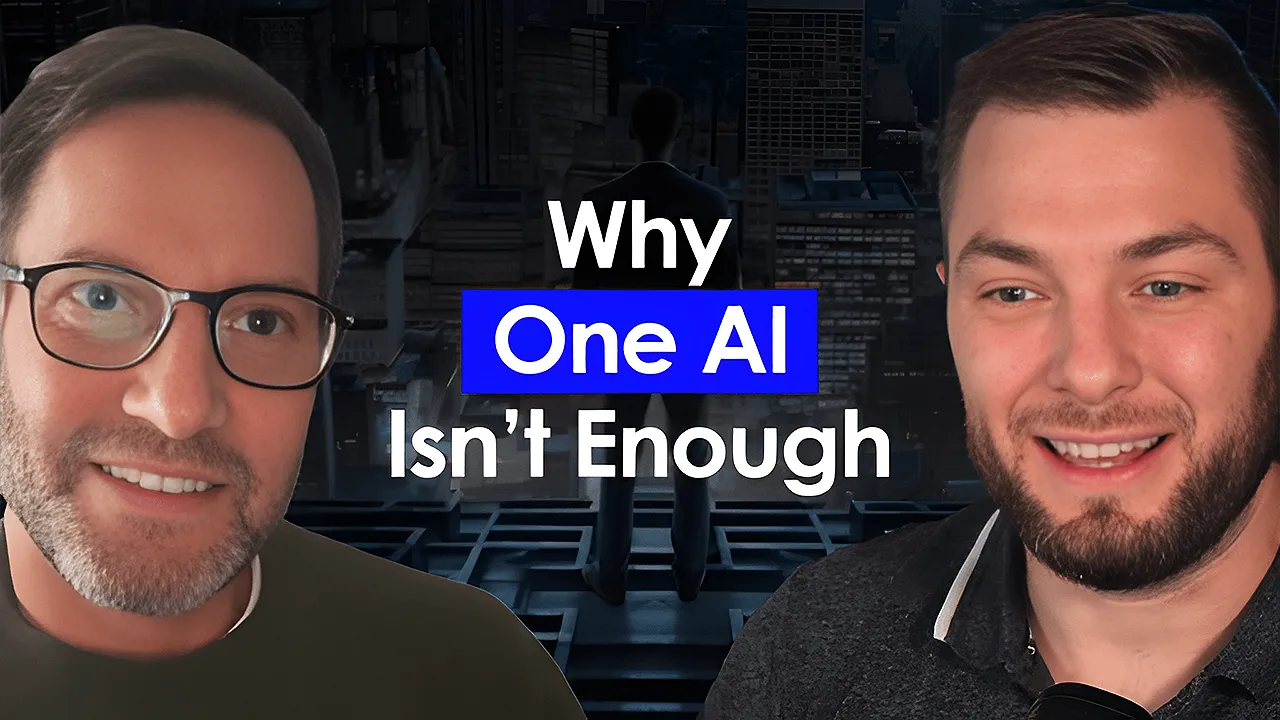
Harnessing the Power of AI Collaboration

Simon Lacasse · Global Black Belt for AI, Microsoft
Share:
Show Notes
What if your next business team isn’t just made of humans, but also intelligent agents?
Samuel sits down with Simon Lacasse, Global Black Belt for AI at Microsoft and author of the white paper Scaling Agents for Enterprise. Simon is part of Microsoft’s SWAT team of AI experts, working with global organizations to bring multi-agent systems to life in real-world production environments.
Key Takeaways
- What agent orchestration actually means and why it’s like a project manager for AI
- Why the real shift isn’t smarter models — it’s smarter ecosystems
- How protocols like A2A and MCP are creating an “internet of agents”
- Why GitHub Copilot is secretly a multi-agent system
- How to start implementing multi-agent architecture without creating chaos
- Agent catalogs, discoverability, and the A2A agent card standard
- The biggest misconceptions about cost, complexity, and governance
Resources
Multi-Agent SystemsA2A ProtocolMCPMicrosoftEnterprise AIOrchestration
Simon Lacasse
I'm happy to be here. Thank you for inviting me. Yeah, so my role is a Global Black Belt AI. I don't do karate or wear a black belt, but essentially I work with a SWAT team of AI experts to help customers basically harness the power of AI, right? Like, to be able to use it properly, responsibly, but also to use it to create really cool things with. So it's a really fun role. I get to, you know, have visibility globally with all the customers developing different AI technology and implementing it with them to, you know, create really, really interesting solutions. So yeah. Yeah, I mean, I think you almost need to start with the definition of an agent because it seems like everybody has a different definition and they see it differently. But the reality is agents aren't something new. It's just essentially a clever way to use models that we already have, right? And simply put, it's like connecting a whole network of AI models that can kind of work together to solve bigger and more complex problems. That's kind of how I see it. The idea is that each model, or agent if you want to call it that, is capable but limited on its own. When you connect models or agents together, they can solve challenges that no single model can handle by itself. And that's really the core idea. It's modularity and abstraction in an agentic design. So basically, you break the problem down, you give each agent a clear responsibility, and you let the system assemble the pieces into something far more powerful. That's kind of how I explain it at a high level. So just to give you an example, let's pretend we're planning a big trip together. Okay. So one agent is specialized in finding flights, finding the best flights, right? You have another that is specialized in comparing hotel prices and availability. You have a third one that helps you build the itinerary around your preferences. And maybe you have a fourth one that checks weather, events, and local rules. And the idea is that you have an orchestrator that basically sits on top of all of this and coordinates everything so that we can get to a final plan that makes sense for me, my budget, my time, and my constraints for my trip. So that's how you use all of these models together to do something much more complex. Oh, well, that's a topic that we can go really deep into, but you can look at it that way. Yeah, you can look at it that way. You could use a model to actually create plans, break down a problem, and then kind of do the orchestration because multi-agents need to collaborate, right? That's the whole power of them. They need to be able to assign each other tasks and be able to respond to each other. That orchestration piece, since you have so many models, you kind of need to have an orchestrator and have the ability to orchestrate all of this because without it, you know, the agents would just be siloed and they wouldn't really collaborate with each other. So that's one way of doing orchestration, but orchestration can be very deterministic too, right? You could use things like robotic process automation to say, hey, I need you to do this step, this step, this step. It really depends on what you're trying to do. Sometimes orchestration can be very dynamic, right? Where I don't know what the next step will be because it will depend on what that agent did, what data it gathered, what actions it took, right? So then you have much more dynamic orchestrations, and oftentimes LLMs and large language models do very well in dynamic planning because they're able to basically recreate the plan on the fly depending on what's happening over the entire workflow. In enterprises, we do see a lot more deterministic workflows where we use, you know, more static types of planners and we don't really leverage AI for planning. We do more deterministic plans and sequential plans. Yes. And it gets complex, you know, because you can have agents working in parallel, right, where they're all basically working at the same time and then coming back with a response. You can have agents that work sequentially. So basically, I need to wait for this agent to produce an output before I can use this agent. But then you can combine the two, right, where you have some agents that can spawn in parallel and then some that can be sequential. And then you mix all that up and then you have long-running workflows. It can get pretty complex. Yes. Yeah, you can think about it like that. Yeah, exactly. Yes, exactly. Yeah, I love that question because I've been trying to develop agents since before the GPT models, right? Even when GPT-2 came out, I was trying to build agents with that stuff. It's actually an old terminology that was coined by Stuart Russell in, oh my God, I forget the year. The terminology is not new. But I do think, and this is what really excites me, is the technology has advanced quite a lot. And that's why for me, it's like I get to build the stuff that I dreamed about building. Today, I think it's doable. And it has a lot to do, you know, for starters, with AI models like GPT-5, Claude, or Gemini. They're far more capable than before, right? Like now we have reasoning models as well. They can reason over a huge amount of data. They can adapt to their environment, right? And they can even take actions on their own, right? We can give them tools and functions, and they have the ability to tap into systems, external systems. They can search the web. They can even control parts of your computer, you know, with computer-understanding agents, right? Computer-user agents that have the ability to control your computer. So they're much more powerful. And so these two things, actually reasoning and actions, they're really the foundation of real agentic systems. If you look at it from a very high level, it's like, hey, can I have an agent have agency in the sense that it can adapt to its environment and take actions depending on that environment being changed? I will probably discuss this a little bit later, but that's a big shift in how we actually deploy agents at scale as well, right? With open standard agent protocols, we can use the same infrastructure. We can use architectural patterns that we're used to in traditional software development. And protocols like A2A, for example, allow us to use the same internet fabric and protocols that already exist today for us to actually deploy these agents in a way where we don't really have technological barriers, right? Because they're all talking the same language and we can exchange them. You can have an agent, I can have an agent, you know, I can have an agent on the cloud. We can share our agents. We can all work together. And that's kind of how I see a lot of this happening. So yeah. It's like a fabric, you know. It's kind of like the new internet where we're not going to go and click, you know, websites and stuff. We're going to have the agents kind of do that for us, right? And we're just going to be interacting with them, helping, and then they will be helping us do these kinds of redundant tasks that maybe we don't like to do, and making us maybe work on more high-value stuff that we like to do, right? Yeah, well, I mean, I definitely believe that we're moving from individual intelligence to a collective intelligence, right? And whether those are AI agents or humans or all of us working together, a single agent can only get you so far, right? It has to understand a problem, plan the solution, execute every step on its own. And that's fine for really simple tasks, but it starts to fall apart as soon as things get multi-step, cross-domain, or require different types of expertise, or even human in the loop, right? That starts to get really complex. And I think that's where multi-agent systems shine, right? Instead of a do-everything model, you basically have this network of focused agents, each one really great at a specific thing. But when they're together, they can work on a similar problem, but, you know, have kind of the ability to solve that problem using different expertise. And on top of that, humans can jump in the loop, you know, at the right moment. They can review, override, or approve, or steer the system the way that they want. In reality, you know, it's really a human and an agent collaboration. You know, we keep domains isolated where needed and we apply specific governance and policies per agent to have workflows, reusable catalogs of agents, and that we can all use together. So for enterprises, that's what makes agents actually scalable and safe, right? The shift is not just smarter models, but it's smarter ecosystems of models working together. That makes sense. Right. Exactly. Yeah. Like, so meaning you have like a... Right, right. Yeah, well, I actually have a white paper that talks about that, and it's around modularity and abstraction, right? Like how modular do you get with your agents versus, you know, having a very abstracted agent that you try to do it all with. I think today the trend is to have specialized agents, you know, because, for example, you can use general-purpose models like ChatGPT-5 to power your agents, but sometimes you have very specific models like anomaly detection models, right? For example, you want that agent. So you start to get into a place where you really have these specialized agents, and it is a question of connecting them together so that they can all work together. I don't know if the models are great enough today to be able to be great at everything. You know what I mean? So I think it's better right now to harness the power and specialize these agents so they're really great at something. In fact, that's a lot how people do it: create a single agent, make it really, really great at something. Then they create another agent really, really great at something. And then they come to the realization, wow, I can stitch them together and then I can do a lot more, right? And then that's where it starts to get interesting. I'm not hiding the fact that maybe in the future we will have this one model to rule them all that will be able to do everything. It's just that we're not there yet, you know? And in fact, creating multi-agent systems is exactly that because you basically start to increase exponentially what your system can do by putting more models into it and having different specialization. And then there's a question also of maintenance of it, right? Like, I only need to change this model for this specific task because it's specialized. So when you have modularity in your system, it's a lot easier for you to focus on certain things in your development process because you're isolating these parts, and it makes it manageable and easier to develop. So if I change something in this one agent, it shouldn't affect this agent. But if I have this one model where it does everything and I change something here, it could affect what that big model will do because you're changing that centralized kind of core of the system. In my multi-agent architectures, all my agents are standalone agents. And then I put an orchestrator to connect them all together and I can do some really cool stuff. But even my single agents, they have their own UI, you know? So somebody can go in there and just use that agent, but it's also part of a collective hive of agents that also has a UI that allows me to control all of them, you know? Yeah, single agent to a multi-agent is not much different. It's just the collaboration piece and how they talk to each other and orchestrate, basically, that makes this multi-agents essentially. It's an old one. Yes, it's an old one. But the concept of the paper is called Designing Multi-Agent Systems. But it's the concept of modularity and abstraction. And I use a drone example to show how drones at the bottom are executing, you know, they're trying to fight a fire in the forest and they only see that part of the fire. But then you have these other drones that control these drones to move these drones in different sections of the forest where there's more fire. And then you have this other drone at the top that's coordinating the whole fleet and has a holistic view of the entire fire to coordinate where the drones need to go to fight the fire. It's pretty cool. We built a computer-user agent with that that basically allows you to control your computer. So you have these agents that move your mouse. You have an agent that basically types on your keyboard, you know, and then you have one that basically is looking at your screen using a vision model, and then you have one that's basically doing a plan. Like let's say I'm searching Amazon. Well, what do I need to search Amazon? I'm going to go on Amazon's website. I'm going to click on this thing, right? And so that hierarchy, when it works all together, you basically have a universal multi-agent solution that can basically browse the internet for you, which is really cool. Yeah, I mean, yeah, for sure. I mean, I see a lot of... In fact, I designed a lot of use cases from fraud detection, anomaly detection, and doing that kind of stuff. Retail is a big one too, hyper-personalization scenarios. But I'll say, you know, one of my favorite multi-agent examples, I think, and I think a lot of people can relate to this, is GitHub Copilot, right? And the new wave of these coding agents. Like when you enable agent mode with these things, Copilot isn't just completing code anymore for you, right? It's planning, it's breaking problems down, it's running tests, it's fixing errors, and it's iterating across a multi-step scenario. And that's like a full multi-agent, you know, pattern hiding in plain sight. As a developer, you don't really see that underneath you have a planner agent, a coding agent, a testing agent, and a debugging agent, but in reality, it's all doing that under the covers. That shift is already changing how developers operate significantly. I can tell you from my personal experience, I use coding agents every day, okay? And I can tell you firsthand, it's cut down my development time by almost 50%. It frees me up to focus on much more high-value work instead of the repetitive tasks that I need to do when I code. That's a great example of how multi-agents can really significantly improve somebody's everyday life and coding and make them more efficient. Yeah, when you put it on agent mode, it's doing a lot of stuff. It's basically a reflection loop, but underneath the covers, they have grounded agents that are really great at debugging and grounded agents that are really great at writing code, you know, and then they combine those together to create this experience for you, which is really powerful. Yeah, that's a great question. I think one of the biggest challenges right now is that most agents are still built in silos. There's so many different types of technologies, ways of having agents communicate with each other. So what happens is every team starts building their own thing and it becomes very incompatible. We have our own APIs, they have their own language, and it makes integration, especially in multi-agent systems, very painful. And it can really dramatically limit what you can do with these things. So now we have these standard agent protocols, like A2A and MCP, that finally kind of break that pattern. What that does is it gives agents a common way to communicate, discover each other, exchange work, and coordinate. Like, you know, you and I, if I spoke to you in French, actually, you would understand because you are French, but we need to speak the same language. If we're going to collaborate, we're going to do cool stuff together, we need to speak the same language. But we also need a way to discover each other. I need to know what you can do, you know, so I can use you properly. I need the ability to give you the proper task so that you can accomplish your work, and you need to do the same thing with me. So what these protocols do, they provide sort of the core primitives for agents to talk to each other. It's almost like we're creating the new HTTP protocol for agents, or the new TCP/IP for people who are more my age would relate. It's kind of the new agent protocol for agents to be able to speak the same language, exchange tasks together in a way that is seamless and standardized across the industry. And what that does is it basically creates this universal layer that turns disconnected agents into kind of a unified network of agents that can all talk to each other. For example, the MCP protocol handles internal reasoning and tool use for agents. So we standardize the way that agents can call tools and take actions. That's basically what MCP does. A2A manages, A2A by the way is agent-to-agent, and it manages communication and collaboration with these things. If you look at the A2A protocol, there's tasks, there's messages, there's artifacts so that agents can exchange files and information. It's all standard. And what makes A2A very attractive actually is that it's not something new like a proprietary transport layer. It's built on top of the same standards that already power the internet. So basically like HTTP, JSON-RPC, all the protocols that we know. So basically if your agent can speak web, you know, if they can connect to the internet, it can speak A2A and MCP. That's the beauty about these protocols. They're sitting on the same fabric that we're used to. And I think that's what makes this wave somewhat different, right? It's not a new ecosystem. It's basically a layer that connects the existing one with the new technology that we have. That is definitely one pattern, one that I really, really like and the one that I probably use the most, but there are so many different topologies. In some cases, you don't have an orchestrator. You just let the agents basically run free and figure out what they need to do to solve the problem. Some systems are goal-oriented, some are not. There's a lot of different topologies that you can set up, these patterns. I'd say the most popular one, though, is definitely this orchestrator with the agents on top so that we can create a layer for planning, reasoning, and orchestration and breaking down. It's definitely a pattern that we see quite a lot. Correct. Yeah, I think so. You know, I think it's funny because MCP is changing quite a lot and so is A2A, right? And I hear people who are developing multi-agent systems just with MCP and using that as a protocol. Initially, and people might argue against me, but initially, you know, the way I see it is that A2A is really for agent-to-agent communication and collaboration and orchestration, where MCP is really, I see it more like A2S, you know, agent-to-system. It abstracts the systems that you have in your organization so that you can bring in the right context and the tools for that agent to be able to basically tap into your enterprise. Then when you have that agent and you want to connect it to another agent, you use the A2A protocol to do that communication protocol. But they work, in my opinion, very... they complement each other. You know, oftentimes you'll see systems where you have A2A and MCP within the whole system, where agents are using MCP to connect to systems and the agents use A2A to connect to the other agents, but all of them have MCP to A2A and then, you know, work like that. Yeah, there's so many ways to start. What I see the most, I guess, in the first phase, and I'm talking about large organizations here, you know, because there's so many things that you could do on your computer today and you can experiment in so many ways. But I think what I see often, there's kind of a phased approach, right, where organizations start very simple. They start by building one agent, you know, using a general-purpose model like GPT-5, for example. And then the next phase is to say, well, once I have this agent, you know, other people in the enterprise can use it a bit like ChatGPT. Then it's about like, how can I then ground it with my company knowledge? How can I hook it up to my company knowledge so that it understands my business, my domain, et cetera? And oftentimes you'll see things like retrieval-augmented generation as a pattern to be able to bring in that information into the agent or the LLM or the model so that it can reason over specific domain data. Then oftentimes it's still single agent at this point. Now you have a general-purpose model that has access to company knowledge. Then oftentimes it's like, how do I extend that? So you add new functions or tools so that the agent can take actions on its own, meaning writing to a service, creating a ticket in ServiceNow, or connecting to Salesforce to create a lead. So you give this agent the ability to basically take actions, you know, so they're not only a consumer of data, but they can also be a producer of data by taking actions and tapping into systems. Then once that works really well, then you build a second agent, then a third. And before long, every team has their own little agent project running in the enterprise. And that's kind of what we're seeing today. But almost every time, each agent ends up becoming its own silo or project since there's no shared communication layer, no discovery, no coordination or orchestration. And ideally, you want agents that can act as a bigger part of an ecosystem, right? So that's usually where the organization or the leaders realize, well, I don't need more agents. What I need is a foundation to deploy these things so that they can collaborate and work together. And so you need things like a common way for agents to communicate. And that's where we look at things like A2A protocols. You need a way for them to discover each other. Oftentimes you'll think about things like agent catalogs or agent registries, right? That I can go in and say, hey, I want this agent and this agent and this agent to be able to help me do my work. And then you bring them into your team, just like you would with humans on Teams, you know. But now you're basically collaborating on Teams with other humans and you bring your agents in to basically help you do the work. That's kind of what really excites me, this human and agent collaboration where I bring my agents, you bring your agents, we mix them together and work together to solve these really cool problems together. Well, I mean, there's different ways of implementing this. You know, Microsoft has an agent registry on Azure that you could use. What I do, what I've been focusing on, is I want the agent catalog to be standard. You know, I want another enterprise to be able to connect to my agent catalog and use my agents. And so I adopt the A2A agent card for that, which is basically a well-defined JSON of what an agent catalog should look like. And in there you'll have your agent name, your HTTP endpoint, the skills that these agents can do, the security that they have, the role-based access and all that kind of stuff, right? And so that's in the agent card, and you could use that for discovery. So anybody can call that endpoint and pick up that agent, the skills, and figure that out. And of course that's kind of, you know, stateless. It's in the protocol itself. So oftentimes what we'll do is we'll persist that agent card into a cloud database like Cosmos DB, for example. And now you have a real centralized cloud registry that other people can come in and use these agents with, you know? So yeah, we can talk a lot about that. And you can have private catalogs, which is kind of my personal Rolodex of agents. We can have a department catalog where we have agents that are done for our work, like let's say it's content creation, we have an image generator agent or different agents. Or you can have a catalog that's enterprise-wide, right, where anybody can go in, pick the agents that they want, and they can build their own agent teams. And then even further, you can have public catalogs, right, where two organizations can use each other's agents together. And so, yeah, there's a lot we can do with that. Yeah, I think when we start looking at multi-agent systems, it's almost always the same fears that I get, you know, like, is this going to be slower? Is it going to be more expensive? You have a lot of models working together, right? And agents with the token usage, what's the reliability? Those things can be very unpredictable, right, because models are probabilistic, and those concerns are all true. They're all fair. And I'd say multi-agent systems do introduce a lot of moving parts, but I'd also say without the right architecture and standards, they can absolutely feel heavier. But often what I tell them is, well-designed ecosystems don't create chaos. They actually eliminate it, right? By breaking things into smaller, specialized agents, which we were talking about before, modularity, you actually increase the reliability, the control through these tighter scoping, and you reduce a lot of latency by running steps in parallel into smaller models, maybe fine-tuned, you know, SLMs, which are small language models. Because of this modular approach, you can really start optimizing this in a modular way instead of forcing one giant model to brute force and do everything, and it costs you thousands of tokens, you know, because you're using the latest and greatest huge model that can do a lot more. And oftentimes, when they see that multi-agent systems aren't a leap of faith, but a structured, measurable architecture, I think their fear starts to disappear and usually turns into excitement more, you know, and they can see what's really possible at the end. And they can understand that if you implement this well, you can get a lot of value from it. Yeah. Yeah, usually. Yeah, that's the case. But again, you know, sometimes the proof of concept is just a single agent. Get that right, you know, and then create a couple more and then stitch them together to try to make them all work together, basically, is usually the pattern that I see. I'd always break down your problems into smaller problems. Don't try to boil the ocean and cram everything into a giant prompt. Okay? Think about your problem and decompose it into sub-steps. That'll give you a lot better response. I'd say prompt engineering and context engineering are extremely powerful as well. And if you don't do it right, you know, you're not going to get the output that you want. So you have to learn how to properly instruct these models and give it the right context for the task. So you've got to give it really clear instruction. You don't want to be too vague or else it will be very difficult. And I'd say overall, iterate, experiment, keep your best prompts because if that doesn't work, try different models. It's really a craft. It's more about refining your craft and getting better results. And I'd say even more importantly, when you start designing more complex multi-agent systems, use standards, you know, use these A2A and MCP protocols because everyone uses them. And so you stay compliant and interoperable with everybody that you do. If you start building your own stuff, then you're going to be stuck in your own little world and you won't be able to connect to the beautiful world of agents and people's work. That's a great question. It's so hard to predict the future because it's changing so fast. You know, oftentimes my nephews ask me, what are we going to do? Like, where will be your jobs in the future? And it's very hard to know that. I'd say I think AI is definitely going to fundamentally change the way we live and work, you know, and it already has. There's no doubt about that. And it's not really about replacing people, but it's by surrounding us with intelligent collaborators, right? Like agents, humans. I definitely see a world where everyone has a team of specialized agents that works with them, you know, whether that's a training agent that helps you go to the gym every day and things like that, and monitor your health style, or they're productivity agents that help you do everyday tasks and things like that. So I don't know. I feel like we could use these teams of specialized agents to help us kind of handle the nitty-gritty stuff that we don't want to do, right? So it basically liberates us to do the things that we really enjoy to do, you know. And instead of searching, clicking, and stitching systems together manually, we can simply state a goal. Our agents take care of the details. And so I think that shifts the lines between the physical and the digital world, right? Where planning trips, running a business, creating content, and much more becomes a lot easier for us to do. And who knows? Maybe it's just a stepping stone. And maybe, like I said, one day we don't need all of this because we have this new fabric of agents in a network that is completely invisible to us, or maybe we have this one model to rule them all. Until that day, I think the future still belongs to humans and agents working together. And I see that happening for a very long time. And I think it's going to be a big human and agent collaboration in the future, which is exciting and scary, but exciting in the sense that we'll be able to do a lot more cooler things, in my opinion. Yeah, no problem. It was my pleasure. Thank you for having me.
I'm happy to be here. Thank you for inviting me. Yeah, so my role is a Global Black Belt AI. I don't do karate or wear a black belt, but essentially I work with a SWAT team of AI experts to help customers basically harness the power of AI, right? Like, to be able to use it properly, responsibly, but also to use it to create really cool things with. So it's a really fun role. I get to, you know, have visibility globally with all the customers developing different AI technology and implementing it with them to, you know, create really, really interesting solutions. So yeah. Yeah, I mean, I think you almost need to start with the definition of an agent because it seems like everybody has a different definition and they see it differently. But the reality is agents aren't something new. It's just essentially a clever way to use models that we already have, right? And simply put, it's like connecting a whole network of AI models that can kind of work together to solve bigger and more complex problems. That's kind of how I see it. The idea is that each model, or agent if you want to call it that, is capable but limited on its own. When you connect models or agents together, they can solve challenges that no single model can handle by itself. And that's really the core idea. It's modularity and abstraction in an agentic design. So basically, you break the problem down, you give each agent a clear responsibility, and you let the system assemble the pieces into something far more powerful. That's kind of how I explain it at a high level. So just to give you an example, let's pretend we're planning a big trip together. Okay. So one agent is specialized in finding flights, finding the best flights, right? You have another that is specialized in comparing hotel prices and availability. You have a third one that helps you build the itinerary around your preferences. And maybe you have a fourth one that checks weather, events, and local rules. And the idea is that you have an orchestrator that basically sits on top of all of this and coordinates everything so that we can get to a final plan that makes sense for me, my budget, my time, and my constraints for my trip. So that's how you use all of these models together to do something much more complex. Oh, well, that's a topic that we can go really deep into, but you can look at it that way. Yeah, you can look at it that way. You could use a model to actually create plans, break down a problem, and then kind of do the orchestration because multi-agents need to collaborate, right? That's the whole power of them. They need to be able to assign each other tasks and be able to respond to each other. That orchestration piece, since you have so many models, you kind of need to have an orchestrator and have the ability to orchestrate all of this because without it, you know, the agents would just be siloed and they wouldn't really collaborate with each other. So that's one way of doing orchestration, but orchestration can be very deterministic too, right? You could use things like robotic process automation to say, hey, I need you to do this step, this step, this step. It really depends on what you're trying to do. Sometimes orchestration can be very dynamic, right? Where I don't know what the next step will be because it will depend on what that agent did, what data it gathered, what actions it took, right? So then you have much more dynamic orchestrations, and oftentimes LLMs and large language models do very well in dynamic planning because they're able to basically recreate the plan on the fly depending on what's happening over the entire workflow. In enterprises, we do see a lot more deterministic workflows where we use, you know, more static types of planners and we don't really leverage AI for planning. We do more deterministic plans and sequential plans. Yes. And it gets complex, you know, because you can have agents working in parallel, right, where they're all basically working at the same time and then coming back with a response. You can have agents that work sequentially. So basically, I need to wait for this agent to produce an output before I can use this agent. But then you can combine the two, right, where you have some agents that can spawn in parallel and then some that can be sequential. And then you mix all that up and then you have long-running workflows. It can get pretty complex. Yes. Yeah, you can think about it like that. Yeah, exactly. Yes, exactly. Yeah, I love that question because I've been trying to develop agents since before the GPT models, right? Even when GPT-2 came out, I was trying to build agents with that stuff. It's actually an old terminology that was coined by Stuart Russell in, oh my God, I forget the year. The terminology is not new. But I do think, and this is what really excites me, is the technology has advanced quite a lot. And that's why for me, it's like I get to build the stuff that I dreamed about building. Today, I think it's doable. And it has a lot to do, you know, for starters, with AI models like GPT-5, Claude, or Gemini. They're far more capable than before, right? Like now we have reasoning models as well. They can reason over a huge amount of data. They can adapt to their environment, right? And they can even take actions on their own, right? We can give them tools and functions, and they have the ability to tap into systems, external systems. They can search the web. They can even control parts of your computer, you know, with computer-understanding agents, right? Computer-user agents that have the ability to control your computer. So they're much more powerful. And so these two things, actually reasoning and actions, they're really the foundation of real agentic systems. If you look at it from a very high level, it's like, hey, can I have an agent have agency in the sense that it can adapt to its environment and take actions depending on that environment being changed? I will probably discuss this a little bit later, but that's a big shift in how we actually deploy agents at scale as well, right? With open standard agent protocols, we can use the same infrastructure. We can use architectural patterns that we're used to in traditional software development. And protocols like A2A, for example, allow us to use the same internet fabric and protocols that already exist today for us to actually deploy these agents in a way where we don't really have technological barriers, right? Because they're all talking the same language and we can exchange them. You can have an agent, I can have an agent, you know, I can have an agent on the cloud. We can share our agents. We can all work together. And that's kind of how I see a lot of this happening. So yeah. It's like a fabric, you know. It's kind of like the new internet where we're not going to go and click, you know, websites and stuff. We're going to have the agents kind of do that for us, right? And we're just going to be interacting with them, helping, and then they will be helping us do these kinds of redundant tasks that maybe we don't like to do, and making us maybe work on more high-value stuff that we like to do, right? Yeah, well, I mean, I definitely believe that we're moving from individual intelligence to a collective intelligence, right? And whether those are AI agents or humans or all of us working together, a single agent can only get you so far, right? It has to understand a problem, plan the solution, execute every step on its own. And that's fine for really simple tasks, but it starts to fall apart as soon as things get multi-step, cross-domain, or require different types of expertise, or even human in the loop, right? That starts to get really complex. And I think that's where multi-agent systems shine, right? Instead of a do-everything model, you basically have this network of focused agents, each one really great at a specific thing. But when they're together, they can work on a similar problem, but, you know, have kind of the ability to solve that problem using different expertise. And on top of that, humans can jump in the loop, you know, at the right moment. They can review, override, or approve, or steer the system the way that they want. In reality, you know, it's really a human and an agent collaboration. You know, we keep domains isolated where needed and we apply specific governance and policies per agent to have workflows, reusable catalogs of agents, and that we can all use together. So for enterprises, that's what makes agents actually scalable and safe, right? The shift is not just smarter models, but it's smarter ecosystems of models working together. That makes sense. Right. Exactly. Yeah. Like, so meaning you have like a... Right, right. Yeah, well, I actually have a white paper that talks about that, and it's around modularity and abstraction, right? Like how modular do you get with your agents versus, you know, having a very abstracted agent that you try to do it all with. I think today the trend is to have specialized agents, you know, because, for example, you can use general-purpose models like ChatGPT-5 to power your agents, but sometimes you have very specific models like anomaly detection models, right? For example, you want that agent. So you start to get into a place where you really have these specialized agents, and it is a question of connecting them together so that they can all work together. I don't know if the models are great enough today to be able to be great at everything. You know what I mean? So I think it's better right now to harness the power and specialize these agents so they're really great at something. In fact, that's a lot how people do it: create a single agent, make it really, really great at something. Then they create another agent really, really great at something. And then they come to the realization, wow, I can stitch them together and then I can do a lot more, right? And then that's where it starts to get interesting. I'm not hiding the fact that maybe in the future we will have this one model to rule them all that will be able to do everything. It's just that we're not there yet, you know? And in fact, creating multi-agent systems is exactly that because you basically start to increase exponentially what your system can do by putting more models into it and having different specialization. And then there's a question also of maintenance of it, right? Like, I only need to change this model for this specific task because it's specialized. So when you have modularity in your system, it's a lot easier for you to focus on certain things in your development process because you're isolating these parts, and it makes it manageable and easier to develop. So if I change something in this one agent, it shouldn't affect this agent. But if I have this one model where it does everything and I change something here, it could affect what that big model will do because you're changing that centralized kind of core of the system. In my multi-agent architectures, all my agents are standalone agents. And then I put an orchestrator to connect them all together and I can do some really cool stuff. But even my single agents, they have their own UI, you know? So somebody can go in there and just use that agent, but it's also part of a collective hive of agents that also has a UI that allows me to control all of them, you know? Yeah, single agent to a multi-agent is not much different. It's just the collaboration piece and how they talk to each other and orchestrate, basically, that makes this multi-agents essentially. It's an old one. Yes, it's an old one. But the concept of the paper is called Designing Multi-Agent Systems. But it's the concept of modularity and abstraction. And I use a drone example to show how drones at the bottom are executing, you know, they're trying to fight a fire in the forest and they only see that part of the fire. But then you have these other drones that control these drones to move these drones in different sections of the forest where there's more fire. And then you have this other drone at the top that's coordinating the whole fleet and has a holistic view of the entire fire to coordinate where the drones need to go to fight the fire. It's pretty cool. We built a computer-user agent with that that basically allows you to control your computer. So you have these agents that move your mouse. You have an agent that basically types on your keyboard, you know, and then you have one that basically is looking at your screen using a vision model, and then you have one that's basically doing a plan. Like let's say I'm searching Amazon. Well, what do I need to search Amazon? I'm going to go on Amazon's website. I'm going to click on this thing, right? And so that hierarchy, when it works all together, you basically have a universal multi-agent solution that can basically browse the internet for you, which is really cool. Yeah, I mean, yeah, for sure. I mean, I see a lot of... In fact, I designed a lot of use cases from fraud detection, anomaly detection, and doing that kind of stuff. Retail is a big one too, hyper-personalization scenarios. But I'll say, you know, one of my favorite multi-agent examples, I think, and I think a lot of people can relate to this, is GitHub Copilot, right? And the new wave of these coding agents. Like when you enable agent mode with these things, Copilot isn't just completing code anymore for you, right? It's planning, it's breaking problems down, it's running tests, it's fixing errors, and it's iterating across a multi-step scenario. And that's like a full multi-agent, you know, pattern hiding in plain sight. As a developer, you don't really see that underneath you have a planner agent, a coding agent, a testing agent, and a debugging agent, but in reality, it's all doing that under the covers. That shift is already changing how developers operate significantly. I can tell you from my personal experience, I use coding agents every day, okay? And I can tell you firsthand, it's cut down my development time by almost 50%. It frees me up to focus on much more high-value work instead of the repetitive tasks that I need to do when I code. That's a great example of how multi-agents can really significantly improve somebody's everyday life and coding and make them more efficient. Yeah, when you put it on agent mode, it's doing a lot of stuff. It's basically a reflection loop, but underneath the covers, they have grounded agents that are really great at debugging and grounded agents that are really great at writing code, you know, and then they combine those together to create this experience for you, which is really powerful. Yeah, that's a great question. I think one of the biggest challenges right now is that most agents are still built in silos. There's so many different types of technologies, ways of having agents communicate with each other. So what happens is every team starts building their own thing and it becomes very incompatible. We have our own APIs, they have their own language, and it makes integration, especially in multi-agent systems, very painful. And it can really dramatically limit what you can do with these things. So now we have these standard agent protocols, like A2A and MCP, that finally kind of break that pattern. What that does is it gives agents a common way to communicate, discover each other, exchange work, and coordinate. Like, you know, you and I, if I spoke to you in French, actually, you would understand because you are French, but we need to speak the same language. If we're going to collaborate, we're going to do cool stuff together, we need to speak the same language. But we also need a way to discover each other. I need to know what you can do, you know, so I can use you properly. I need the ability to give you the proper task so that you can accomplish your work, and you need to do the same thing with me. So what these protocols do, they provide sort of the core primitives for agents to talk to each other. It's almost like we're creating the new HTTP protocol for agents, or the new TCP/IP for people who are more my age would relate. It's kind of the new agent protocol for agents to be able to speak the same language, exchange tasks together in a way that is seamless and standardized across the industry. And what that does is it basically creates this universal layer that turns disconnected agents into kind of a unified network of agents that can all talk to each other. For example, the MCP protocol handles internal reasoning and tool use for agents. So we standardize the way that agents can call tools and take actions. That's basically what MCP does. A2A manages, A2A by the way is agent-to-agent, and it manages communication and collaboration with these things. If you look at the A2A protocol, there's tasks, there's messages, there's artifacts so that agents can exchange files and information. It's all standard. And what makes A2A very attractive actually is that it's not something new like a proprietary transport layer. It's built on top of the same standards that already power the internet. So basically like HTTP, JSON-RPC, all the protocols that we know. So basically if your agent can speak web, you know, if they can connect to the internet, it can speak A2A and MCP. That's the beauty about these protocols. They're sitting on the same fabric that we're used to. And I think that's what makes this wave somewhat different, right? It's not a new ecosystem. It's basically a layer that connects the existing one with the new technology that we have. That is definitely one pattern, one that I really, really like and the one that I probably use the most, but there are so many different topologies. In some cases, you don't have an orchestrator. You just let the agents basically run free and figure out what they need to do to solve the problem. Some systems are goal-oriented, some are not. There's a lot of different topologies that you can set up, these patterns. I'd say the most popular one, though, is definitely this orchestrator with the agents on top so that we can create a layer for planning, reasoning, and orchestration and breaking down. It's definitely a pattern that we see quite a lot. Correct. Yeah, I think so. You know, I think it's funny because MCP is changing quite a lot and so is A2A, right? And I hear people who are developing multi-agent systems just with MCP and using that as a protocol. Initially, and people might argue against me, but initially, you know, the way I see it is that A2A is really for agent-to-agent communication and collaboration and orchestration, where MCP is really, I see it more like A2S, you know, agent-to-system. It abstracts the systems that you have in your organization so that you can bring in the right context and the tools for that agent to be able to basically tap into your enterprise. Then when you have that agent and you want to connect it to another agent, you use the A2A protocol to do that communication protocol. But they work, in my opinion, very... they complement each other. You know, oftentimes you'll see systems where you have A2A and MCP within the whole system, where agents are using MCP to connect to systems and the agents use A2A to connect to the other agents, but all of them have MCP to A2A and then, you know, work like that. Yeah, there's so many ways to start. What I see the most, I guess, in the first phase, and I'm talking about large organizations here, you know, because there's so many things that you could do on your computer today and you can experiment in so many ways. But I think what I see often, there's kind of a phased approach, right, where organizations start very simple. They start by building one agent, you know, using a general-purpose model like GPT-5, for example. And then the next phase is to say, well, once I have this agent, you know, other people in the enterprise can use it a bit like ChatGPT. Then it's about like, how can I then ground it with my company knowledge? How can I hook it up to my company knowledge so that it understands my business, my domain, et cetera? And oftentimes you'll see things like retrieval-augmented generation as a pattern to be able to bring in that information into the agent or the LLM or the model so that it can reason over specific domain data. Then oftentimes it's still single agent at this point. Now you have a general-purpose model that has access to company knowledge. Then oftentimes it's like, how do I extend that? So you add new functions or tools so that the agent can take actions on its own, meaning writing to a service, creating a ticket in ServiceNow, or connecting to Salesforce to create a lead. So you give this agent the ability to basically take actions, you know, so they're not only a consumer of data, but they can also be a producer of data by taking actions and tapping into systems. Then once that works really well, then you build a second agent, then a third. And before long, every team has their own little agent project running in the enterprise. And that's kind of what we're seeing today. But almost every time, each agent ends up becoming its own silo or project since there's no shared communication layer, no discovery, no coordination or orchestration. And ideally, you want agents that can act as a bigger part of an ecosystem, right? So that's usually where the organization or the leaders realize, well, I don't need more agents. What I need is a foundation to deploy these things so that they can collaborate and work together. And so you need things like a common way for agents to communicate. And that's where we look at things like A2A protocols. You need a way for them to discover each other. Oftentimes you'll think about things like agent catalogs or agent registries, right? That I can go in and say, hey, I want this agent and this agent and this agent to be able to help me do my work. And then you bring them into your team, just like you would with humans on Teams, you know. But now you're basically collaborating on Teams with other humans and you bring your agents in to basically help you do the work. That's kind of what really excites me, this human and agent collaboration where I bring my agents, you bring your agents, we mix them together and work together to solve these really cool problems together. Well, I mean, there's different ways of implementing this. You know, Microsoft has an agent registry on Azure that you could use. What I do, what I've been focusing on, is I want the agent catalog to be standard. You know, I want another enterprise to be able to connect to my agent catalog and use my agents. And so I adopt the A2A agent card for that, which is basically a well-defined JSON of what an agent catalog should look like. And in there you'll have your agent name, your HTTP endpoint, the skills that these agents can do, the security that they have, the role-based access and all that kind of stuff, right? And so that's in the agent card, and you could use that for discovery. So anybody can call that endpoint and pick up that agent, the skills, and figure that out. And of course that's kind of, you know, stateless. It's in the protocol itself. So oftentimes what we'll do is we'll persist that agent card into a cloud database like Cosmos DB, for example. And now you have a real centralized cloud registry that other people can come in and use these agents with, you know? So yeah, we can talk a lot about that. And you can have private catalogs, which is kind of my personal Rolodex of agents. We can have a department catalog where we have agents that are done for our work, like let's say it's content creation, we have an image generator agent or different agents. Or you can have a catalog that's enterprise-wide, right, where anybody can go in, pick the agents that they want, and they can build their own agent teams. And then even further, you can have public catalogs, right, where two organizations can use each other's agents together. And so, yeah, there's a lot we can do with that. Yeah, I think when we start looking at multi-agent systems, it's almost always the same fears that I get, you know, like, is this going to be slower? Is it going to be more expensive? You have a lot of models working together, right? And agents with the token usage, what's the reliability? Those things can be very unpredictable, right, because models are probabilistic, and those concerns are all true. They're all fair. And I'd say multi-agent systems do introduce a lot of moving parts, but I'd also say without the right architecture and standards, they can absolutely feel heavier. But often what I tell them is, well-designed ecosystems don't create chaos. They actually eliminate it, right? By breaking things into smaller, specialized agents, which we were talking about before, modularity, you actually increase the reliability, the control through these tighter scoping, and you reduce a lot of latency by running steps in parallel into smaller models, maybe fine-tuned, you know, SLMs, which are small language models. Because of this modular approach, you can really start optimizing this in a modular way instead of forcing one giant model to brute force and do everything, and it costs you thousands of tokens, you know, because you're using the latest and greatest huge model that can do a lot more. And oftentimes, when they see that multi-agent systems aren't a leap of faith, but a structured, measurable architecture, I think their fear starts to disappear and usually turns into excitement more, you know, and they can see what's really possible at the end. And they can understand that if you implement this well, you can get a lot of value from it. Yeah. Yeah, usually. Yeah, that's the case. But again, you know, sometimes the proof of concept is just a single agent. Get that right, you know, and then create a couple more and then stitch them together to try to make them all work together, basically, is usually the pattern that I see. I'd always break down your problems into smaller problems. Don't try to boil the ocean and cram everything into a giant prompt. Okay? Think about your problem and decompose it into sub-steps. That'll give you a lot better response. I'd say prompt engineering and context engineering are extremely powerful as well. And if you don't do it right, you know, you're not going to get the output that you want. So you have to learn how to properly instruct these models and give it the right context for the task. So you've got to give it really clear instruction. You don't want to be too vague or else it will be very difficult. And I'd say overall, iterate, experiment, keep your best prompts because if that doesn't work, try different models. It's really a craft. It's more about refining your craft and getting better results. And I'd say even more importantly, when you start designing more complex multi-agent systems, use standards, you know, use these A2A and MCP protocols because everyone uses them. And so you stay compliant and interoperable with everybody that you do. If you start building your own stuff, then you're going to be stuck in your own little world and you won't be able to connect to the beautiful world of agents and people's work. That's a great question. It's so hard to predict the future because it's changing so fast. You know, oftentimes my nephews ask me, what are we going to do? Like, where will be your jobs in the future? And it's very hard to know that. I'd say I think AI is definitely going to fundamentally change the way we live and work, you know, and it already has. There's no doubt about that. And it's not really about replacing people, but it's by surrounding us with intelligent collaborators, right? Like agents, humans. I definitely see a world where everyone has a team of specialized agents that works with them, you know, whether that's a training agent that helps you go to the gym every day and things like that, and monitor your health style, or they're productivity agents that help you do everyday tasks and things like that. So I don't know. I feel like we could use these teams of specialized agents to help us kind of handle the nitty-gritty stuff that we don't want to do, right? So it basically liberates us to do the things that we really enjoy to do, you know. And instead of searching, clicking, and stitching systems together manually, we can simply state a goal. Our agents take care of the details. And so I think that shifts the lines between the physical and the digital world, right? Where planning trips, running a business, creating content, and much more becomes a lot easier for us to do. And who knows? Maybe it's just a stepping stone. And maybe, like I said, one day we don't need all of this because we have this new fabric of agents in a network that is completely invisible to us, or maybe we have this one model to rule them all. Until that day, I think the future still belongs to humans and agents working together. And I see that happening for a very long time. And I think it's going to be a big human and agent collaboration in the future, which is exciting and scary, but exciting in the sense that we'll be able to do a lot more cooler things, in my opinion. Yeah, no problem. It was my pleasure. Thank you for having me.
Related Episodes
You might also enjoy



Stay in the Loop
Never miss an episode.
Get new episodes and AI insights delivered to your inbox.