Episode 30
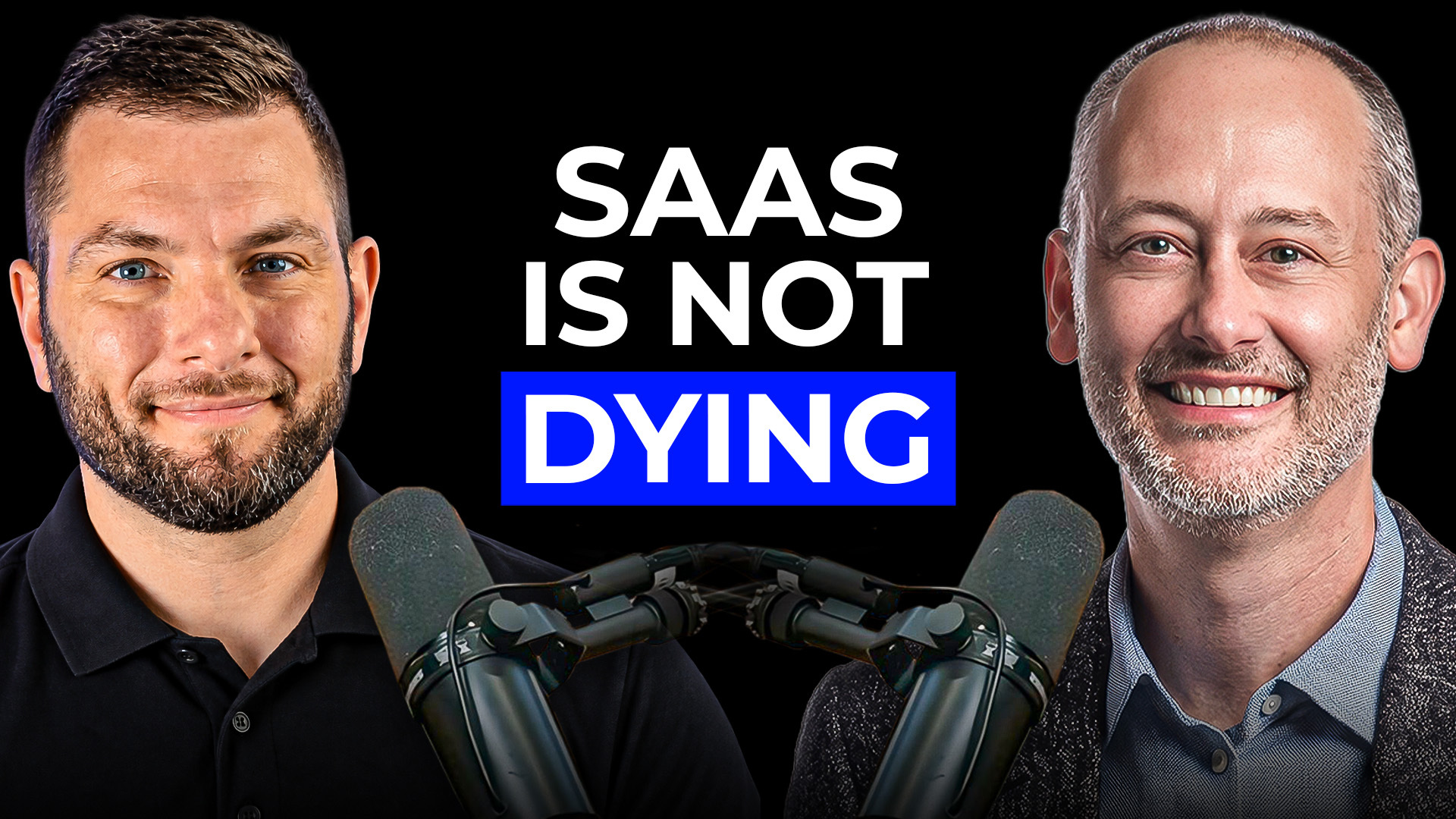
This Is Why Microsoft Is Betting on SaaS Getting Bigger

About This Episode
Making each person faster is the small win. Rebuilding the process is the real one.
Bryan Goode, Corporate Vice President for Business Apps and Agents at Microsoft, joins Samuel Boulanger to explain why he sees AI making SaaS more important, not less. As agents take on more work, businesses still need reliable systems of record, security, compliance, and visibility into what is happening. The interface may change, but the underlying business platform becomes even more valuable.
We explore the “toggle tax” of moving information between disconnected applications and why individual productivity gains alone do not fix a broken process. Bryan explains how pre-built Dynamics 365 agents and custom Copilot Studio agents can work together, where human approval belongs, and why successful organizations combine employee experimentation with executive-sponsored transformation.
His practical advice: start with one process, one business owner, and a clear metric. Measure the outcome relentlessly, iterate, and use the time you gain to build stronger human connections.
You’ll Learn
- Why Bryan believes agents make SaaS and systems of record more important
- How the “toggle tax” turns employees into middleware between applications
- When to use pre-built Dynamics 365 agents versus custom Copilot Studio agents
- How multiple agents can handle different parts of a business process
- Why human oversight and observability matter as agents gain autonomy
- How to combine bottom-up experimentation with top-down process transformation
- How to choose a first process, secure executive sponsorship, and measure business results
A Practical Starting Point
- Map the manual handoffs. Find where people copy information between systems.
- Choose one process and one owner. Give a senior business leader responsibility for the outcome, supported by an implementation team.
- Pick a measurable result. Track a business metric such as customer satisfaction, mean time to resolution, or lead qualification rate.
- Start with oversight. Keep humans involved while you build confidence in the agent and the process.
- Measure and iterate. Adjust the workflow, the agent, and the level of human involvement as you learn.
About Bryan Goode
Bryan Goode is Corporate Vice President for Business Apps and Agents at Microsoft. He was part of the team that launched Microsoft Teams and now works on Dynamics 365 and the agents being built around it. In this conversation, he shares a vision for business applications that help people spend less time managing systems and more time solving customer problems.
Episode Sponsor
This episode is sponsored by We Point, a consulting firm supporting AI, data, enterprise application, and infrastructure transformation for private and public organizations.
Listen and Watch
Guest: Bryan Goode
Host: Samuel Boulanger
COLD OPEN
Bryan Goode
Basically, we have relegated ourselves to this job of middleware, and the human has become this middleware layer. In fact, sometimes I'll talk about this as "toggle tax." Some studies have estimated that it will cost the average information worker something like four hours a week just in terms of the toggling.
Samuel Boulanger
My guest is Bryan Goode, corporate vice president for business apps and agents at Microsoft. He was part of the team that launched Teams, and he now owns Dynamics 365 and the agents being built around it.
Making each person faster is the small win. Rebuilding the process is the real one.
Will there still be a user interface, or will we just deal with agents?
Bryan Goode
Some have said, "Oh, does AI mean that SaaS goes away? The SaaS apocalypse?" I actually think it's exactly the opposite.
Instead of logging into some crusty business application that they groan every time they log into...
Pick a function, pick a process, make sure you've got the right senior executive support, and then add an agent to it with a clear eye on the metric that you're trying to impact. Then measure it relentlessly.
I hope that the human connection stays the same. We've all probably gotten those emails or read those documents that were clearly generated by AI. I want your authentic perspective.
INTRODUCTION
Samuel Boulanger
Most of us spend the day moving information between systems. Copy from there, paste it there, upload it again. We've basically turned ourselves into middleware. That is the whole point of today's conversation.
My guest is Bryan Goode, corporate vice president for business apps and agents at Microsoft. He was part of the team that launched Teams, and he now owns Dynamics 365 and the agents being built around it.
His argument is simple: making each person faster is the small win. Rebuilding the process is the real one.
By the end, you will know when to use a pre-built Dynamics agent versus building your own in Copilot Studio, how to choose your first process, and where a human still signs off.
This episode is brought to you by We Point, experts in artificial intelligence. We Point redefines the era of consulting by supporting the major transformations of private and public organizations. Six hundred talents in New York, Montreal, and Quebec City.
Before we jump in, I have a small favor to ask. If you're getting value from this show, hitting subscribe, dropping a comment, or leaving a like is one of the best ways you can support us. It helps more people find these conversations, and honestly, it means the world. Thank you.
Now, let's jump in.
CONVERSATION
Samuel Boulanger
Bryan, welcome to The AI Frontier Playbook. Thank you so much for making the time. I know your schedule is full, and you're just back from sabbatical, so thank you for making the time.
Bryan Goode
You're very welcome, Sam. It's great to be here. Just as you said, I took a couple of months away, and it was an awesome opportunity to get a bird's-eye view of what's happening in the market, what's happening with our customers, and what's happening with the technology.
It was a really useful experience, and I am so happy to be back. I'm full of energy and can't wait to help our customers transform.
Samuel Boulanger
There's so much that happened in the last two months. I just can't imagine how much you had to catch up on when you came back.
Bryan, you've been part of some of the big shifts in how people work, from launching Teams to now leading AI business processes at Microsoft. The thing I keep coming back to in your writing is that the bottleneck isn't the people, so I'd like to start there.
You've described employees as the human glue connecting disconnected systems. Why doesn't making every individual faster with AI fix the underlying process?
Bryan Goode
Yeah. Well, if I zoom out, I'd say if you think about the way that we work today, we work across a bunch of fragmented applications and systems. We end up spending our time as knowledge workers pivoting from one system to another, swivel-chairing from this application and copying over here, sending an update to somebody over there, taking some notes, and then uploading them over here.
Basically, we have relegated ourselves to this job of middleware, and the human has become this middleware layer. In fact, sometimes I'll talk about this as "toggle tax." This moving from app to app actually has a real impact on us. Some studies have estimated that it will cost the average information worker something like four hours a week just in terms of the toggling that they're doing.
I think there's a far better way. Just making those individuals faster and more productive, to answer your question directly, certainly helps. But if you're not addressing the way that the overall business flows, the way that we've set up business processes in an organization today, you're simply not going to have the impact that you could have.
Of course, it's about enabling every one of us with a great AI productivity assistant like M365 Copilot. But if you're not thinking about the process, the system in which this work flows, you're only going to get a bit of the reward. You're not going to really see the transformational benefit that you could see otherwise.
Samuel Boulanger
This is so true. I've seen so many people whose job was taking information from one system and copying it into another system. Even if you give them AI and they're faster at doing it, they're still playing the role of middleware, right?
Bryan Goode
Yeah, exactly. I think we can do so much more. It's not just that we can save a little time and be a little more productive. We can cut down on errors that happen when you're moving from one system to another and toggling back and forth.
Frankly, it frees us up to go spend time doing things that I think only we are capable of. We can be more creative as we think about product concepts. We can spend more of our time with our customers to understand what it is they really need. We can go solve some of these problems that, frankly, we just don't have time to solve in the average workday.
The opportunity here is really massive, both for us as individuals to put AI to work for us, as well as for organizations to get the most out of AI. We're really at a crucial moment, I think, this year.
Samuel Boulanger
Love it. Then it will give us more time to do things we enjoy, right? I don't know a lot of people who enjoy taking an Excel spreadsheet and then putting it into an ERP system.
Bryan Goode
Yeah, exactly. Most of us got into this business, or whatever business we're in, because we love solving customer problems. That's what we're here for. Let's use AI to free us up to all spend more time with our customers and solve more of their problems, not copy and paste and swivel from one app to another.
Samuel Boulanger
From your customer conversations, what's an example where changing the process made a noticeable difference for the customer? What actually got better?
Bryan Goode
One example that I think about is LNG. They are a financial services company in the UK, and they serve a number of customers. One of their divisions, their retail division, had a challenge: they had a bunch of disconnected systems, just like I was describing, and several thousand people in the front and back office whose job it was to try to serve customers.
They didn't have a single view of the customer, though. They were able to use some of our tools and our AI capabilities to create a single view of the customer and enable thousands of their employees to spend more of their time really helping understand what their customers need and how to do a better job serving them. They used AI to automate call transcripts and a number of other things like that.
Again, that's a really tangible example of a company putting AI to use, really rethinking the way they do business with AI. The results promise to be very transformational.
Another example I might give is Lifetime. They're a sporting goods manufacturer. They thought about it not in terms of the customer angle, but instead the order fulfillment and order processing angle. Once an order has been received, how do you think about taking that, making sure you've got the right inventory, and getting it to the right customer somehow?
They deployed AI and our tools to be able to do that. Just in one division, they've been able to see a very significant improvement in efficiency, I think to the tune of 95%, and that happened pretty quickly. They're also using agents to automate the way they think of their supply chain and really rethink it.
I think those are two super examples of customers that are seeing real benefits, really rethinking the way they operate with AI. It's more than just improving employee productivity. It's really rethinking your business process.
Samuel Boulanger
Yeah. Instead of the human being the glue between the systems, it's now the agents doing all the work of making sense of all this information. I've seen customers using 17 different systems, and it can create real bottlenecks.
It's not the most fun part of the job, right? People would likely prefer being in front of the customer and servicing the customer.
Bryan Goode
Absolutely. Yeah. I think the opportunity here is multifold. There's an opportunity for the company. There's an opportunity for each of us in terms of the way we grow.
In fact, at Lifetime, to go back to that example, as they put this in place, they had people who previously ran an order from one warehouse to another. Once they automated some of their order fulfillment process, they were able to help those people, instead of doing that, go do things that were more rewarding for them. They put them to work on higher-value activities.
I think it's a great example of what AI can do, again, for the organization and also for each of us as employees.
Samuel Boulanger
Now we're hearing AI, Copilot, and agents in every part of our organization, right? From Azure, business apps, and M365.
What does the next generation of business applications look like in practice? Will there still be a user interface, or will we just deal with agents? What should customers expect to be different, not just an AI feature added to the same application?
Bryan Goode
Yeah. Well, now you're speaking my language. In this world where you have human employees, and now you have AI agents working on problems, collaborating together to swarm on a problem, you really need to rethink that business application platform that maintains state, your system of record, and helps you audit these things.
Some have said, "Oh, does AI mean that SaaS goes away? The SaaS apocalypse?" I actually think it's exactly the opposite. I think that SaaS and this underlying foundation of maintaining state become more important than they ever were before, because now you have even more actors acting on a potential customer record, as an example. They become more important than ever.
However, they change state a little bit. For example, that user interface matters less, because my bet is that most employees, instead of logging into some crusty business application that they groan every time they log into, are going to be able to do so much of that from their productivity applications that they're already spending time in. Maybe it's Outlook or Teams.
They're going to be able to use their AI assistant, like Microsoft 365 Copilot, to update records or create dashboards that they need, or whatever you might need. You'll be able to do that all in the flow of work in an intelligent way, rather than logging into some siloed system.
The business app is going to be more important than ever. I'm convinced of that. But the form of that business app is going to change from being a classic three-tier application to more of an intelligence platform, if I'm honest.
That's an area we're investing deeply in here at Microsoft with our Dynamics apps, and I'm happy to chat more about that anytime. It's a big bet that I think we're making and that the industry is moving towards.
Samuel Boulanger
I think every single seller I'm speaking to, the first thing they ask me is, "Is there a way I don't have to go into the CRM, and I can just update from an agent? Can I use voice? Can I build my own dashboard?"
It's all now feasible. We just announced, I think it was last week, that with co-work and Copilot Studio, you can now spin up an app using natural language. This is crazy.
Bryan Goode
Yeah, exactly. It's a new era, and it's really exciting. Somebody on my team built an app to help us with launch disclosures, as an example, just using co-work. It's a super easy implementation for her.
She just had a couple of prompts and built this app. It's got these little tiles that we can move around. My entire team can see it. It allows us to collaborate. That's not packaged software. She built that using co-work in a matter of hours. We are in a really interesting era.
Samuel Boulanger
The data store and the brain of it still are Dynamics 365 or Dataverse, for that matter, right?
Bryan Goode
Yeah. That goes to where I was talking about the future of business apps. As we think about that, instead of the value being the user interface, the value really starts to float down to the data store, the connection of that data into the intelligent fabric, which on our side we call Microsoft IQ, the security and compliance policy around that, and the manageability.
That's where a lot of the value flows. In the app that I was describing, certainly the data sits in a data store like Dataverse, but then gets piped into our intelligent framework and beyond. That's a critical piece. As I said, quite an exciting time.
SPONSOR BREAK
Samuel Boulanger
A quick word from our sponsor, We Point. If the kind of transformation we're talking about today sounds like your organization, We Point does that work.
Six hundred consultants across New York, Montreal, and Quebec City will [unclear wording about business strategy], then optimize the ecosystem underneath it: AI, data, enterprise applications, infrastructure, public sector and private, all backed by the Onepoint Group and its 4,500 people worldwide.
If you need a hand with any of this, you can find their website in the description.
Now, let's get back to the discussion.
CONVERSATION CONTINUED
Samuel Boulanger
I think, as Microsoft, we live a bit in the future. I'm talking with a lot of customers who are not there yet. They're still trying to understand how to use basic agents and basic Copilot.
I know Dynamics 365 has a lot of embedded AI inside of it. There are pre-built agents. Where should I build something specific to my business with Copilot Studio versus using what is out of the box with Dynamics 365? How do those work together?
Bryan Goode
Great question. You're absolutely right. We have delivered a series of pre-built agents as part of Dynamics 365 that can help you with things like sales qualification, to go qualify leads, or help prompt a sales rep on what the next best action might be with a customer, or help with your supply chain with our Supplier Communications Agent. Those are all built into Dynamics 365.
What's special about those is they're pre-built. A customer who's just trying to figure out, "How do I get time to value? I don't have a lot of time. Just prove it to me quickly," these agents are perfect for that.
They're common business processes. You have to do very limited customization of them, and they just work. They just work out of the box.
The reality, though, is many customers will either have more advanced needs or they'll say, "Gosh, that's not the way my org works. I work a little bit differently. I want to build something custom."
That's where Copilot Studio comes in. They can build their own custom agent for their very specific process or their very specific needs. It can still connect to Dynamics 365 data using our MCP servers. It can leverage tools and knowledge and all kinds of things that you can need to be very sophisticated. That's the role of Copilot Studio.
I see them not as an either-or. I see it a little bit more as you can start with these in Dynamics just to get going, and then soon thereafter start to really experiment with what's possible with custom agents in Studio.
Samuel Boulanger
Can you do both, in the sense of using agents working together? Let's say I create my own Copilot Studio agent, and I'm leveraging an out-of-the-box agent as well.
Bryan Goode
Yeah, absolutely. The ability to do what we call multi-agent orchestration, connecting multiple agents together, one agent does one part of the process, another agent picks up from there and does a second part, that's an important piece of what we're building here.
These almost become reusable parts that can all be connected into the system that you use to really change the way that you work. That's a big bet for us.
Samuel Boulanger
When you're at the point of having multiple agents taking action inside one or multiple business processes, if I'm taking the supply chain, for example, now they're starting to make decisions and take action.
How should you decide where human approval is required? Basically, who's accountable when something goes wrong?
Bryan Goode
Most of our customers and the folks I talk to start to move into this world pretty gradually. They'll start out, pick a process, and have a lot of human oversight. They'll do that, of course, to make sure that the agent and the process are working as expected. The human can still review things and tell the agent to proceed or not to proceed.
As that organization gains confidence in that particular agent, that it works 99% of the time and it's a pretty low-risk situation because it's not going to be a major problem, they can often start to take off those guardrails and just allow the agent to work more autonomously, if you will.
This is a little bit aside from the human oversight, but we also are delivering a set of tools that allow every company to do observability of their AI agents. You can see all the AI agents in your organization as an IT administrator. You can manage which ones have access to which resources.
We call that Agent 365. It's a very important new product for us, and that complements what we're doing here.
Certainly, we want human oversight and to enable customers to have that until they feel comfortable. Even then, we want to make sure they have observability across their agent estate with a tool like Agent 365.
Samuel Boulanger
I had this conversation with a customer yesterday. They were worried that once everybody starts creating agents, you'll end up a bit like we've seen with Excel a couple of years ago, where everybody has their own version of the same spreadsheet.
Is Agent 365 what will help us prevent that?
Bryan Goode
Yeah, certainly. Now, I would say there's an important caveat here. I actually think there's some real value in both a top-down approach to AI agents as well as a bottom-up approach.
As an example, I think it's really important to give every information worker the ability to build their own Excel files, even if there's some duplication, because oftentimes they're going to be closest to the problem. They're going to be the one who's accountable for solving a particular problem. Let's give them those tools.
On the other hand, there's a set of very high-value business processes that really are, let's say, org-wide processes or policies. Those are the ones you really want to drive in a top-down way.
The most successful companies I'm seeing are doing a combination of that bottom-up adoption, letting every employee experiment and try things and use it themselves, with that top-down adoption. If you combine those two things together, you can really have transformational results.
Samuel Boulanger
Interesting. Yeah. And rebuilding your whole process with AI.
Bryan Goode
Yeah, that's right.
Samuel Boulanger
How should a leadership team choose its first process and the metric that will tell them it's working? What should they look for in the first 90 days and change if the results aren't there?
Bryan Goode
I often coach customers to pick one process. Pick a function, and maybe it's whoever raises their hand first. Every one of our functions inside a traditional organization is going to embrace AI. I'm convinced of that.
Really, it's a question of who wants to raise their hand first and say, "Let me go first."
Pick a function, pick a process, make sure you've got the right senior executive support, so a senior leader along with an implementation team that can support that senior leader. Then add an agent to it with a clear eye on the metric that you're trying to impact.
If what you want to focus on is customer satisfaction, or you've got an agent that's focused on customer service, make sure you're looking at things like the mean time to resolution. Make sure you're looking at things like the customer satisfaction score with that experience, and then measure it relentlessly.
Usually, this takes iteration. It's not that you won't see some improvement in the very first 90 days. It's just that you put it in place and realize, "Well, gosh, this changed some things that we expected. I need to iterate on what the agent does, or maybe I need to bring in more human involvement, or maybe I need to actually remove human involvement because it's operating the way we want." Then just keep an eye on it.
We've actually taken a very similar approach to that inside Microsoft as we've gone from function to function and deployed our own AI agents. We've had pretty significant positive results across our functions. That's the roadmap, if you will, that I like to share with our customers.
Samuel Boulanger
If I go back to the bottom-up approach, would you say that the ownership of those proofs of concept, of those business processes, is with the business units? It's governed by IT, right? But it's not owned by IT. It's governed by the business units that know their processes.
Bryan Goode
Exactly. As an example, the head of sales is going to care most about the sales pipeline or the lead qualification rate. The head of customer service is going to care about customer satisfaction and mean time to close. The CFO is going to care about accounts receivable and that type of thing.
That's where you bring that BDM into that discussion and actually have them act as sponsor. Certainly, you need the technology staff. They're the ones who are going to be working with that business decision-maker to put the solution in place. But you really need that BDM to act as the key sponsor. They're the ones who need to see the business results and want those business results.
Samuel Boulanger
It makes total sense. We're almost at the end of our time, and I'd like to switch gears with my [unclear: "Alexis question"]. We've been talking about other people's processes, but I'd like to learn more about your process.
What's the one thing you now hand off to an agent every day that you will never take back?
Bryan Goode
I don't know if I could get it down to one, if I'm totally honest. Let me just share a couple of my favorites. How about that?
One of my favorites is I'm using our autopilot capabilities with Microsoft Scout to run a report for me every single day on news that's happening in the market. As part of my job, I need to be up to date on everything that's changing. As we talked about before, it's a really busy time.
I use an agent that runs every single day that helps me stay up to speed on the most important things I need to be aware of for my business.
I also have an agent that helps me prepare for customer meetings. I meet with a lot of our customers to understand what they're trying to do. It's hard to stay prepped because I meet with so many of them. I have an agent that, before I meet with the customer, will brief me on what it is they're looking for and what I should talk about.
At my team level, we've even created a chief of staff agent. Folks on my team, if they have questions about policy or what have you, ask our chief of staff agent.
Honestly, all this is just scratching the surface. There are probably five to ten agents we're using across my team and myself on a very regular basis that give us time back, help us be more effective, and have been tremendously useful for us.
Samuel Boulanger
I've built a couple of agents with Scout as well, but just for the benefit of our audience, I know a lot of people haven't heard about Scout yet. What is it exactly?
Bryan Goode
You could think about Scout as an agent that runs autonomously with its own identity. In many ways, it's a little bit like an AI teammate, if you will. It really runs fairly independently.
Just like I might delegate or hand work off to somebody on my team, I can hand work off to Scout, and it comes back to me. It will give me an update in Teams or send me an email in Outlook. In many ways, it's just like another teammate, which is pretty powerful.
Samuel Boulanger
It's basically scraping the web for news and giving you this report every day, looking at your to-dos and what's coming up on your calendar. It will do part of the preparation work for you automatically, without you having to trigger it.
Bryan Goode
Exactly. Right. Yeah, it does it all autonomously, and it's been a real value for me.
Samuel Boulanger
For me as well. I do agree. This is very powerful, and I can't wait until we get out to the market with this autopilot that's coming soon.
Looking ten years out, if we get this right and agents are running a real share of the processes we spent decades building screens for, how do you see that reshaping the way we live and work? What do you hope stays exactly the same?
Bryan Goode
I hope that the human connection stays the same, and I'm confident that it will. In fact, I think that's going to be more and more.
Maybe as an aside, I'll say we've all probably gotten those emails or read those documents that were clearly generated by AI, and you're like, "Oh man, this is giving me too much stuff here. I want your authentic perspective. Just tell me what you want in human language."
I think that speaks to that opportunity for us really to do more and more from a human connection perspective.
Sure, AI and agents are going to be running our business on our behalf, handling a lot of these core processes. It's going to give us time for that human connection, meaning it's going to give us time to really meet with our customers, deeply understand what it is they need, and go work with our partners inside the company to ensure we're delivering exactly what that customer is looking for with high quality, with our suppliers and our supply chain.
I actually think this new world is going to enable us to have a much deeper human connection with one another because we can spend our time on that, which is what's going to matter, not this toggling and working on internal systems. I'm quite optimistic for it and excited for what the future holds.
Samuel Boulanger
I am as well. Thank you so much for your time today, Bryan. It was very insightful seeing where the business application world is going. This is very different from what we've experienced so far.
It's evolving very fast. There's not a single week where there are no new features added. But I think, like you've said, it will help us get more connected and spend more time on meaningful tasks instead of being this middleware between different systems.
Thank you a lot for your vision and your insights today.
Bryan Goode
You're welcome, Sam. Thanks so much for having me on. It's great to be here, and I appreciated the time.
Samuel Boulanger
Thank you. Have a great day.
Bryan Goode
Thanks.
OUTRO
Samuel Boulanger
That conversation was really about one idea: the bottleneck is not your people. It's the process they're holding together by hand.
Three things I want you to walk away with from this episode.
First, the human has become the middleware layer. Bryan calls the app-to-app switching "toggle tax," and he cited studies putting it around four hours a week per information worker. Go look at one workflow in your team this week and write down every place a person is moving data between systems. That list is your agent backlog.
Second, start with one process and one owner. Bryan's advice is to pick a function, ideally whoever raises their hand first. Get a senior business leader to sponsor it, with an implementation team behind them. Then add an agent and pick the one metric you're trying to move, whether that's mean time to resolution, customer satisfaction, or lead qualification rate. Measure it relentlessly and expect to iterate.
Third, you don't have to choose between out of the box and custom. Use the pre-built agents in Dynamics 365 to get to value fast, then build in Copilot Studio when your process is genuinely different and connect it back to your Dynamics data through the MCP server.
Bryan also made the point that the best results come from combining top-down and bottom-up, with Agent 365 giving IT visibility across the whole agent estate.
If you're getting something out of this conversation, subscribe to The AI Frontier Playbook wherever you listen, and sign up for The AI Frontier Playbook newsletter to stay sharp between episodes.
Thank you so much for listening, and I'll see you in the next one. See you.
EDITORIAL NOTES - NOT PART OF THE TRANSCRIPT
- The cold open, introduction, sponsor break, conversation, and outro have been retained. Repeated cold-open excerpts are intentional, not duplicate transcript errors.
- Speaker turns were inferred from context because the source did not contain speaker labels or timestamps.
- The guest's name has been standardized to Bryan Goode, consistent with the source filename.
- Confirm the sponsor's spelling, transcribed as "We Point," against the sponsor's approved copy. "Onepoint Group" also appears in the source.
- Confirm the UK financial services company's name, transcribed as "LNG." It may refer to L&G, but this has not been substituted without confirmation.
- Confirm the product names transcribed as "co-work" and "Microsoft IQ." They have been retained rather than replaced with an assumed product name.
- The sponsor sentence about business strategy and the phrase transcribed as "Alexis question" require an audio check and are marked inline.
- Numerical claims, customer outcomes, product capabilities, and relative timing references are retained as spoken claims, not independently verified facts.
Related Episodes
You might also enjoy

Stay in the Loop
Never miss an episode.
Get new episodes and AI insights delivered to your inbox.