Episode 23
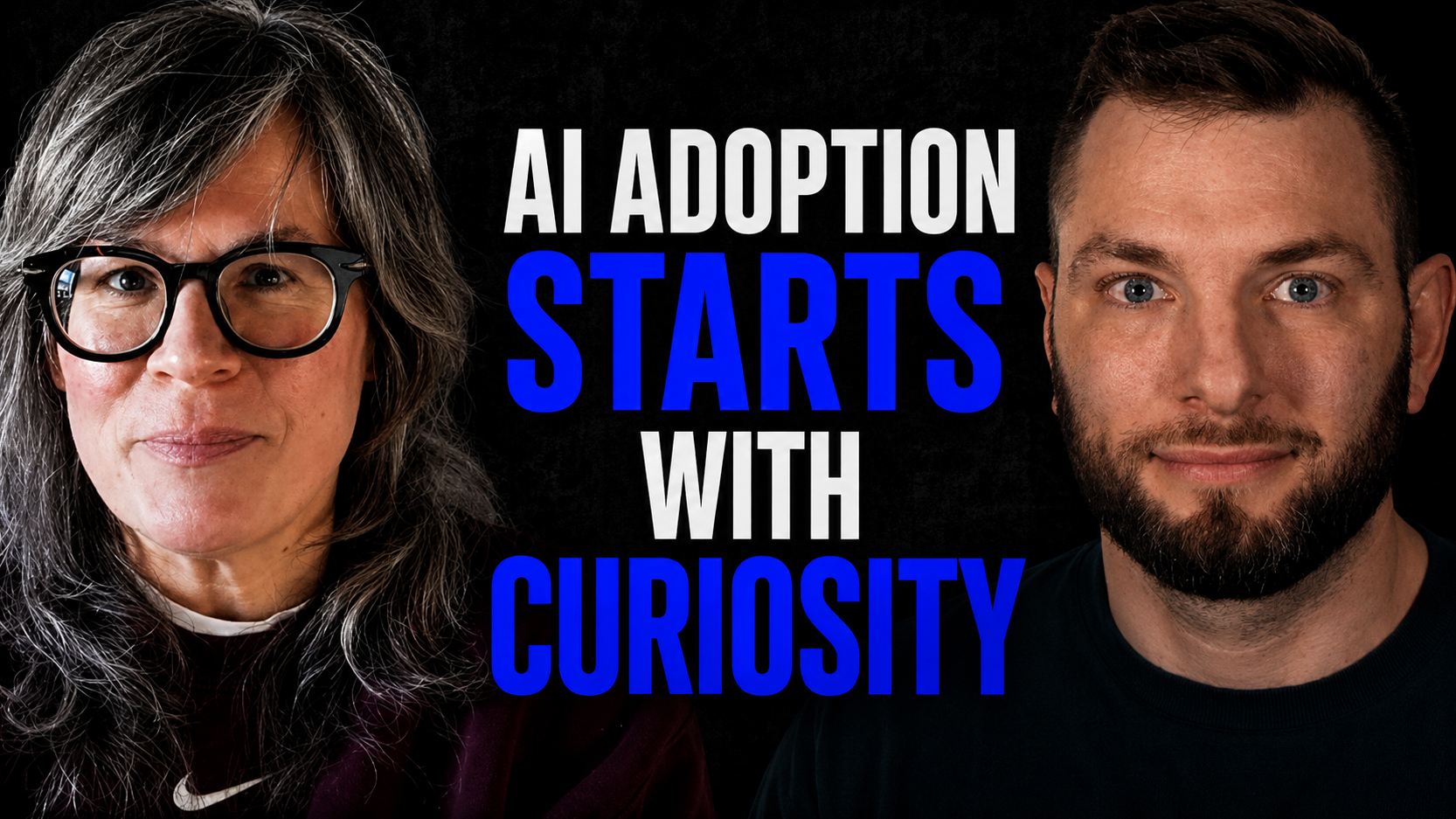
The AI Grok Moment: Why Most Companies Miss It | Stacey Mulcahy, Microsoft Senior Director

Show Notes
Why does AI adoption fail in business? In this episode of The AI Frontier Playbook, an AI podcast for enterprise leaders, I sit down with Stacey Mulcahy, Senior Director of the Microsoft Garage, to break down the real AI adoption challenges companies face and how Microsoft solves them with curiosity, hackathons, and hands-on AI skilling.
Stacey leads the team behind the Microsoft Global Hackathon and the Skill Up AI program, engaging over 70,000 employees in grassroots AI learning and employee enablement across the company.
We go deep on why formal learning paths are not enough, why curiosity and exploration drive real behavior change, and what Stacey calls the grok moment: the point where AI stops being a search engine and starts changing how you work. She also shares why leadership modeling makes or breaks adoption, how she runs learning in the open by streaming her own experiments, and why the GitHub Copilot CLI has completely changed her daily workflow.
Key Takeaways
- Why AI adoption gets stuck even when the tools and programs are good
- How to create the grok moment that turns skeptics into adopters
- Why leadership modeling matters more than any champion program
- What community skilling looks like and why learning with others beats learning alone
- How creativity and play outperform productivity use cases as an entry point to AI
- Why durable skills like adaptability, delegation, and taste matter more than tool knowledge
- How Stacey uses the GitHub Copilot CLI, custom agents, and MCP integrations to run her day
- What the future of work looks like when everyone manages a team of agents
Whether you are a leader driving AI transformation in your organization or an individual contributor trying to build AI literacy on your team, this episode gives you a practical playbook for making adoption actually stick.
Resources
Stacey, thank you so much for joining us on the AI Frontier Playbook. Stacey, you're the Senior Director of the Garage program at Microsoft. The Garage, Skill Up, hackathons. It's all informal learning communities that you're part of at Microsoft. And I think our audience can learn a lot on how to bring AI literacy based on what you've done internally at Microsoft. So I'd like to hear from you today about how you've managed those programs. Can you give us the landscape? Like what are these programs and why does Microsoft invest in informal skilling alongside the formal stuff?
Stacey
So thanks for having me. This is a topic I love, I love to talk about, super passionate about. I work in the Garage at Microsoft, which really focuses on grassroots innovation at the employee level and enablement there for employees. As you mentioned, one of the things that we do is we embrace motions like hackathons. We run the Microsoft Global Hackathon that has over 70,000 people participating in some way, shape, or form across Microsoft. And we also do lots of focus on employee enablement for AI and skilling. And that shows up in a program that I drive called Skill Up AI, which is probably its full second year now that we've been doing this across the company, because the Garage, again, is an organization that works across Microsoft. And so we engage employees from all roles, disciplines, teams, areas in Microsoft in AI skilling and engagement.
And yeah, you kind of alluded to like, why do we do this? And what does this look like? And so for the Garage perspective, we really focus on kind of like a microcosm of what we see when we run hackathons. And so what I mean by that is we bring people together across orgs. So it's an opportunity for people to meet other people. We believe in community skilling, meaning that doing it with others potentially is going to have an additive benefit because you're building that culture of relentless curiosity. We also think that getting hands-on and just exploring stuff and creating that iterative exploratory mindset is really, really important in this space, because as you probably know, the experience day to day, we're kind of drinking from a fire hose. The tools are changing, the landscape is changing, the capabilities are changing. And so how do we build those durable skills around things like resiliency and adaptability and creativity? How does that kind of get built in? And so those are kind of our tenets when we think about our principles, when we think about the kind of programming we want to do with employees, we really want them to be hands-on, doing them with others, across org kind of learning.
Microsoft like nowhere else has no shortage of formalized learning, skilling, paths as people often like to call them. Adjacent to that. We're not capital L learning in that way. We are very much just in time, future thinking, and hands-on exploratory is definitely some of our principles. And it's important to have a balance of both of those things because everyone, and you discover when you learn with others, picks up things in very, very, very different ways. Especially now in this landscape, if you're not getting dirty with the tools, with the approaches, with the platforms, and if you're not revisiting them, because capabilities are changing so fast, it's really easy to be left behind or feel like you're left behind. That's kind of where we sit. And across Microsoft, like I said, there's no shortage of enablement and skilling and learning. And there's many orgs that are doing really, really, really great work. We just happen to be one that sits in this area. And that's kind of our focus. So that employees have options. Because again, you don't know how someone's gonna gravitate towards what kind of approaches or how they learn. Even as adults, we're still figuring out how we learn, I think, especially in this landscape.
Samuel
I do agree. And I think everyone has his own way of learning. So you mentioned it, creating those communities, well, all seeing different ways of uniting those tools from different parts of the organizations and getting hands-on. I think it's very important. We have guests on the show talk about literacy frameworks, champion programs. We had Katie Neepe talking about how we built this champion program at Microsoft. I think those are really important, but you've spent years watching people encounter AI for the first time in your different sessions that you're delivering. So I'd like to know that based on that experience, where does adoption actually get stuck from what you've seen and how much of this is about the tool versus how people are approaching it?
Stacey
That's a great question. And there's a lot of friction points to adoption. And this may be in any company, not just a big company, this may be in any company. One is going to be, I would say, a gap in expectations can be a friction point. And what I mean by there is that we hear a lot of marketing, we hear a lot of stuff that people can do, we hear these crazy stories of people doing wild things with these tools. And it's not to say those aren't accurate. I mean, those are probably very accurate. But they're also accurate in the environments that they exist. And when you work in a company, your environment might be a little bit different. Your environment might be a little bit more locked down, might be admin'd by others.
And so sometimes there's a gap in expectations because of what you're seeing people do or what people believe that you can do and this perception that creates, especially at a higher level with leadership. And then when it comes to the reality of having that gap between leadership to the employee and employees like, I would love to go explore that. How do I get my hands on that? How do I get access to that? And so I would say sometimes it's a little bit about the gap of expectations and then access and what you can actually do in your environments and what you can enable people to do. So I kind of file that under enablement and expectation setting because all of those variables come into play in terms of what you can actually ask someone or one of your employees to go do in that landscape.
You have this great kind of spectrum of mindset that you'll start to see and you have the early adopters super enthusiastic, can't live without this stuff. That would be me. Change the way I work. Like you could not tear the tools out of my hands if you tried. You'll start to see the spectrum of people as we come up.
Samuel
Me as well.
Stacey
On the other side of the spectrum of those mindsets, you're going to have people who are really cynical and skeptical, and those are great. Like, you should actually welcome that. And then you have everything in between. The people who kind of explored it, can kind of see it. And that spectrum is really rich. And it's not something to be afraid of. It's actually something to embrace because that diversity of perspectives makes all of that experience so much richer. With some of the skeptical cynicism, sometimes that's just a mindset thing. And it's maybe often grounded in a lack of exploration by people and not always. Some people are super grounded. They've used a tool. They've tried to do many things with it or they've tried to inject AI into a workflow that they're doing or they're trying to think about it different and it's just not working. And I think that's also because we have to understand that some of these things, you're gonna find a use and it's gonna be wildly valuable, but sometimes there's just things that currently you can go do and you can go do faster.
So it's about having the right tool in the toolkit. And sometimes the right tool in the toolkit is doing it how you have always done it at this moment in time. And sometimes it's going to be totally radically changed. And so another thing with adoption of those mindsets is that just always, you're going to see them. You should embrace them. There's not a good and a bad parallel on that. It actually makes that experience much more richer for everyone because people will have those kind of perspectives and perceptions. And again, if you bring people together, they can help lead each other through that and learn from all of those perceptions. I would say the other thing that you see just as a friction point to adoption is often people don't have the time, like they're not given direct time. And listen, we're in a landscape as adults working, especially in tech, working in tech, we're supposed to have the answers. We've always had documentation. We've always been able to Stack Overflow something, or we've always had all these things.
Like, I need to use an API. Here's a documentation. Here's a step by step. Like, we're used to a lot of that. And now we're in a landscape where things are non-deterministic. And it's almost like you have to go back to like how you were as a kid and just come with complete curiosity and complete like, what if I did this? What if I did this? Like, and try to break the tools.
And so I always use the word exploration because I think it's better received by a corporate environment than play. Although fundamentally that's what playing is, is carving out some time to be curious and to not come with a specific agenda, whereas exploratory feels like you're trying to get to an angle. And so that's why I use that terminology, but you have to create those spaces for people to have some of that. And so I think that's also a friction point, is that people don't really have time to go and find that grok moment for them, that moment where they go, it's not just that it did something delightful or did something useful, but that also it kind of changed how they would think about working. And that's what I kind of call a grok moment in AI. It's not just like, I'm delighted by this. It's that connection moment that you feel, and it's that moment when we just have a realization that's very rich. And so that's why I call it kind of that grok moment because it's like, I just grok that, I totally get it. And like you probably had a little bit of pain to get there, and that's why that moment is so important. Because once you learn it, it changes something about you or how you approach things. And I think that's super key for people. And so giving them the time and space to go and discover them for themselves or from someone else or from others, I think is super important. Also I think it's just, time's really hard. You got to carve out time for it. And so I think that's a huge friction point as well.
Samuel
So if I summarize, trying to reduce the gap between reality and expectation. Specifically, I think from the leadership side of things, because if the leadership has big expectations, but in fact the product can't deliver, the user will get stuck trying to make something work that might not be feasible. You also mentioned giving space and time for people to experiment, which I think is really important where everything's going so fast. And I think people need to adapt or adjust to the fact that like you mentioned, there's no documentation anymore. There's some documentation out there obviously, but it's being updated pretty quickly. I've watched a couple of your sessions and you've been using creativity as the entry point, like live sessions, music generation, visual remixing, like building things on the spot during those sessions. And I think most enterprise leaders would never think of that as an adoption strategy. So why do you think it works better than just starting with productivity use cases?
Stacey
Yeah, I think when building in like an AI native mindset, I think you got to come at it from many angles. And I think you need to think of this as, you know, anytime you're doing like adoption, there's a journey someone goes through. And this is a well documented type of user journey. Like, I'm curious, I'm inspired, now I'm trying to explore. Okay, now I've adopted, now I'm innovating. There's a well known kind of spectrum there. And you could phrase those stages in many, many different ways. And there's frameworks for that. When I think about that, and I think about that journey, I think about, it's not just pointing people to go do a learning path, it's got to be like, hey, here's some other approaches to how we can get people inspired. And one of the approaches that you alluded to that I do is that I really put my own learning on display and I call it the dumbest thing I've done at Microsoft because it's pretty vulnerable for a person who's been here 10 plus years to say like, I don't know. And so I embraced that about two years ago is like, I don't know. I'm going to figure it out and here's me figuring it out. And I'm not a SWE by trade. I can code, I can pick up the tools, I'm more of a creative technologist, all of that kind of stuff.
As I go through, I started just like almost Twitch streaming what I was exploring, SDKs, tools, things. I also do another session that's like, here's how I keep up in AI and what I figured out this week, here's the news in AI, kind of gravitated towards that. And we have hundreds of people joining that call because that's how they can keep up with the fire hose. And when I thought about like, how do we engage employees? What are the ways that might be meaningful? What is the way that is passive and active as well as we think about those things?
I started to think of these different modes and modalities that we could do that's not going to suit everyone and it's not going to interest everyone, but the right person will find the right modality for them. And so some of that stuff, like you said, me sharing what I'm building and doing and exploring and then have people build with me, like I learned so much from everyone else, and they're not making fun of me, they might be experts and they're like, just do this or, hey, try this or whatever. And it's again, that microcosm of learning together and just showing some vulnerability around that has really done reams of goodness, I think, for a lot of folks in that way. And some people come to those sessions, like you say, and they're just interested, and they might be an expert in it. And then some folks have no idea. Like, what are you even trying to do? I've never seen this before. And so again, creating that rich community and perspectives that can make that learning experience so much more than a learning path is kind of how we try to approach that.
Samuel
I will assume there's a lot of skeptics joining those calls. And if we're trying to build a framework out of it and like, where's this moment where people go from skeptics to this grok moment, like you've mentioned, what does that moment look like? Do you think it's repeatable or scalable or just happens depending on the type of personality that's joining those?
Stacey
Yeah, I think that's a really hard one. Because I think that, first of all, we're just talking about mindsets, right? And it has nothing to do with AI tools. It's mindset. And you'll see this in everything. And so I think that it's a hard thing to scale. I haven't seen a winning path there. But I do think that the moment if you can present enough different variations of things and peer knowledge sharing and creating a culture of exploratory sharing amongst others. And I do think that that's where that becomes rich for those kind of people, because they'll go, that's kind of like me.
I think that grok moment has to be deeply personal. I think it has to be like super related to something you're passionate about or doing or a workflow or a pain point and that might not be shared widely. And so if you can create this kind of community peer sharing and learning kind of culture, you know, you had mentioned like, talking about like building champs and things like that, like those are really important. They do such great work there because maybe someone will see something reflected in themselves. It's kind of like that inclusion principle. Like if I can see it, I can be it. A little bit. And so that's also with some of these like adopting things. It's like, if I can see a use case, it's also my use case, which can be very hard. Like you can't just go, there's 10 use cases. Then what is that?
And so that's why those kind of like bringing people together and sharing how people are doing is so important. And I think for those skeptics, I think you scale it through others. And creating these environments where there's transparency in what people are exploring. There's transparency in where things are excelling and where they're not. We should be okay with that. I think everyone thinks it's all rainbows and positivity, but there's also some just realistic like, hey, it doesn't really work great for that yet. So let's revisit that thing. And I think just having that kind of balanced, authentic culture around it is how you can bring some of those folks in. I think when you come at it in a disingenuous fan person kind of way all the time, it doesn't feel relatable. It doesn't feel representative of their experience. And so I think that you have to cultivate that culture to take the good, the bad, the ugly, the transparency of the sharing, the successes, the iterative mindsets. And I think that that's how you scale tackling some of that mindset. But you know if others have great approaches for how they do that, I am all ears.
Samuel
What I heard from what you said, or what I think came back is community, vulnerability, and experimentation, right? These non-scripted demonstrations where you're being vulnerable might spark new ideas from others and make them feel comfortable to experiment themselves. And the fact that you're building this community of people working in the same industry but might be in different departments, but sharing together and finding new ways of using these tools might create again this spark, versus someone following a learning path on the web alone in his office where there's only so much you can achieve through that.
Stacey
Yeah, and you'll notice those things that we just talked about. I didn't list the technical skill in there. We're talking about skills that we've had forever, that we've always been trying to build. And so when we talk about skills in this landscape and the things that we need to develop, the tools are going to change, they're going to change at such a rapid pace and like we're good at tools, like in our industry. Generally, we're pretty good at tools. We can pick up new stuff. We can learn really fast. There's a new feature. Now it's faster than ever. Copilot CLI is shipping twice a day right now with new features, and that team's crushing it. It's awesome. We're used to tools. It's the skills that we have to build around resiliency. To your point, a little bit of vulnerability. Modeling that for others, like managers have a huge opportunity in the space as well. The skills of taste and delegation and task decomposition. That is not your traditional technical learning path. And I think that's what's so interesting about this space.
Samuel
In the past, when you wanted to learn the ERP, I remember at the beginning of my career, you have this, we were printing this 100 pages document, we were learning them by heart, and then it was done. We were good until the next update, which might happen twice a year. Now we're not there anymore.
Stacey
Yeah, I really was doing a workshop and within 24 hours, how they did something like how they installed plugins, for example, in the CLI and not the CLI changed it, but like the actual marketplace had changed it. And so like, again, that was not fathomable a couple of years ago. So everything you have to just be iterative.
Samuel
So after you've been doing that for some years now, how do you know the behavior of someone has actually changed after experimenting? Because it's all drilled down to a behavioral change in the sense that we need to stop doing what we've been doing for the past decade and learn resiliency, like you mentioned, in the workplace in the sense that we need to adapt to new functionality, to new tools every day, actually. So on the flip side, what's the thing that you think kills adoption most often, even when the program itself is good? When people are changing behaviors, what's the sign that they change behavior? And on the other side, what does kill adoption?
Stacey
When you see someone that's got that mindset, and I'm gonna just call it like the mindset shift that we need to work on, and you see them being like AI native, AI first, or AI friendly, or AI collaborative, however you wanna phrase it, doesn't really matter to me. They start everything with AI. And I don't mean like they're creating slop or anything like that. I mean, when they think about something when they're working on something, or even if they're putting together something or doing strategy, it's at the table at the beginning. It's part of the process. And they're using it in a much more mature way. And that's part of that journey. So it's not a criticism. And so when you see that, you see people who have developed workflows that create efficiencies for them. And they spent the time to go do that because they know that either that workflow brings them no delight, it's a task they hate to do, it could be easily automated. Lots of opportunities right there.
And so you see things like someone who's going to charter what they're doing with AI as a collaborator, something that boosts what they're doing and lets them do what they do best. And that can be in anything from producing documents to thinking about strategy to having multi-turn conversations that's doing research and taking that research and composing it into a strategy and then thinking about execution. Folks who are starting with even like, as we think about development and software, that's where it's like developing that maturity of how do I create really good specs in my issues so I can assign it to a cloud coding agent and things like that. Like you kind of see this maturity. But for me, it's always like, you're not Q and A-ing. It's not like a Bing or a search engine for you anymore, which is where we all start. Or we start with a bit of personal delight. And there's nothing wrong with that. But it's when it moves the spectrum, if you think of things going from highly creative and maybe delightful or whimsical to full utility, it's when it starts to move across the spectrum. And you're starting to see like, okay, these are the workflows that I'm running.
Hey, we've got a new project, so I'm gonna go organize it, and I'm gonna use AI as my collaborator, and I'm gonna offload this work. There's a term internally at Microsoft, see a bunch of people saying, I'm having my agents do it. And it sounds so like whatever, but really, you could just be in M365 and having it help you create some documents. It could be much more mature than that. You could have a network of agents. So I think you kind of see the spectrum go towards like, what are the things that I could really just, if I could delegate these to someone and you don't have someone, AI is a someone. The minute you see people scaling themselves with AI is that moment where you're starting to see maturity and adoption.
If you are a lazy person, you are the best person, honestly, because you want to solve a hard problem, you put a lazy person on it because they find the most efficient way to do it. And I think that's like when you see those use cases where people just go, well, why don't we just do this? We could have it do X and then it'll do Y. And then someone's like, whoa, yeah, I never thought about it that way. When you see those more creative, it's weird because you're going towards utility. But it's also the creativity that the human's bringing into the loop to think of the ways that it could be utilized for utility that you start to see really shine.
And then you kind of said, well, on the opposite end, what is the thing that absolutely kills it? And I would say there's a few things that are going to kill your adoption. And that's number one, if you don't have leadership modeling and leadership support. As managers, as leaders, you cannot underestimate the immense impact you can have by modeling what you want people to do. So modeling, I'm in the tools. I'm exploring the things. Like we ran a mini hackathon with our org and our org leaders were sitting beside everyone, just hacking just like them, exploring the tools, just like them, asking other people questions, just like they're asking the people to do.
Samuel
That's great.
Stacey
When you see that happening, that's immensely powerful. And where it gets killed is where you see someone who goes and delegates it to like, here's a growth opportunity. You should bring things along and I'm just going to charter you to do it. And I'm going to be on the side. And so I think that when it comes to the adoption that we're talking about, leaders and managers, and also just natural leaders on your team, the people who might be the individual contributors that show up as leaders on the team, you have to show up that way. You absolutely have to show up that way because if you don't, it's done. Like you're going to get a few high adopters and the rest are going to be, you know, like it's so much easier when you model stuff. And so I really, really respect leadership that shows up in that way and isn't afraid to what we discussed before about being a little vulnerable, being a little like, I'm also learning this too. I've set expectations for us all, but I'm also trying to meet the expectations I set. I have immense respect for that type of leadership. And when you see that and the impact that can draw, it's really wild. So I would say that if you don't have that, everything else is going to be so much more difficult.
Samuel
Yeah, I think a lot of organizations got the bottom up approach where people should have champions and enthusiasts, but a lot of them forgot the top to bottom approach. Like I'm seeing a lot of leaders not using the tools and asking their employees or the frontline workers to start using them. And this is not how it works. You need to inspire people. I totally agree.
Stacey
It's a problem of time. And it's a problem of prioritization. And so again, if leaders and managers can figure out the way to go and prioritize that for themselves as well. Whatever you're asking your employee to do, you almost have to do for yourself, right? In the same way.
Samuel
So you've practiced learning in the open. You're basically constantly experimenting with new AI tools and new workflows, reinventing your own workflows. What's one thing you're doing with AI right now? And I know it might change tomorrow, but that has genuinely changed how you work day to day.
Stacey
I'm a TPM. So my day to day is a lot of traditional kind of PM work. I've played with the CLI tools for quite some time since they've been released. And so I'm quite familiar with them, but like my go-to tool is the GitHub Copilot CLI. And let's not be mistaken, I'm not having it necessarily write a ton of code. It's not always about code. And that has completely changed how I work. It has MCP integrations, you can call APIs and CLIs and all those things. And I know enough development stuff that I can be dangerous in that way. But that has completely changed how I work. That's the first tool I open up in the morning. I can use the Work IQ MCP to figure out what I've got for the day.
Samuel
Interesting. So instead of going in Copilot, you're going in like VS Code, you're opening like, not even, right?
Stacey
I don't even VS Code, no, I literally use the CLI. I encourage everyone to explore the CLI. You can use the CLI also in VS Code, but I just use the CLI straight up. And for those folks who aren't familiar with that command line interface, it's like what you see on all the hacker shows and it feels very unapproachable, but because it's so simplified and because all you're doing is asking it stuff and responding, it's just, I think it's the simplicity of that interface that I really love. And so it's creating files, it's renaming things for me. I've created custom agents that will help me do content creation or competitive analysis or any of those things that I need to do. We have MCPs that you can go and tap into.
Here's a prime example. Every morning I have a workflow. It goes to Work IQ. It tells me what I have to do today, the emails I didn't answer, your kind of daily briefing report. And then it sends me a Teams message because I don't like email and it'll send me a Teams message with all those things. And now I feel, especially since I'm neurodivergent, I'm like, I'm organized. This is amazing. I didn't really have to do a lot. And so that's where I start, but I do almost, I try to do all my work in it and I fully have embraced GitHub as a platform and a collaboration platform. I actually have one of my teammates who's a PM and we collaborate on there rather than opening up some traditional documents because agents love markdown. They love text. And so why not work in the places that they love so that you can get more use out of them? And so that's kind of how I've morphed the things that I'm doing. And I do a lot of creation, like content creation. And I get AI to, yes, help me write some of it for sure. But because I've worked with it for so long, and I have my writing style in a lot of those things, now I can leverage it and it can help me scale out in those ways even faster.
I'm an extreme example probably, but it's the tool that I'm using like nonstop every single day. Because you know, you can switch out the models, you can research in it, you can plan in it. There's so many good features. I can do a whole session and if I accomplish something, I can easily just share it with you and you can just kind of use it as context and replicate what I did. There's just so much to love about it personally. So that's how I'm working. And that's how actually quite a few PMs, especially even on my team, they've really picked it up and it's cool to see the things that they're doing with it.
Samuel
I'll definitely try it. Actually, I was using GitHub Copilot inside of VS Code, but I never thought of using the CLI at all.
Stacey
CLI is awesome. It is, but update, update, update. That team is crushing it. They have new features. Like you have to update almost twice a day, if not more. So when people say that Microsoft is like a big company and we can't move as fast, I would say that that team proves us very, very wrong. And they're doing an amazing job.
Samuel
That's great. This is going on top of my to do list for sure.
Stacey
Yeah, it's fun. It's fun.
Samuel
Last question, based on everything that you've seen from inside the Garage, how do you think AI will change the way we learn and work over the next 10 years?
Stacey
I mean, when it comes to skilling, I think that if you're not using it to help yourself and build skills, it's such a missed opportunity. Many people at Microsoft like to go write credential exams, and sometimes their job requires them to, depending on their role, doing certain things, especially with customers. And so we run the session where we're bringing people together. It's like a study group session. But one of the core tenets that we're doing in those sessions is teaching people or inspiring people and creating knowledge share around it on like, how can you use these tools to help you learn what you need to learn faster? And there's so many good tools out there for that, and so many good approaches and everyone has all these awesome prompts around it. And so it's not just in a study context, but it's also like in that research, trying to understand the landscape, trying to understand a customer, trying to understand all that kind of stuff.
And so I think from a learning perspective, our ability to solve just in time skills, like I just need to know this, like I just need to know infra in Azure, I've never done it before. Our ability to solve just in time skills, because of the computer vision in some of these models, you can snapshot the portal or whatever you're working on or the site, or even have it debug it. Because of all that stuff, again, you can learn so much. And if you watch a chain of thought from some of these tools where it's printing out what it's doing and how it's thinking about it, there's also like a ton of stuff you can learn from that and how it approaches that. So it can take you from here to here real fast in learning some of those things. Now, are you learning all the best things, all the best practices? That's totally debatable. And I'm not going to go down that debate, but I'm saying it's just a wealth of opportunity for you to really do just in time skills versus six-hour learning paths and solve immediate problems. More people get on that bandwagon. Many people are there. That's like immediate, when you see that immediately, you're going to have immediate skilling opportunities there.
So I think that learning applications of it is wild, personally, because you can do anything for any kind of learning style. Make me diagrams, write me a storybook, give me ways to memorize this, give me a metaphor, whatever, however you learn, like there's so many ways, create a podcast so I just listen to it. So I think that there's so many opportunities there.
I think how it's going to change how we work is that, I do think it's important that you don't get lost in the sauce. And a lot of people, a lot of these tools, it's generative AI, it's NLP, it wants to write text and wants to predict the patterns as it goes along. And so you see a lot of people writing a lot of documents. Like I got an example of this the other day. And it was like, wrote a whole bunch of documentation, but it was all outdated and wrong because they wrote it but they didn't have the domain knowledge to know that it was wrong. And then a lot of slop was generated and a lot of slop as a result of a lot of the slop generated more work. So it was like this weird cycle. And so I think not getting lost in the sauce and thinking about how we work in the future and how we can properly steer and delegate these tools.
And like my hope is that it allows us to spend more time on the really unique things that you bring to the job because yeah, these tools have been trained on tons of text and data and all this stuff. But I have 20 years in tech industry experience, I've gone through the good, bad and ugly of deploying dot-coms and doing interactive installations and things that you could not predict. And that's valuable. And the way I think is valuable. And the way my systems level thinking or the way that I approach something. And so I think it's really important not to get lost in the sauce.
And I think in the future, I do believe you will have a team and you will have a team of agents, or an agent team or some kind of manifestation of that. And yeah, your job may be managerial. You may need to delegate more and you may need to, everyone's talking about AI taste, you need to have all of that. But what I hope it does is it allows us to have greater human connection. Because the stuff that I need to go off in the corner and spend three hours doing, because it's so painful to go do, maybe that can be set over here. And so therefore, I can spend more time having that human connection and collaborating and working with others in a very meaningful way and only the ways that we can.
That's what I hope that future of work looks like. And I think it does mean that roles are going to change as it enables us to do other things with greater confidence. And as that stuff improves, I do think that it's a wild time because my parents would never have dreamed I would change careers, like they had the same career their entire life. And then for me, it's like pretty normal at my age for people to have one or two career changes. And like my nieces and nephews, it's really common for people to just hop, do different things, try out different things. And there's a totally different mindset about it.
And so I do think that I'm hoping even though roles will change and jobs will change and new opportunities will open up, I hope it brings a little bit more of that intersectionality that we all as genuine humans have. We have different interests and different things. And so that idea that you're five years old and what do you want to be? And you say five different things or wildly crazy. Like, maybe we're moving a little bit towards that too, where you can hop in and feed some of those things that make you uniquely who you are.
That's kind of what I'm hoping for, but I also know there's a reality around it and that roles and how we work will inherently be affected and changed. But I do believe with all of that, when a door closes, another one opens and there will be other things to explore. So I'm actually very personally really excited about it. Because I just, I dream of doing X or I dream of doing Y and I feel like some of this will enable some of that, whether or not it enables success is a different story. But that's what I'm hoping. I'm hoping for a little bit more human connection and maybe that's just a really naive thing for me. I don't know.
Samuel
This is great. I love your vision of the future. That's all the time we had together. Thank you so much for your time. I think we can get a framework on how to improve AI adoption in organizations from the conversation we just had. So thank you so much for your time and your insights.
Stacey
Yeah, my pleasure. Thanks for having me. This is fun.
Related Episodes
You might also enjoy
Stay in the Loop
Never miss an episode.
Get new episodes and AI insights delivered to your inbox.