Episode 12
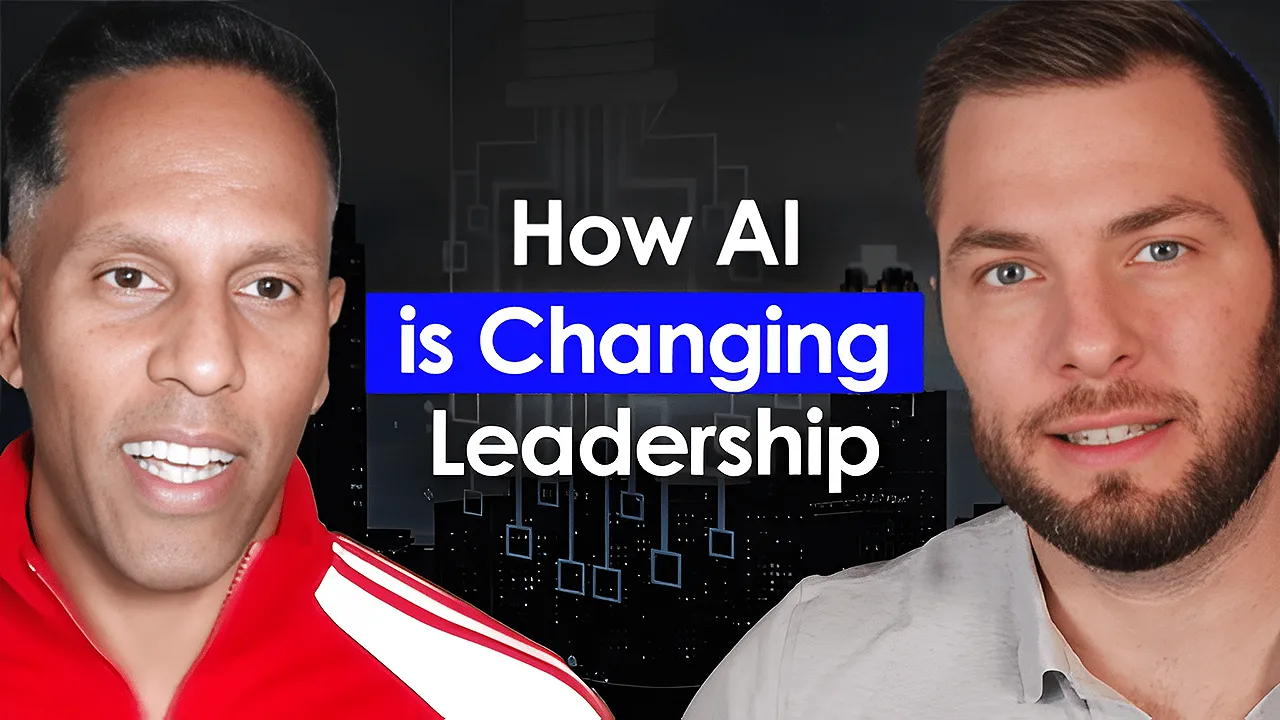
The Future of Leadership Isn't Human-Only
Show Notes
AI isn’t just changing how we work — it’s changing how we lead. Kree Govender leads SMB sales at Microsoft Canada, supporting 1.4 million businesses through Microsoft’s partner ecosystem. With over a decade of experience leading teams across South Africa and Canada, Kree has had a front-row seat to the AI transformation.
In this episode, Kree breaks down what it means to be an “AI-enhanced leader,” why trust and curiosity are now strategic advantages, and how to lead teams that include not just people, but AI agents. They talk about cultural resistance to change, the risk of outsourcing your thinking, and how to stay human in a world of automation.
Key Takeaways
- What being an “AI-enhanced leader” actually looks like today
- Why the biggest mistake leaders make is treating AI as a software rollout instead of a cultural shift
- How to spot and address cultural blockers that slow AI adoption
- The concept of “agent-boss” leadership: leading hybrid human-agent teams
- Why empathy, curiosity, and adaptability are the most important leadership skills
- The risk of outsourcing your thinking to AI and neurological implications
Resources
Hello, Kree. Very nice to have you on the podcast today. So Kree, you're one of my colleagues, you're a friend. So I'm very excited that we're going to have this conversation about leadership in the age of AI today.
Kree Govender
I'm super excited to be here, Samuel. It's wonderful to be here. We've been planning to do this for some time, and I'm very excited for what we're gonna chat about.
Samuel
Before we start, can you please explain what's your role at Microsoft? What's your journey actually at Microsoft?
Kree Govender
Yeah, I've been very fortunate that Microsoft is the organization that I've managed to stay at the longest. So just over 10 years now, and I started my career at Microsoft in South Africa. I led our specialist team for data and AI, our public sector team, the consulting services business. Then I came across to Canada three years ago. Tomorrow will be three years to the day, actually. I joined as a Sales Excellence lead for the corporate side of the managed business, and then over the last two years I've been leading our SMB business, which has the opportunity to go and serve 1.4 million Canadian small and medium businesses every day through our partner ecosystem. It's very energizing and purposeful.
Samuel
That's a lot of customers. You've been right in the middle of the AI transformation, obviously being at Microsoft, but being a leader at Microsoft puts you in the right spot to experiment with the new tools. Like when Copilot came in two years, two years and a half ago, and you had to learn how to lead using those tools. From your perspective, what does being an AI-enhanced leader actually look like today?
Kree Govender
Today, it's an absolute imperative. And we've seen it recently, the recent announcement by Accenture where they said the people that were largely let go were the ones that were not willing to, or were not trainable or retrainable, would I say, in terms of adopting AI. It's an absolute imperative. It's one of the three A's that I look for with people as well when I'm trying to pull them in. The first one is attitude. The second one is aptitude. Aptitude speaking to your ability to learn and relearn things. Within our organization and now the landscape at large, for leaders and for ICs alike, it's that aspect of being able to be a continuous learner. An AI-enhanced leader today is very much in my mind like a navigator at sea. The map has changed, but the horizon hasn't, right? You still need this clear destination, but now you have better instruments to help you get to your end destination. And AI-enhanced leadership for me isn't about mastering every single tool out there. You can't; there's 70,000 that were just released this year, or prompting. But it's about how do you manage to master your curiosity? It's about being very comfortable in the gray area because it's not a deterministic technology, and it's where this intersection of data meets, in many ways, I would say, discernment, and where your logic starts to combine with your human instinct. It's about leading your teams to not just see AI as this cold machine that they engage with, but rather this amplifier of all of our potential that we have. I don't like the term, how do you use AI, but rather I've started to replace it in my own vernacular and hopefully for others too, but how do I work with AI? It's very much as a companion. And for leaders today, an AI-enhanced leader really needs to look at it in that manner. How does this help close down on some of my opportunity areas? How does this help me amplify what I currently do? How can this be a thought partner together with me? And critically, how can I take that through to the team so that it lifts our performance?
Samuel
You mentioned so many important things there. So you mentioned curiosity. I think it's one of the key ingredients when you're playing with generative AI. Like we're mentioning AI, but generative AI specifically, one of the limits of what you can do is your own curiosity, it's your own creativity. I totally agree on that. I love that you mentioned it's not using AI, it's working with AI. That's why we call it Copilot, right? Because it's not the pilot, it's the Copilot. It's acting like a colleague. When I train people on how to prompt properly, that's something I'm telling them: act with LLMs like you would act with a buddy, your colleague. If what you ask is not clear for a colleague, it's not clear for an LLM. So I really like this distinction. Using tools like Copilot to take your decision, how do you balance this gut instinct and what the AI is telling you? We know LLMs might be prone to hallucination. Is there one decision process that you think leaders should experiment with AI first?
Kree Govender
Yeah, and this is a bit of a watch-for, I would say, for society at large. Many of the things that we see today, we naturally assume are fact. You see a large proliferation of information that is sometimes not even grounded in fact. So having the ability to be critical is a key one. I think this aspect of instinct and AI as two lenses in the same pair of glasses, if you can think about it that way, maybe not smart glasses, glasses as we know them today, where one starts to see nuance and the other one starts to see pattern, if you can think about that. And you need both of those in combination to see the full picture. I go back to a Microsoft principle here. Maybe it's not as harsh as this, but then I think about security. The foundational thing there is zero trust. So you verify incrementally. I think that is how you marry up your gut instinct with what's being generated by any sort of AI. Microsoft, we've got responsible AI. There are many things that are built into this so that we largely eliminate that as far as possible. We've got other tools that only snap to things that are referenceable so that it eliminates a large portion of that, so you can put a high degree of trust in that. But once again, just verify explicitly. You still got to do the work. I always got people, as I know you do too, to say, this is not an outsource of your thinking. Once again, you've got to work with it. If you had a super smart intern or even a phenomenal employee that you were delegating a task to, you wouldn't take it off and just pass it off. You would want to critically evaluate. You'd want to add in feedback into that. You'd want to make sure that there are components of it that are genuinely yours so that your fingerprints can be seen on that. And coming to the second part of the question, where should leaders go and experiment with first in that? I would say it's around decision support. So pick a process that's heavy, but it's emotionally neutral. For me, that's something like, you think about finance, like forecasting or prioritization, right? It's emotionally neutral. Let the AI start to challenge your biases. Ask it to tell you what the data doesn't show you, apart from what you can see. And often, the most valuable insights there lie in this tension between the model prediction and what your intuition kind of suspects is there as well. And so that balance is more about humility, knowing when to trust the numbers and when to listen to that voice at the back of your head that's been driven from years and years of experience that you've gleaned over time.
Samuel
Do you have a trick when you have a doubt that the output might not make sense?
Kree Govender
Very much so. What I've started to do is I start to use different models. And then I try and triangulate between them.
Samuel
That's a good idea. Actually, I got the question asked by a customer yesterday. Personally, what I do is I'm asking to give me a citation of where you found the information very specifically. If you had a hard time to find it, maybe it might be a hallucination. I found that with Copilot, when it's grounded on work or wherever, that doesn't happen often because there's a mechanic inside of the product that will double-validate that the information is there. I think it might be harder for non-tech people to know when it might be a hallucination and when it might be not. We've seen this proliferation of content on LinkedIn, blog posts, et cetera, all over the internet, basically, that are being generated by AI and might not be true. And the interesting thing about this is that the next generation of AI, since they are trained on the web, will be trained on this data. So...
Kree Govender
Yeah, and we've just recently seen one of the ill effects of this. I can't remember which consulting house it was, but what I do know is it was for the Australian government. It was one of the big four, nevertheless, irrespective of who it was. But they passed off a piece of work that wasn't vetted and verified. So there was no real critical human analysis that went behind it.
Samuel
Yes.
Kree Govender
When the customer looked at this, they realized, this isn't grounded in fact. There was a lot of hallucination in there. And apart from the money that they paid back, which they had to, the reputational damage that does is almost irrevocable.
Samuel
Yeah, totally agree. And I have seen this use case in the news as well. Can you share a moment from your own work where AI has completely changed how you made a decision, for better or worse, but where you heavily used AI to help you take a decision as a leader?
Kree Govender
Yeah, there are many examples I can go to here. If time permits, I'm going to try and share two. The first one was when I was preparing for a keynote, and I had AI generate just some of the Cliff Notes for me in terms of the speaker notes that I wanted to leverage as I was presenting. Oddly enough, it was in Montreal, and it was for the ShowWeb Conference. And guess what? When I got there, it didn't work. The speaker notes were not available to me, and I was like, boy, I gotta be on my toes here. And what that showed me is nothing is going to trump human preparation. You cannot just leave everything up to a device, irrespective of what it is. We're going into a business review, yeah, it's great to have that and you can have your speaker notes on the side, but rather prepare for the situation that may occur where, for whatever reason, they may not be there.
Samuel
Mm.
Kree Govender
So that was one. It may not be 100% around purely AI, but it did help me in creating that. Maybe one that's a bit more practical is around this. We work with a lot of partners, especially in the SMB space. And we're measuring a ton of their activities in terms of engagement rates, completion stats, program utilization, things that you and I are very familiar with. And what really stood out here, and I connect this back to the previous answer I gave on the previous question, is when we applied the AI to the data, and it started to uncover some surprising insights for us. And the one that really stood out for me was the partners who scored the highest weren't necessarily the ones that were the busiest. It was really about the ones that were hyper intentional. It revealed that those that engaged more deeply rather than frequently had far better business outcomes than we had looked at. We were measuring the frequency of the things that they were doing. And that was an aha moment for me. And that's like switching on a light in a room, and you didn't know that the room was actually dim. So that ended up shifting our entire strategy.
Samuel
So have you used AI for the analysis? What did you use, basically?
Kree Govender
Yes, we used the Analyst for that.
Samuel
Okay, so the Analyst agent in Microsoft 365 Copilot. Okay, great. I don't use it often because of my role, but I just hear good things about it. I should give it a try.
Kree Govender
Yeah.
Samuel
Now, you took AI to improve your work process, right? And what's the biggest mistake you think leaders make when they try to roll AI into their workflow? You're working with a lot of customers, so I will assume that you've heard a lot of stories of people trying to add AI in their decision-making and having, let's say, mixed results.
Kree Govender
Yeah, there's two here. The first one is not necessarily knowing what a great use case for AI actually is. Because it's so topical, because it's largely in the buzzword vernacular right now, there's a combination of, well, if I'm not doing something with AI, am I going to get left behind? And will I be superseded? And it's like, okay, what do I go and do? And not doing enough work internally around where can this really genuinely go and make a difference. That's one, and coupled to that is breaking this mindset around traditional ROI. Traditional ROI has really been, at its crudest form, how much am I paying for this and how much of revenue is this going to generate for me once we take out all of the costs? And it's not about that. We have to rethink, and some organizations are doing that, what those ROI metrics are when it comes to AI-based technologies. So that's number one. But something that supersedes all of this for me is really about when leaders think about this as a software rollout, when it really is about a cultural and mindset revolution. So too many of these leaders think that this is a technical challenge when it really is an enablement, cultural, mindset one. You can train an algorithm very quickly and in days sometimes, but shifting people's beliefs and habits takes months, sometimes even longer. And you and I have been at the heart of arguably the biggest tech company in the world that has driven a lot of this change. And we've seen how challenging it's been even with our peers to get the large-scale adoption in this change. It's not my term, but it's something I've picked up along the way.
Samuel
It is.
Kree Govender
And it refers to this aspect of reflexive AI, where you're doing something and it's no longer part of your thought. It's almost like when you're driving a manual car and you're changing the gears and you're not thinking about it after a couple of months because it's reflexive. In the same way, when you're in this flow of work and what you're leveraging and how you're using these tools in concert becomes reflexive. And that is a mindset shift, and it's something that becomes cultural. Those are the two biggest ones that I've seen.
Samuel
Since it's a cultural shift, how do you spot cultural blockers that will slow your adoption of those tools? Adoption is a big concern for all our organizations right now. You need to change how people work, their habits, and, like you mentioned, the culture.
Kree Govender
Yeah, that's a phenomenal question, right? And here, once again, so much stands with the leaders to create psychological safety. Because one of the biggest things from a cultural standpoint, and they're often subtle, but they sound like things like this: that's not how we do it. Or, I don't trust what the AI says. And what they're saying is something, and what they're trying to really say is, I'm afraid to look foolish in this new world, and I'm afraid to look like I am now replaceable. That's one of the key things. And that's the big underlying cultural piece. So people will actively work against the technology if they feel like they're going to be replaced by it. I'm actually reminded of something. I'll take you back. This is many years ago. We were developing a system for Department of Home Affairs, it's almost like social security in South Africa. And we had this biometric scanner, and we couldn't understand that after a few weeks those devices would just keep breaking. It's because the people were afraid. The people that were actually taking the thumbprints with legacy ink were afraid that their jobs were going to go away, so they would keep unplugging them and find ways to sabotage it. So when you talk about culture, those are things that you've got to think about. How do you create the psychologically safe space so that people understand how this is going to amplify them rather than eliminate them, and create this high degree of trust? But it takes a special kind of leader to be able to do that.
Samuel
Wow. And I think as a leader, there's a gift you're giving your employees and your team members, because you mentioned it at the beginning, this report from Accenture. Actually, people losing their job right now are people that are not able to use those tools, just because, simply put, a colleague doing the same job using AI will be two, three, four times more productive. So it just makes sense. So as a leader, to empower your team members to use those tools, I think is really a gift to get them ready for what's coming from this new world of AI.
Kree Govender
There's a saying that I read and I often share it with our customers as well. And it says, if you can't waste minutes, you will lose years. And waste, in inverted commas, meaning wasting that time in experimentation and learning and experiencing, you will lose years.
Samuel
I love the saying. That reflects on what I'm saying when I'm training people on prompting. I'm like, you will spend more time creating a good prompt than you were creating a search query for Google, for instance. Obviously, instead of seconds, it will be maybe two, three minutes creating this good prompt, but you will save so much time not analyzing the data, crafting this email, crafting this document, or actually crafting a part of it because it will never be at a hundred percent. But you'll save so much time spending more time on crafting the right prompt. I love that saying. On what you've seen with the different organizations you work with, what do you think the new leadership skills are starting to matter for this new AI-driven world? Because it's very different from what it was 20 years ago. And also it's just not AI. I think all during this evolution of technology in the last 30, 40 years, every big step had the leadership adapt and change their skills. So what do you think are the most important skills right now for a leader in this AI-driven world?
Kree Govender
It's about actually looking internally and being much more human. We're entering this era where leaders need to be interpreters, not just managers. They've got to translate between what data is showing us and what the human heart, in many ways, feels. So there's got to be a lot of empathy around this. Empathy, curiosity. You mentioned the word adaptability. We did a course as the leadership team last year around something called adaptive leadership. And I found it really fascinating. So it's a different framework for leadership, but it's about how you now approach things in this new world. And those are the real currencies of leadership today, those elements that I just mentioned: empathy, curiosity, and adaptability. Because if you think about it, when AI starts to handle the practical tasks and the predictable things, what really then becomes left for us as the humans is to really start to shine the light on the things that are genuinely us: the emotional aspects, the moral pieces, and also the creativity as well. Those are some of the things, and I think that the leaders of today really need to do that and create these safe spaces. Once again, I go back to this aspect of psychological safety, this place where we can all learn together and we can experiment together so that everybody really feels like they're walking on this journey together. I see a flattening of the hierarchy, to be absolutely honest. We speak about it at Microsoft in the Frontier Firm, and we've seen it in many large organizations, ones that have been more public. Quite recently we've seen a flattening, but there's been a large chunk of very senior leadership that have been removed in light of pushing forward the first-line manager and those that are the closest to the people that are executing. So we're starting to see these tighter-formed teams that will start to develop. I know this is not part of the question, but something else that I kind of start to see that will happen over time is where we're going to have people that will come together in these composable teams to go and achieve a portion of work. They'll come together, they'll go work on that task almost like a SWAT team, and then they'll decompose and they'll go off and they'll form into other groups handling things. Organic, us as humans being the organic component, and then these AI agents as the synthetic piece that works in concert with them.
Samuel
So you mentioned empathy, adaptability, and creativity. It's all things I think AI is not able to do. So it just makes sense that you expect your leader to be able to bring those skills into the equation if you don't want to get replaced by an agent at some point. I heard that some companies have started, like I heard that Walmart has started to have AI agent managers. I haven't looked into it, but I don't know how it's unfolding.
Kree Govender
Yeah.
Samuel
That's an interesting concept. But for sure, again, empathy, adaptability, and creativity is not something an AI agent can do right now. I've known you for a while now. I think trust is a big part of your approach. How do you build that trust, and how do you keep people accountable when AI agents are part of the team? If I'm asking Kree to do something, do a keynote with me or provide something, how can I trust that it's really Kree delivering, it's not the AI?
Kree Govender
I think it was our CFO who said this a few years back, and it's always been something that stuck with me. She said, trust is earned in drops but it's lost in buckets. And inside Microsoft, we have a sign that says, Microsoft runs on trust. And I think it's such a beautiful saying. And so even if we move a few steps backwards, once again, it goes to the human aspect. How do I go about building this aspect of trust with the people that I work with? It's not something that happens in one team meeting or one external activity. It's a high-frequency thing that occurs day after day that shows genuine interest in who this person is, both personally and professionally. When you can connect at that level, it also means reciprocation. So it's not just you as the leader asking those questions. You've also got to offer up information, and that's where, as a team, you'll start to build very strong bonds of trust. That's the route that I've gone over the years as a leader, and it served me very well. Now, if you play it forward and you've got these synthetic employees that are gonna be joining our teams, it's literally like getting a new teammate, but one that doesn't sleep, that doesn't get tired, that doesn't get emotional on things. But trust here in this world now begins with clarity. And that's one of our leadership principles as well. And the number one leadership principle for us in Microsoft is create clarity. So the conversation that I always suggest that leaders start with is this: where do we want AI to own? What do we want it to go and inform? And what must we as humans still get to decide upon? And that kind of clarity sets the tone for accountability for what we want the AI to do and what we want the humans to do. Because when people know that these AI agents or these synthetic employees are a partner and not a competitor, they stop fearing that replacement piece and then really start focusing on the accountability to which they've been assigned. It's the human in the loop, it's the human on the loop through the observability, and the combination of those.
Samuel
Yeah, that's a really important concept. People tend to forget the human in the loop. I've got this asked so many times: can you create an agent that will answer back to all my emails? And I'm like, okay. And then the receiver will have an agent that will answer back, and then agents will just talk together. And where are we in this loop? AI is very powerful, but you can't apply it everywhere. And you need to, again, like you mentioned, use it as a co-worker, not a thing that will replace entirely your work, or we're losing this human touch, we're losing the value that we're bringing in the conversation, this empathy, this creativity, et cetera.
Kree Govender
There's one more element, Samuel, and there was a recent study done, I believe it was either by Stanford or Harvard, and people that have really outsourced their thinking to a large degree to AI. And you can see it. I can spot it. I don't know how much longer I'd be able to spot it, but you can tell when something's not written in the style and the tone of the person that you've known for a very long time. You're like, this isn't you, right? With people that are not working with it, I'm so careful that I still craft things on my own and then I involve Copilot in the process. It's never the other way around. I don't just start with Copilot and then try and fill in after that. I always start. I do not want to lose my ability to critically think. That Stanford study showed that people that have gone the other route where they've just largely outsourced their thinking to this, they refer to it as neural pruning, where you're losing your ability...
Samuel
That's how I do.
Kree Govender
...to be able to critically think. Because a brain, like anything else, it becomes a use-it-or-lose-it mechanism, and history teaches us this. Before mobile phones, we had those books, and I still remember phone numbers from the time I was a kid, but kids today, they don't, just because there's no need for it. So there's a cautionary tale in there.
Samuel
Makes sense. I do too. That's what I'm teaching my kid as well. I'm using an agent to write my LinkedIn posts, but I'm doing the writing myself, all the thinking, the structure is done by myself. English is not my first language. It took me a long time for me to look for my structures or grammar, et cetera. So having an agent is convenient, but still it's my ideas. It's my structure. It's me. Often what I do is I'm using the voice mode and I'm just describing what I want to share with the world, and then it just structures it the right way. So it's eye-catching. It's well structured. There's no mistyping. My son has started using Copilot for school as well. And that's what I'm teaching him. Try it the first time, and you can ask Copilot if you were on the right path and ask for it how you can improve. Don't let it do the work for you because, as you mentioned, you'll lose this capacity of critical thinking and reflecting, which is really important, makes us human, right?
Kree Govender
Absolutely. I do the same with my posts, by the way. So we've got to compare notes on how our agents are working.
Samuel
Yes. You've talked a couple of times about agents, agent boss during the conversation. Now, you've talked about something on LinkedIn, if I remember correctly, agent boss leadership. So first thing, for someone hearing that term agent boss for the first time, what does it mean and what does it actually look like in practice?
Kree Govender
And for those of you that are not familiar who are listening to this podcast or watching it, Microsoft releases what I think is one of the things which is a must-read every single year, which is the Work Trend Index. And the latest version of this speaks to the three phases that take you to a frontier firm. And the third phase speaks about this agent boss or leader. And here it's where leadership is not just leading in a world where you have organic employees, humans, but where some of those members are synthetic or digital. And the boss aspect is really this art of orchestrating between the human capacity and the machine capacity to create something that could not be achieved alone. And I invite people not to think of agents as one agent that will fulfill everything in the business process, in the same way that you have human employees that are really great at being specialists, those that are really fantastic at doing copywriting or in finance and so forth. You will spin up the equivalence of those in a synthetic capacity. The beauty about it is that those become scalable, so we can generate something called an agent swarm that can go out and handle multitudes of tasks in parallel that would be cost-prohibitive and training-prohibitive for organizations today with organic employees. What this really looks like, and the Work Trend Index doesn't go into this in much detail and I can't find much information around it, so I've started to imagine what this looks like in terms of the day of a leader who's an agent boss and managing over this capacity. But very much in the same way that you have humans, where you as a leader, you'd want to be giving them direction. They bring you a piece of work and you critically want to evaluate it, and you'll say, hey, you need to go and modify on this. The same way that you do your check-ins with them, I see exactly the same happening with these synthetic employees. And in the same way, over time, you may want to retire one of those agents and bring in a more suitable agent. So like this aspect of deprecation won't be firing, but it will be deprecation, which is something that comes out of code, right? And adding in a new code base that is better, leaner, faster, more scalable, all of those elements. So it's a very exciting time. But what it really does is every single individual contributor, almost every single one in an organization, now becomes a leader. It may not necessarily be of human capacity, but absolutely over synthetic capacity as well. So I think it's a very interesting time to come into that.
Samuel
How do you see it in a mix of autonomous agents and, because there's different types of agents, right? There's the one you're querying that can answer to a question, grounded on some information. There's a semi-autonomous agent that can accomplish one task for you, and then autonomous agents that are just running on their own. How do you foresee a leader using those agents? Because if it's all agents I need to trigger myself, I might think I will end up overwhelmed as much as I am right now trying to manage all those data. I'll produce more, but I'm still being overwhelmed.
Kree Govender
Yeah, I think it's gonna be a mix, Samuel, between all three of those. We're not gonna index entirely on one, just fully autonomous agents. So you'll still, as the leader, have instructive agents where you go and provide them guidance. You'll have, at the uppermost echelon and in a synthetic employee, those that are largely autonomous, but probably with some guardrails in place as well, where they cannot have agency on certain things, and they'll probably have to revert back to a human for whatever that may be. And we already get an inkling of this when we look at some of those agents that are like the operator agents that we've seen that are navigating websites, but when they come to credentials, stop there and they wait for human input. So I think it's going to be a flavor of that, but naturally at a much larger scale.
Samuel
We've seen, I've seen in the news, I don't remember which media it was, but it was saying when AI took a decision, who was in charge of the decision, right? Who was responsible for that decision? So I will assume it will be the same with agents. So where do you think ethics should sit in AI leadership? Do you own this responsibility to double-check the output?
Kree Govender
This is such a tricky question. It's a super tough question and probably one that needs to be at the forefront of what we as a human race start to grapple with. Number one, I don't believe that this should be left entirely up to big tech to decide for humanity. It has to be the public sector.
Samuel
I know. Mm.
Kree Govender
As in government and nation states need to have a very, very, very strong point of view in terms of this, something that I'm not seeing right now. So ethics should sit at the center of this table, not at the edge of it, that's for sure. That's my point of view. Through my own lived experience growing up in South Africa during apartheid, I saw firsthand and felt firsthand what happens when systems are designed without moral accountability. And that's really shaping how I'm thinking about AI today. We cannot allow AI to become a reflection of our biases or a reinforcement of inequality. Leaders really have to stand up and own the outcomes of these algorithms as they would the outcomes of any sort of business decision and/or what their teams go and execute on. So ethical leadership for me means asking these uncomfortable questions: who benefits from this, and who might be left out? At the same time, balancing both of those things out. But it really comes back to where I started. It has to be big tech at the table in conjunction with nation states.
Samuel
I totally agree on that. And I'll add to that, that right now, because we don't have those guidelines, it's the decision of the user of deciding when to use AI or not. There's time where it's good to use AI and there's other when it's not. Like it could be as simple as if you don't have the time to double-validate the output and you're posting out there, for instance, on social media, just don't use it. I'm seeing more and more, like ChatGPT released Sora 2, that lets you generate all kinds of videos. And wow, I've seen a couple of non-ethical ones using celebrities without their consent, generating videos. It's just an example of it. So I think as well, as a society and as a user of those technologies, we need to be responsible ourselves and deciding when it's not time to use AI until we have frameworks and guidelines and guardrails around this.
Kree Govender
Yeah, absolutely. I'm so with you. I think that that's got to move to the very forefront of the discussion right now. Case in point was just two days ago, I'm sure you would have seen, and I was deeply disappointed by this. Initially when Grok came out with this and now that OpenAI has followed suit where it's going to allow these explicit conversations, and even though there's going to be age verification and so forth, I think that we're, from an ethical and moral standpoint, we're losing our way on that.
Samuel
Yeah, I agree that that's a whole conversation, but yeah, I totally agree. We're almost at the end. I have my two signature questions. So the first one is fairly easy. What's your number one productivity tip when it comes to working with AI in your own work? You know, originally this question is how to use AI, but I'll change it to how you work with AI.
Kree Govender
I like that, Samuel. You're tying back to the start of our discussion. For me, I'm very curious. I'm a polymath, so I love to know a lot about a lot of things. And we live in a world today where the volume and velocity of information is so widespread, it's almost nearly impossible to keep up. And for someone like me, that creates irritation and a little bit of anxiety too. And especially when it comes to AI, there are so many publications. There's The Verge, there's TechCrunch, there's the internal Microsoft collateral, this is what our competitors are doing. So it's very hard to keep track of everything outside of newsletters, which I don't want to do. So for me, I'm up early and I like to feed my brain early in the morning. So I have a combination here. It's a one-two punch that I've... the second piece is something I've literally just built in recently. But what I did was I built an agent that goes out every single day to the publications that I want. And it's looking for specific keywords on specific topics that I'm after. And it will bring that back to me. It will give me the headline. It will tell me why it's important for me, some of the key details, and a hyperlink. And sometimes I even get it to go and write into a short-form LinkedIn post if I want to post that out. So I get this digest from this straightaway that I can go into every single morning that gets delivered to me by my agent. The augmentation of this now is I've converted that also into an audio podcast. So when I'm training in the morning and I'm running outside or on the treadmill or cycling, then I'm listening to the audio version of it too. So that's my number one. That's my favorite one.
Samuel
I do have something similar to aggregate news, but yours seems far more advanced. So I'd like to add the instruction.
Kree Govender
No problem. It's not complex at all. It's a quick one in Copilot.
Samuel
I'll ask a question a bit more tricky. Looking ahead 10 years, it's a lot of time. How do you see leadership evolving when humans and AI are working side by side every day?
Kree Govender
It's almost a variation of an answer I've given you already, but leadership is going to look a lot less like what it looks like today. Even if you think about leadership today versus when I started my first job in 1996, the profile of a manager and what that represented was very much this hierarchical construct, and where concentration of power and very dictatorial. And you look at it today and there are words that we would never have associated almost 30 years ago, right? Things like empathy and care and model, coach, care, those were not part of the vernacular there. So if we look forward another 10 years, I see it less like looking like managing a team, even in today's construct, and more like conducting this symphony of intelligence, for want of a better word. And leaders will need to then blend this human empathy with digital fluency to harmonize logic and compassion together with all of the data that we're getting and dignity. AI will handle the tasks, but leaders will need to handle this aspect of trust. It goes back and I'm connecting into some of your prior questions as well. The more intelligent our tools become, the more human our leaders must become. So we're really going to have to go deep. In many ways, it's going to force many of us to look into ourselves and delve deeper into parts of us that we've not necessarily had a need to or even wanted to for some time. Yeah, that's how we see the evolving landscape of leadership.
Samuel
This is a very positive outlook. I love the answer. Thank you so much for your time, Kree. I think this conversation has been super insightful. I think we have a couple of LinkedIn posts and blog articles we can get out of it. It was very interesting. Like always, it's a pleasure to talk with you. So again, thank you for your time.
Kree Govender
Thank you. Thank you, Samuel, for what you do. And I learned so much from you. I'm always learning stuff from your posts. So please keep doing that. You're not just inspiring and teaching me, but countless others as well. So thank you.
Samuel
Thank you, my friend. Have a great day.
Kree Govender
You too.
Related Episodes
You might also enjoy

Stay in the Loop
Never miss an episode.
Get new episodes and AI insights delivered to your inbox.