Episode 17
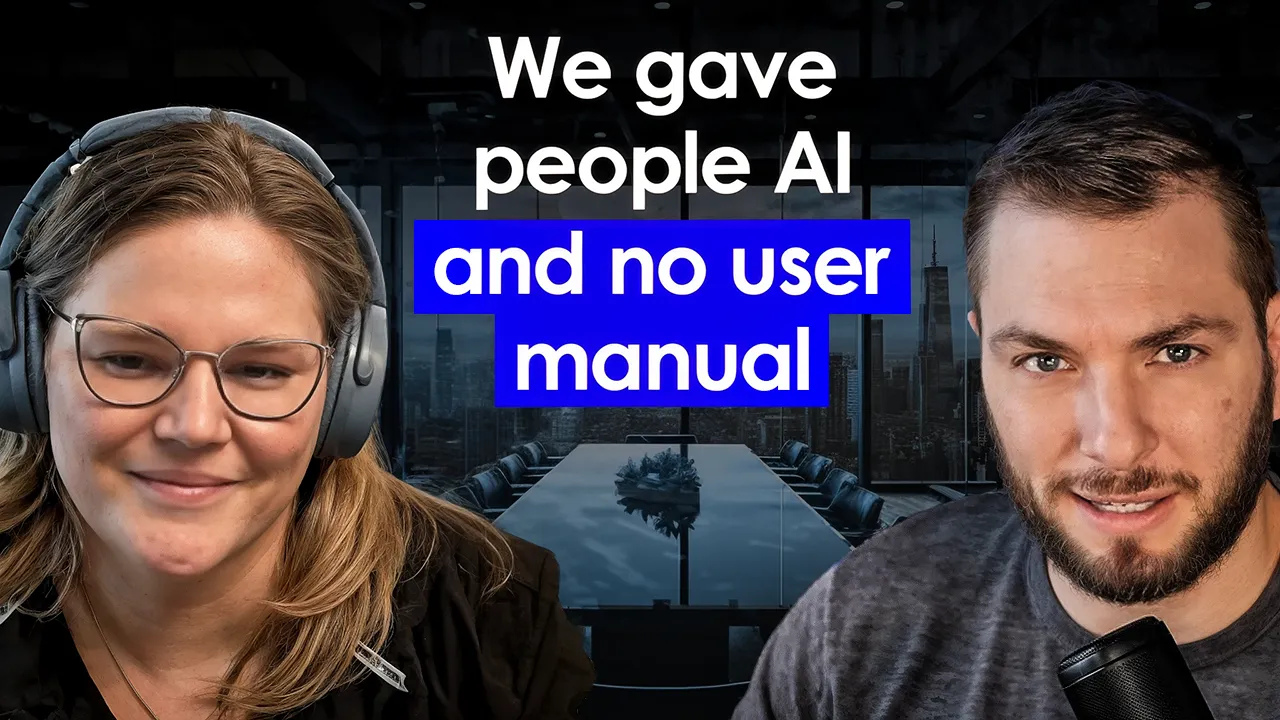
Microsoft's Future of Work Report 2025: What Leaders Need to Know

Jenna Butler · Principal Applied Research Scientist, Microsoft
Share:
Show Notes
What does Microsoft’s latest research say about the future of work? Samuel sits down with Dr. Jenna Butler, Principal Applied Research Scientist at Microsoft, to unpack the Future of Work Report 2025 and what every leader needs to know.
Jenna reveals the productivity pressure paradox, the growing AI literacy gap, and the fundamental shift from content creation to content evaluation that is reshaping how organizations operate.
Key Takeaways
- What Microsoft’s Future of Work Report 2025 reveals about AI adoption
- The productivity pressure paradox: why doing more isn’t always doing better
- AI literacy gaps across organizations and how to bridge them
- The shift from content creation to content evaluation
- What leaders need to prioritize to stay ahead of the work transformation curve
Resources
Microsoft ResearchFuture of WorkAI LiteracyProductivityWork Trend Index
Samuel
Hello, Jenna, and welcome. Thanks for being here. I've been looking forward to this one. Jenna, you're a principal applied research scientist at Microsoft. Your work is right at the intersection of technology, productivity, well-being, and how AI is changing the way people work. I think you specialize in developers and teams in hybrid and remote environments. You're also one of the editors on the Microsoft New Future of Work Report 2025, which is what we're going to be discussing today.
Jenna
You know.
Samuel
But just before we start, can you please introduce yourself? Tell us a bit more about your background, your path as a scientist?
Jenna
Yeah, absolutely. Thank you so much for having me today. I'm excited to be here and have this fun conversation. To tell you a bit about myself: I originally went to school, my undergrad was bioinformatics, which is basically biology and technology. So I've always enjoyed the intersection of multiple fields. With bioinformatics, I was actually looking at what types of drugs you could combine to halt early cancer. Yeah, it was totally different. It was really interesting. So I did that, but then wanted something different. After graduation, I came to Microsoft as a developer and spent four or five years as a developer. Some people would think that was boring, but it was pretty fun. As I was doing that, I started getting very, I had a lot of curiosity about whether the way we assign bugs was efficient and optimal, and what's the impact on a developer of having this number of open bugs. Obviously, software is a technology, but it's written by humans, often written for humans, and humans have a lot of impact on how it's developed. And of course, the last couple of years, that's been largely about AI.
Samuel
Wow, that's an incredible path and journey. Congratulations. And actually, it's very different from what you, not that different, is it? It's all about technology, but it's not biotechnology, right? It's more technology.
Jenna
Yeah, it's definitely just straight-up technology. But the only reason I did bioinformatics was because I wanted to help people with cancer, and that was my motivation. I realized I'm going to have impact on more people working in tech. So that was my path.
Samuel
You worked on the Future of Work Report 2025. It's been released last year, obviously. So to set the stage, can you tell us what the New Future of Work Report is all about?
Jenna
Yeah. So this is actually our fifth annual New Future of Work Report. I've been an editor or an author every year. And each year we're capturing what we're seeing as a major shift in how work is being done. And then it just sort of happened that there was another monumental shift in how we worked, which is the introduction of generative AI. And we do limit the focus to areas where we have a researcher. So Microsoft Research has labs all over the world.
Samuel
And you just mentioned it, there are 50 authors to this report. So it's very extensive. I read through it and it's very, very thorough.
Jenna
Yes.
Samuel
And is this already a real gap inside organizations today, or more of a warning sign for what's coming?
Jenna
Yeah, I think you're right. AI literacy is sort of woven throughout the report. We talk about how education is critical. People need to understand how these tools work, what they can do, what they can't do, so they don't overutilize it. They might underutilize it. They could even have some dangerous outcomes for not using it correctly. But just having a basic understanding, I think, will really help people use them in the most productive, effective way.
Samuel
And where do you think there's the biggest gap of knowledge around those tools? What don't people know?
Jenna
Yeah, well, I'm always surprised when people don't know that they can make things up. So we call it hallucinating, which is a funny term. But essentially what's happening is the model is trained on patterns. They know, hey, when I see this sequence of words, the next most likely word is this. And then they can keep building from there. It doesn't know about anything. It's a probabilistic model, right? It's just giving you some probabilities. And so I think it's the best at helping you brainstorm, or where there isn't a single right answer on the internet that I'm trying to find. I'm more brainstorming or looking for creative options.
Samuel
Yeah. So I like the fact that you said it doesn't know something. It's guessing, basically.
Jenna
And it doesn't know what it doesn't know. People think it's withholding information or it's not admitting that it doesn't know. But it actually just doesn't know.
Samuel
I think it sounds so much like a human being that we tend to anthropomorphize them. And I said them, so it's it, but...
Jenna
Absolutely, yes, we love that. Exactly. Well, it's hard because the builders of these things, the engineering they put on top of the models is anthropomorphizing them.
Samuel
Even myself, I mean, I'm working daily with those tools, having a podcast on AI, and I'm still sometimes forgetting that the machine, it doesn't know me, and it doesn't care about me.
Jenna
Yeah. Yeah. Yeah. I read a great Substack recently about this. One of the top researchers in AI was working on a paper about how our cognitive biases affect our relationship with AI, and he got totally sucked into something totally made up about AI when he was reading how to repair a hat. And it told him that you could use a hammer to repair it, which is just totally false. So yeah, it's something that everyone is susceptible to because of the way our brains have been trained. So I think it's really important that we're thinking about this.
Samuel
Really good point. And if you had to define what's the minimum viable AI literacy for a non-technical employee in 2026, because we're in 2026 now, what would that be?
Jenna
Yeah. Yeah. Yeah. Yeah.
Samuel
The outputs, and get value on a day-to-day basis.
Jenna
Yeah. So when I teach non-technical people about these, I think first they should understand the pattern matching. And that means the model is trained on a bunch of data. It sees patterns. And it's saying, what's the most likely next word? Yeah, weekend. That's the most likely next word to come out of my mouth because it's a Monday, and we've seen this pattern a hundred times. And so they have a lot of biases that humans have, and that's not always obvious or clear. So we can't assume that we're getting unbiased information from them.
Samuel
That's interesting. I had another episode with the CEO and founder of Emprisa.AI, and she was mentioning how LLMs are biased because of the data they were trained on, and the training data was about a man. That's right. Yeah.
Jenna
Yeah. Right. And when you're biased towards a language, that's not just a problem for people who don't speak the language, but it's a problem for representation. Cultural ideas would say, yeah, super red flag, but in totally different parts of the world that would be considered completely normal.
Samuel
Switching gears a bit, in the report, you frame the shift that we're living right now as moving from creation to evaluation. Can you unpack that in practical terms? Like, what does it look like in someone's workflow when their job shifts from producing to evaluating?
Jenna
Yeah, absolutely. So I think we've all faced the blank page problem, where maybe we have a report we have to write or we have to create some documents. I have a few ideas. I think I want to go in this direction. Write me something, and it'll write the report. And then my job changes to, does this reflect what I want to reflect? Does it match my style? Does it reflect what I want it to reflect? And so I'm looking more at evaluating the output of something else's creation rather than creating from scratch.
Samuel
I think when, at first, LLMs became widespread, like two and a half, three years ago, people were feeling that it was cheating. How do you see it now from your perspective?
Jenna
Haha. I'm in such a bubble, because if I didn't use AI in one of my days at work, I think I would feel like, what have I been doing? But I was talking to some high school students, and they said, well, our other teachers told us not to touch it with a ten-foot pole. Maybe that's cheating, but you'll probably also look kind of like an idiot, right? You're still responsible for your work. And so they're using them in ways that are just another tool at their disposal as opposed to a shortcut.
Samuel
And I think it's creating a tension between jobs are changing and the reality that some roles are completely changing. How do you all hold these truths at once without minimizing the disruption people are feeling right now?
Jenna
I think this is such a critical question right now. And as a builder of technology, but also a consumer of technology, I feel the tension. And so I do see how work is drastically changing and some work may not have to exist for very much longer. And I think that's fair. So it's true, every major technology shift did create more jobs than it removed, but there was a long period of instability. What am I, as a consumer, willing to give it, willing to pay for, not willing to pay for? Those will all impact what the builders choose to build.
Samuel
Yeah, and even next month, ask me.
Jenna
Oh yeah. Yeah. I'm hiring some PhD interns this summer to work for us, and someone asked, oh, what are they going to work on? And I said, honestly, I don't know. We're going to figure it out together.
Samuel
And you described it as a socio-technical shift. Now, who's responsible for shaping this shift?
Jenna
Yeah.
Samuel
Let's say at the organization level, I don't want to talk about government or agency, but who's responsible in an organization for shaping the future of work?
Jenna
That's a great question. I think there's sort of two ways about it. So there's bottom-up and top-down. The bottom-up is the employees who are influencing how these tools operate inside your workforce, whether they operate in secrecy, whether the results are transparent, how they're using it. And the top-down is leadership, who decide how it's rolled out, and how people use it in turn informs how it's rolled out and how people use it. It's sort of this weird cycle. In which case, how much longer would you have needed to employ me anyway, right? So there's going to be some HR policies we need to think about. And there's going to be rules about, does something run locally, living locally, but it doesn't go to the cloud? So there's going to be some rules there that are going to need to happen.
Samuel
Interesting, this concept of having a digital twin or a digital AI of ourselves. And this is what it is at the end of the day, right?
Jenna
Yeah. Yeah. Yeah. There's a quote in software that says software companies don't ship code; they ship people, or they ship org charts. And so essentially what you're doing is encoding my patterns and my approach and my extra information that's just sort of floating in my head, and that's a really different world. So that'll be interesting to see how that plays out.
Samuel
A big change in paradigm and the way we're building businesses.
Jenna
Absolutely. Yeah, definitely.
Samuel
The report also argues that the future of work isn't predetermined, right? It's shaped by decisions leaders will make now, decisions about which tools to use, how to use them, and who gets to use them, for the future. What do you think are the most critical decisions?
Jenna
I don't know about what decisions or choices are most important. I think that some skills are very important. So I would advocate for teaching people about these tools and what we do from creation to evaluation or from mostly typing to maybe voice input, like however it's going to evolve. But if a leader says, hey, you can be ten times more productive, so go be more productive, and they think, I don't know what to do with this tool. I don't know how to be productive with it. So leaders need to not just give people tools, but also think about training or coaching so that it can fundamentally shift how they work to be more productive. And so I think choices like that that organizations make are going to be really important.
Samuel
So it's all coming back to experience, learning, and just making those tools your own. I think we're still at that stage where there's a lot of experimentation happening.
Jenna
Yeah. Yeah. Yeah. Yeah. The acceleration is just wild. I feel like every day at work is busier. And I think it's just because my brain is having to adapt to new ways of thinking.
Samuel
If a leader listening takes one idea from the report and acts on it this week, in your opinion, what should it be? Like, what's your number one recommendation?
Jenna
Okay. I think for something concrete, changing their language to be about this chance to learn and experiment would be very important. There's an analogy that I loved from the report where someone learned to drive in a parking lot first. They didn't throw you immediately on the highway and never even showed them what it looked like to get in a car and drive. Like, we release these to individual humans working with them. And I think leaders really need to communicate, hey, we're all learning together. The pace of innovation is crazy fast right now. Take some time, experiment. It's okay to be slow at first. And leaders really need to communicate with their team that this is a big shift. We don't have all the answers, but we're going to learn together.
Samuel
I agree this narrative will help, because I feel people are trying stuff, it doesn't work at first try, and then they just go back.
Jenna
Exactly. Right. I don't want to waste any more time. Exactly. And they'll never be able to take advantage of them if that's what they do.
Samuel
That's another very good point. I'm on the field, right? So I'm working with customers, and often I'm being asked, yeah, what should we do? And the answer is so different from what we were asked maybe a year or two ago.
Jenna
Yes. Yep. Exactly, yeah. Mm-hmm.
Samuel
Now in tech, how fast it's going and how everything from designing to delivering those products has changed.
Jenna
Yeah. Mm-hmm. Yeah, I totally agree.
Samuel
Jenna, we're almost at the end of our time together, but I have my two signature questions. First one being, on a personal level, how are you using AI in your day-to-day?
Jenna
Yeah. So one thing I've really enjoyed, and I don't know if this is too broad, but when I'm using a tool at work and it doesn't meet my needs, I spin up Claude and I say, hey, this is the type of work I do. These are the features that the tool doesn't have right now. Can you help me think about this? And actually, often the tool I'm using will have those features, or I'll discover a different way to do it. So that's one thing. And I don't think that that is something that I want to give to a model and ask it, what are the themes? Like, I want to understand the nuance myself. One thing, and I think a more maybe simple or easier-to-get-started space is, I regularly go to an LLM when I'm starting some writing. I'll give it my voice, and I'll ask the LLM questions to prompt back to me so that I can think more deeply and engage more deeply with my work. And I find that really helpful.
Samuel
Really great tips to put in place rapidly if you want to embed that into your workflow. If you're looking at the New Future of Work reports, where do you see the biggest opportunities for people?
Jenna
Yeah.
Samuel
The Future of Work reports started at the beginning of the pandemic. It wasn't about AI at all at that time. How do you foresee the next report looking?
Jenna
You know, I knew you were going to ask me this, and I still do not have a great answer because I just do not think that anyone can predict the future. One thing that I am pretty certain about is that humans are very resilient. So I think it's easy to get stuck in some fears of like, everything's going to change and we're all doomed. But we're not. And I don't like that as a simple answer. So when technology leaders are like, don't worry about job replacement because we'll create new jobs, that's not the full story. It's easier to say in technology, people often think that these new technologies will remove toil, and usually they just shift toil. They might remove one type of toil. It really shifts to something new. So we like to think AI will get rid of all of the boring parts of work we don't like, but the reality is it shifts toil. And the exciting thing is that new technologies also allow for the discovery of new things. They allow papers to be written and shared faster, people to get access to data quicker.
Samuel
I think nobody does, but I really like your take on it. We're almost only talking about LLMs, but the truth is AI as a whole has evolved massively.
Jenna
Yeah, it'd be amazing. Yeah. Yeah. Yeah, like that's the New Future of Work Report moving from the pandemic to AI is not really three different shifts. Like that was really driven by the pandemic, the massive document on the vaccine. So there were doctors all over the world who had to access the same document, but with different languages and different backgrounds. So we actually have more equitable access to information in a way, to a degree a continuation of what happened during that time. And so we have these new vaccines now, the RNA vaccines that we wouldn't have had otherwise.
Samuel
I hope as well. I'll do a follow-up in 10 years to tell you if you're right.
Jenna
Yeah, we'll see.
Samuel
Jenna, thank you so much for your time today. This was a very valuable conversation. Thanks so much for making the time for us.
Jenna
Yeah, thank you again for having me. Thanks.
Samuel
Have a great day. And that's a wrap.
Hello, Jenna, and welcome. Thanks for being here. I've been looking forward to this one. Jenna, you're a principal applied research scientist at Microsoft. Your work is right at the intersection of technology, productivity, well-being, and how AI is changing the way people work. I think you specialize in developers and teams in hybrid and remote environments. You're also one of the editors on the Microsoft New Future of Work Report 2025, which is what we're going to be discussing today.
Jenna
You know.
Samuel
But just before we start, can you please introduce yourself? Tell us a bit more about your background, your path as a scientist?
Jenna
Yeah, absolutely. Thank you so much for having me today. I'm excited to be here and have this fun conversation. To tell you a bit about myself: I originally went to school, my undergrad was bioinformatics, which is basically biology and technology. So I've always enjoyed the intersection of multiple fields. With bioinformatics, I was actually looking at what types of drugs you could combine to halt early cancer. Yeah, it was totally different. It was really interesting. So I did that, but then wanted something different. After graduation, I came to Microsoft as a developer and spent four or five years as a developer. Some people would think that was boring, but it was pretty fun. As I was doing that, I started getting very, I had a lot of curiosity about whether the way we assign bugs was efficient and optimal, and what's the impact on a developer of having this number of open bugs. Obviously, software is a technology, but it's written by humans, often written for humans, and humans have a lot of impact on how it's developed. And of course, the last couple of years, that's been largely about AI.
Samuel
Wow, that's an incredible path and journey. Congratulations. And actually, it's very different from what you, not that different, is it? It's all about technology, but it's not biotechnology, right? It's more technology.
Jenna
Yeah, it's definitely just straight-up technology. But the only reason I did bioinformatics was because I wanted to help people with cancer, and that was my motivation. I realized I'm going to have impact on more people working in tech. So that was my path.
Samuel
You worked on the Future of Work Report 2025. It's been released last year, obviously. So to set the stage, can you tell us what the New Future of Work Report is all about?
Jenna
Yeah. So this is actually our fifth annual New Future of Work Report. I've been an editor or an author every year. And each year we're capturing what we're seeing as a major shift in how work is being done. And then it just sort of happened that there was another monumental shift in how we worked, which is the introduction of generative AI. And we do limit the focus to areas where we have a researcher. So Microsoft Research has labs all over the world.
Samuel
And you just mentioned it, there are 50 authors to this report. So it's very extensive. I read through it and it's very, very thorough.
Jenna
Yes.
Samuel
And is this already a real gap inside organizations today, or more of a warning sign for what's coming?
Jenna
Yeah, I think you're right. AI literacy is sort of woven throughout the report. We talk about how education is critical. People need to understand how these tools work, what they can do, what they can't do, so they don't overutilize it. They might underutilize it. They could even have some dangerous outcomes for not using it correctly. But just having a basic understanding, I think, will really help people use them in the most productive, effective way.
Samuel
And where do you think there's the biggest gap of knowledge around those tools? What don't people know?
Jenna
Yeah, well, I'm always surprised when people don't know that they can make things up. So we call it hallucinating, which is a funny term. But essentially what's happening is the model is trained on patterns. They know, hey, when I see this sequence of words, the next most likely word is this. And then they can keep building from there. It doesn't know about anything. It's a probabilistic model, right? It's just giving you some probabilities. And so I think it's the best at helping you brainstorm, or where there isn't a single right answer on the internet that I'm trying to find. I'm more brainstorming or looking for creative options.
Samuel
Yeah. So I like the fact that you said it doesn't know something. It's guessing, basically.
Jenna
And it doesn't know what it doesn't know. People think it's withholding information or it's not admitting that it doesn't know. But it actually just doesn't know.
Samuel
I think it sounds so much like a human being that we tend to anthropomorphize them. And I said them, so it's it, but...
Jenna
Absolutely, yes, we love that. Exactly. Well, it's hard because the builders of these things, the engineering they put on top of the models is anthropomorphizing them.
Samuel
Even myself, I mean, I'm working daily with those tools, having a podcast on AI, and I'm still sometimes forgetting that the machine, it doesn't know me, and it doesn't care about me.
Jenna
Yeah. Yeah. Yeah. I read a great Substack recently about this. One of the top researchers in AI was working on a paper about how our cognitive biases affect our relationship with AI, and he got totally sucked into something totally made up about AI when he was reading how to repair a hat. And it told him that you could use a hammer to repair it, which is just totally false. So yeah, it's something that everyone is susceptible to because of the way our brains have been trained. So I think it's really important that we're thinking about this.
Samuel
Really good point. And if you had to define what's the minimum viable AI literacy for a non-technical employee in 2026, because we're in 2026 now, what would that be?
Jenna
Yeah. Yeah. Yeah. Yeah.
Samuel
The outputs, and get value on a day-to-day basis.
Jenna
Yeah. So when I teach non-technical people about these, I think first they should understand the pattern matching. And that means the model is trained on a bunch of data. It sees patterns. And it's saying, what's the most likely next word? Yeah, weekend. That's the most likely next word to come out of my mouth because it's a Monday, and we've seen this pattern a hundred times. And so they have a lot of biases that humans have, and that's not always obvious or clear. So we can't assume that we're getting unbiased information from them.
Samuel
That's interesting. I had another episode with the CEO and founder of Emprisa.AI, and she was mentioning how LLMs are biased because of the data they were trained on, and the training data was about a man. That's right. Yeah.
Jenna
Yeah. Right. And when you're biased towards a language, that's not just a problem for people who don't speak the language, but it's a problem for representation. Cultural ideas would say, yeah, super red flag, but in totally different parts of the world that would be considered completely normal.
Samuel
Switching gears a bit, in the report, you frame the shift that we're living right now as moving from creation to evaluation. Can you unpack that in practical terms? Like, what does it look like in someone's workflow when their job shifts from producing to evaluating?
Jenna
Yeah, absolutely. So I think we've all faced the blank page problem, where maybe we have a report we have to write or we have to create some documents. I have a few ideas. I think I want to go in this direction. Write me something, and it'll write the report. And then my job changes to, does this reflect what I want to reflect? Does it match my style? Does it reflect what I want it to reflect? And so I'm looking more at evaluating the output of something else's creation rather than creating from scratch.
Samuel
I think when, at first, LLMs became widespread, like two and a half, three years ago, people were feeling that it was cheating. How do you see it now from your perspective?
Jenna
Haha. I'm in such a bubble, because if I didn't use AI in one of my days at work, I think I would feel like, what have I been doing? But I was talking to some high school students, and they said, well, our other teachers told us not to touch it with a ten-foot pole. Maybe that's cheating, but you'll probably also look kind of like an idiot, right? You're still responsible for your work. And so they're using them in ways that are just another tool at their disposal as opposed to a shortcut.
Samuel
And I think it's creating a tension between jobs are changing and the reality that some roles are completely changing. How do you all hold these truths at once without minimizing the disruption people are feeling right now?
Jenna
I think this is such a critical question right now. And as a builder of technology, but also a consumer of technology, I feel the tension. And so I do see how work is drastically changing and some work may not have to exist for very much longer. And I think that's fair. So it's true, every major technology shift did create more jobs than it removed, but there was a long period of instability. What am I, as a consumer, willing to give it, willing to pay for, not willing to pay for? Those will all impact what the builders choose to build.
Samuel
Yeah, and even next month, ask me.
Jenna
Oh yeah. Yeah. I'm hiring some PhD interns this summer to work for us, and someone asked, oh, what are they going to work on? And I said, honestly, I don't know. We're going to figure it out together.
Samuel
And you described it as a socio-technical shift. Now, who's responsible for shaping this shift?
Jenna
Yeah.
Samuel
Let's say at the organization level, I don't want to talk about government or agency, but who's responsible in an organization for shaping the future of work?
Jenna
That's a great question. I think there's sort of two ways about it. So there's bottom-up and top-down. The bottom-up is the employees who are influencing how these tools operate inside your workforce, whether they operate in secrecy, whether the results are transparent, how they're using it. And the top-down is leadership, who decide how it's rolled out, and how people use it in turn informs how it's rolled out and how people use it. It's sort of this weird cycle. In which case, how much longer would you have needed to employ me anyway, right? So there's going to be some HR policies we need to think about. And there's going to be rules about, does something run locally, living locally, but it doesn't go to the cloud? So there's going to be some rules there that are going to need to happen.
Samuel
Interesting, this concept of having a digital twin or a digital AI of ourselves. And this is what it is at the end of the day, right?
Jenna
Yeah. Yeah. Yeah. There's a quote in software that says software companies don't ship code; they ship people, or they ship org charts. And so essentially what you're doing is encoding my patterns and my approach and my extra information that's just sort of floating in my head, and that's a really different world. So that'll be interesting to see how that plays out.
Samuel
A big change in paradigm and the way we're building businesses.
Jenna
Absolutely. Yeah, definitely.
Samuel
The report also argues that the future of work isn't predetermined, right? It's shaped by decisions leaders will make now, decisions about which tools to use, how to use them, and who gets to use them, for the future. What do you think are the most critical decisions?
Jenna
I don't know about what decisions or choices are most important. I think that some skills are very important. So I would advocate for teaching people about these tools and what we do from creation to evaluation or from mostly typing to maybe voice input, like however it's going to evolve. But if a leader says, hey, you can be ten times more productive, so go be more productive, and they think, I don't know what to do with this tool. I don't know how to be productive with it. So leaders need to not just give people tools, but also think about training or coaching so that it can fundamentally shift how they work to be more productive. And so I think choices like that that organizations make are going to be really important.
Samuel
So it's all coming back to experience, learning, and just making those tools your own. I think we're still at that stage where there's a lot of experimentation happening.
Jenna
Yeah. Yeah. Yeah. Yeah. The acceleration is just wild. I feel like every day at work is busier. And I think it's just because my brain is having to adapt to new ways of thinking.
Samuel
If a leader listening takes one idea from the report and acts on it this week, in your opinion, what should it be? Like, what's your number one recommendation?
Jenna
Okay. I think for something concrete, changing their language to be about this chance to learn and experiment would be very important. There's an analogy that I loved from the report where someone learned to drive in a parking lot first. They didn't throw you immediately on the highway and never even showed them what it looked like to get in a car and drive. Like, we release these to individual humans working with them. And I think leaders really need to communicate, hey, we're all learning together. The pace of innovation is crazy fast right now. Take some time, experiment. It's okay to be slow at first. And leaders really need to communicate with their team that this is a big shift. We don't have all the answers, but we're going to learn together.
Samuel
I agree this narrative will help, because I feel people are trying stuff, it doesn't work at first try, and then they just go back.
Jenna
Exactly. Right. I don't want to waste any more time. Exactly. And they'll never be able to take advantage of them if that's what they do.
Samuel
That's another very good point. I'm on the field, right? So I'm working with customers, and often I'm being asked, yeah, what should we do? And the answer is so different from what we were asked maybe a year or two ago.
Jenna
Yes. Yep. Exactly, yeah. Mm-hmm.
Samuel
Now in tech, how fast it's going and how everything from designing to delivering those products has changed.
Jenna
Yeah. Mm-hmm. Yeah, I totally agree.
Samuel
Jenna, we're almost at the end of our time together, but I have my two signature questions. First one being, on a personal level, how are you using AI in your day-to-day?
Jenna
Yeah. So one thing I've really enjoyed, and I don't know if this is too broad, but when I'm using a tool at work and it doesn't meet my needs, I spin up Claude and I say, hey, this is the type of work I do. These are the features that the tool doesn't have right now. Can you help me think about this? And actually, often the tool I'm using will have those features, or I'll discover a different way to do it. So that's one thing. And I don't think that that is something that I want to give to a model and ask it, what are the themes? Like, I want to understand the nuance myself. One thing, and I think a more maybe simple or easier-to-get-started space is, I regularly go to an LLM when I'm starting some writing. I'll give it my voice, and I'll ask the LLM questions to prompt back to me so that I can think more deeply and engage more deeply with my work. And I find that really helpful.
Samuel
Really great tips to put in place rapidly if you want to embed that into your workflow. If you're looking at the New Future of Work reports, where do you see the biggest opportunities for people?
Jenna
Yeah.
Samuel
The Future of Work reports started at the beginning of the pandemic. It wasn't about AI at all at that time. How do you foresee the next report looking?
Jenna
You know, I knew you were going to ask me this, and I still do not have a great answer because I just do not think that anyone can predict the future. One thing that I am pretty certain about is that humans are very resilient. So I think it's easy to get stuck in some fears of like, everything's going to change and we're all doomed. But we're not. And I don't like that as a simple answer. So when technology leaders are like, don't worry about job replacement because we'll create new jobs, that's not the full story. It's easier to say in technology, people often think that these new technologies will remove toil, and usually they just shift toil. They might remove one type of toil. It really shifts to something new. So we like to think AI will get rid of all of the boring parts of work we don't like, but the reality is it shifts toil. And the exciting thing is that new technologies also allow for the discovery of new things. They allow papers to be written and shared faster, people to get access to data quicker.
Samuel
I think nobody does, but I really like your take on it. We're almost only talking about LLMs, but the truth is AI as a whole has evolved massively.
Jenna
Yeah, it'd be amazing. Yeah. Yeah. Yeah, like that's the New Future of Work Report moving from the pandemic to AI is not really three different shifts. Like that was really driven by the pandemic, the massive document on the vaccine. So there were doctors all over the world who had to access the same document, but with different languages and different backgrounds. So we actually have more equitable access to information in a way, to a degree a continuation of what happened during that time. And so we have these new vaccines now, the RNA vaccines that we wouldn't have had otherwise.
Samuel
I hope as well. I'll do a follow-up in 10 years to tell you if you're right.
Jenna
Yeah, we'll see.
Samuel
Jenna, thank you so much for your time today. This was a very valuable conversation. Thanks so much for making the time for us.
Jenna
Yeah, thank you again for having me. Thanks.
Samuel
Have a great day. And that's a wrap.
Related Episodes
You might also enjoy
Stay in the Loop
Never miss an episode.
Get new episodes and AI insights delivered to your inbox.