Episode 21
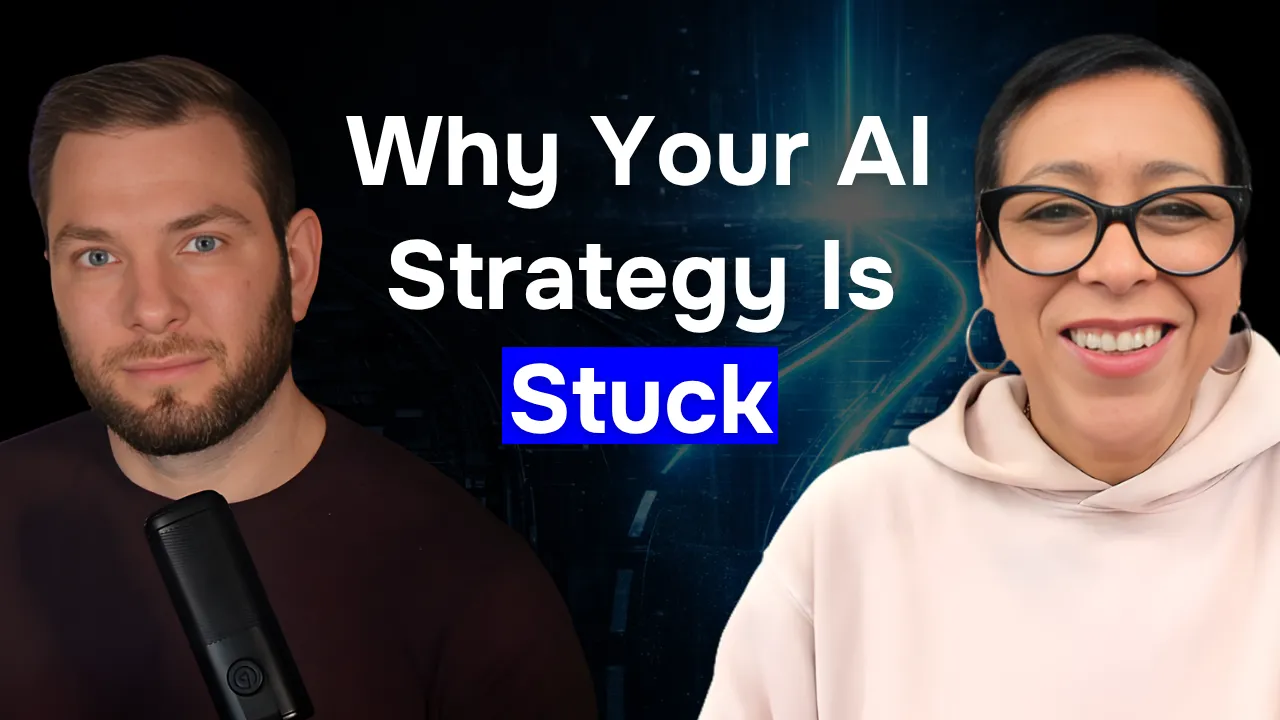
The Hard Truth About Your AI Strategy | Pam Maynard, Microsoft Chief Transformation AI Officer

Show Notes
AI strategy stuck in pilot purgatory? In this episode of The AI Frontier Playbook, I sit down with Pam Maynard, Microsoft’s first ever Chief AI Transformation Officer, on artificial intelligence adoption, organizational change, leadership, automation, and the future of work.
Pam led Avanade as CEO across 60,000 employees before taking on this pioneering role at Microsoft. We unpack the four-layer metrics framework that prevents pilot purgatory, the Manulife $1 billion AI value example, why middle managers decide whether AI adoption sticks, and the McKinsey research showing companies with AI led from the top perform 3x higher than those without.
A big thank you to ITI for sponsoring this episode. ITI is a proudly Canadian company that has spent over 30 years helping organizations bring their IT projects to life by making technology accessible, meaningful, and human.
Whether you are a C-suite leader trying to scale AI across your enterprise or a manager closing the adoption gap on the ground, this episode delivers a practical framework you can put into action this quarter.
Key Takeaways
- Why a clear North Star and bold ambition from the top is what separates scaling from pilot purgatory
- The four-layer metrics framework: usage, throughput, output, and outcome
- How Manulife’s CEO turned a $1 billion AI value declaration into cascading ownership across business lines
- Why middle managers are the most critical layer for sustained AI adoption
- The tell-teach-show-guide change framework for enterprise AI rollout
- How to build a responsible AI council that enables innovation without stifling it
- McKinsey research: companies with AI led visibly from the top perform 3x higher
- Why treating AI transformation like a cloud migration will cause you to fall behind
Resources
Hello, Pam. Thank you so much for joining me on the AI Frontier Playbook podcast. I'm really truly honored to have you on the show. You are Microsoft's first ever Chief AI Transformation Officer. You are also an Officer of the Order of the British Empire, OBE, awarded by King Charles III for services to businesses and technology. You were named Black British Businessperson of the Year in 2024, and you spent five years as a CEO of Avanade, leading 60,000 people to one of the biggest technology shifts in a generation. And what I find remarkable is that none of this was a straight line. So can you please start by walking us through your journey and how you ended up in this pioneering role at Microsoft?
Pam Maynard
Yeah, thank you. Thank you for such a wonderful introduction and thank you for having me here on your show. It's a real privilege, a real honour. And you're absolutely right, my journey wasn't a straight line. I never really, I never knew what I wanted to become. So I wasn't one of those young people or a young child that had a plan. I didn't have a five-year plan. And instead, I took my mom's advice. My mom is one of the greatest mentors to me. And she said to me, you will be offered opportunity and it's going to be up to you to walk through those doors of opportunity when they're open to you. And so as my life unfolded and those opportunities were presented to me, the doors were opened. Maybe sometimes I considered, was it worth stepping through? But more often than not I did, right, which has led me all the way through my career to here. And that mindset of being bold, taking personal risk, and sometimes when those opportunities are really scary, so one of them for me was moving to Seattle. I'd grown up here in the UK, and even though I'd had international roles up to that point, I'd never lived in a different country. So I moved from London to Seattle. I went on my own, I had no family with me, I left all my friends behind. And I went there to lead product and innovation for Avanade after leading the UK business, after leading Europe, Africa and Latin America. And so this was an opportunity for me to do something that was non-P&L oriented and help Avanade to create a new aspect to its operating model. As I say, this product and innovation piece, which, for Microsoft listeners, would be the Avanade version of solution areas, right? That's why I went and came and lived in Seattle. It was a real leap into the unknown. And again, even though I'd visited Seattle as part of business trips, I'd never lived here. Right. And so that was a real change for me. And in fact, I heard somebody say this recently, that when you take those opportunities to go and live in different cultures, in different countries, it kind of accelerates your personal growth. Really, that leap into the unknown was one of those which absolutely helped prepare me to be CEO. And I still absolutely believe that ultimately, because it put me on the track to be CEO, it's also led me to this, as you say, pioneering role at Microsoft. And so every twist and turn in my journey actually helped me to grow, whether it's navigating new markets, navigating new roles, new propositions, building diverse teams. I've done a lot of that in my career. And always adding to my teams, I always look to add talent that I'm going to learn from, people that I aspire to be like, or that inspire me to learn from, and then ensuring that I'm empowering those people. And I've learned from all of those different moves. And I think all of that has contributed to me, as you say, having the opportunity to undertake this or to take on this pioneering role, which again was a door that was open to me. And I walked through it, Samuel.
Samuel
Honestly, you have the credentials to be the safe choice in any room. So what pushes someone like you to still chase the uncharted path?
Pam Maynard
What pushes me is I'm a learner. I've got a huge amount of curiosity and learning, always looking to seek different experiences, and I think that's what pushes me. I don't like steady state. I suppose I could say I get bored with steady state. And so, and I think that's probably one of the reasons as well that I chose consulting as my career, because in consulting, you're always in different clients, different clients with different problems to solve, maybe different industries. From a technology perspective, one day you might be advising around an ERP or a customer strategy, another time right now I go in and I talk to customers about their agentic strategy or about change and adoption or about how they're going to define ROI. So every single day is different. And that's why I think I chose the services career as well, because it fuels my need for constant change, because I absolutely believe that with that change, you continue to grow.
Samuel
I love it. I think that path clearly shaped how you think about transformation, right? Not as a straight line, as a series of intentional bets. Which brings me to my first question. Being an AI-first leader, as you put it, starts with a company-wide AI strategy and a culture of trust. I know a lot of executives listening have kind of pockets of AI experimentation, but not necessarily a unified strategy yet. So what does it actually take to go from scattered pilots to an enterprise-wide AI priority?
Pam Maynard
Well, that starts at the top. I think it's a constant conversation that I'm having with customers, actually. And also as I look at the journey of enterprises and enterprise leaders that we've come on, because again, if I look back to when I started on the EAP program as the Avanade CEO for Copilot, we were on the EAP. It really was about inspiring the organization to use the technology, and so we, and to, and so that's that whole thousand flowers bloom, and sort of creating that groundswell. But one of the things that was really important back then, and what I talked to customers about time and time again, to answer your question, is to have the North Star. Right? Because if you've got the North Star, if you've got the strategic priority, the why for AI, that's what you need. Because then what you can do is you look at that groundswell of activity. You can then tie it to: is it really taking us to where we want to get to in terms of our why? Right. For those organizations that don't have the why, that's when I see this continued scattered pilot kind of motion. All right? But having the why, clear business goals linked to AI enablement, just helps to tie it all together into one strategic direction. So that for me is really, really important. It also helps to build trust across the organisation because people understand early why AI is important to the company. It means you communicate that with one message. It means then that you can lean into any fears very openly because, again, you can tie why you're doing this as a business to that North Star. It enables you then as well to empower some cross-functional teams to work together to drive AI initiatives together. So AI becomes that team effort linked to the North Star. And I think the other thing as well in terms of this is, you also then can tie in your guardrails. So as you think about your responsible AI, yes, absolutely, you've got to think about that from a privacy, from a trust perspective, transparency perspective. But also as you think about responsible AI, you can think about it in the context of your culture and your values and your North Star as well.
Samuel
Can you give me some examples of the why of the North Star? Like, are we looking at, like, why are we trying to transform our business with AI? It's to improve customer service. It's to improve employee satisfaction. How can an organization define their North Star?
Pam Maynard
So I've worked with, as you know, from my role I'm internally facing, but also has a huge external aspect to it. Some of the customers I've been speaking to, so I'll take the Canadian institution of Manulife, right? The Manulife CEO declared to the market that he was going to find a billion dollars of AI value and create a billion dollars of AI value for Manulife. That was his North Star. Now, I know from speaking to some of the leaders internally within Manulife, what happened was that internally, he said to each of those lines of business leaders, what share of the billion are you going to take? Right? And so the leadership team lined up behind that ambition. And then within those different lines of business, then there were some AI strategies that might be ring-fenced within those businesses. So it might be driving, to use your example, efficiency in operations. Or it may be that as a leadership team, they were looking at driving AI initiatives that would span across those lines of business in order to get to the North Star. But the North Star was a billion dollars of value. I was talking to a customer this week, or preparing for a customer meeting this week, where exactly the same thing. The leader, the top of the organization, has said, this is the Holy Grail at AI. And that's some examples of what I'm seeing. And I'm seeing that very deliberately now. And over the last six months, nine months, I'm really seeing that sea change where organizations, leaders, are coming out and saying, this is why we want AI. And as you say, that billion dollars in terms of value, or that North Star, can also include, and in doing that we want to continue to drive customer satisfaction, we want to continue to drive employee experience, but that comes from achieving that value, which is that North Star.
Samuel
So it's more than only metric-driven. It's defining bold ambition and defining who has the ownership to attain this bold ambition.
Pam Maynard
Yeah, yeah, it's ambition. Yeah, it's exciting. Yeah, it ignites, it catalyzes the organization.
Samuel
It is. You have more than 25 years in tech. You've been through cloud, mobile, digital. You've made the point that AI is fundamentally different because it requires business model change, leadership change, mindset shift, even cultural change, and all of this at once. Can you unpack that? Like, what if a leader treats this like the last wave of digital transformation, taking the cloud, for example?
Pam Maynard
I think it's because, as you've just called out, so much is happening at the same time. And with cloud, it was largely, it fell from conversations I was having and from my own experience, largely like a technology upgrade. What we're experiencing now with AI, and in particular, GenAI, because this is the other thing, everyone's like, oh, AI. We both know, right? Our listeners know AI has been around for a long time. But the sea change that's happened, this shift in terms of the technology industry, it's GenAI at the heart of that. That's what's created this paradigm shift. Yeah, that's what we're seeing, unfolding across every single industry at the same time. So there isn't one single industry that's not talking about AI. Yeah. In past waves, in cloud, be it mobile, you could adopt, I think, new technologies kind of incrementally, layering them into existing processes, into existing business models, without having the opportunity to fundamentally rethink how we operate. But AI is different because it's creating that opportunity to fundamentally reinvent, reimagine, enhance what we do and redefine it. It's not looking just at what you take to your customers. It's also looking at how work is done. Who does the work? You point out as well. And therefore, what culture do you need to bring into the organization to achieve the real potential with AI? So all of these different things are happening at once. I believe to really capture that opportunity, it does require a shift in business model. It does require company-wide reinvention of products or processes, of leadership. And also fundamental to that as well, one of those culture shifts is about this continuous learning, and preparing people to work alongside intelligent systems, and getting comfortable with that, and getting comfortable with delegating to those intelligent systems. And then I think the other thing is the pace, the breadth, as we've talked about. There's a lot to cope with in terms of the wave, that's not just about a wave that you're riding, it's absolutely a complete sea change opportunity to lead. All right, so that's a lot in terms of answering your questions. I'm certainly, I'm certain you want to go a bit deeper on some of those points, but yeah, everything's happening at once, right? And it's creating that opportunity of a complete business model change in ways that I don't, we didn't see and experience with some of those previous technology shifts.
Samuel
Yeah, that's what I see from the field as well. People want to do the old processes, but just applying AI to it without reinventing themselves or rethinking the whole process. And I'm seeing a lot of friction and resistance. What are you seeing from the C-suite level, actually? How do you get past it? Because from a lot of conversations I've had myself, I see a lot of resistance in reinventing themselves.
Pam Maynard
I think, and again, when I look at what's happening and I look at where we get some of these pockets of resistance and where we're not, we get pockets of resistance when people feel threatened and they don't really understand how the AI can help them to do even more and be even more relevant to their customers. Yeah, in terms of the field, as you point out, what we've been doing in some parts of the business where we've run peer-to-peer, small huddle, seller to seller, say eight to 10 sellers together, sharing their experiences with AI, that's actually helping us to overcome that resistance because they're learning from one another, actually seeing how the technology in their flow of work can actually help them, can really help them to have more time in front of customer, have more focus time, reduce the admin. And so when we've broken it down and got very close to helping sellers to understand, well, this technology, you shouldn't see as a threat, this technology is there to help you, to enable you to do more, ultimately achieve your sales goals. That's how we've been able to overcome the resistance. But we've seen the resistance is because that why is not being understood. Now, what's been good with the Microsoft technology is we've been able to look at the key input metric, which is usage, and we've been able to spot where usage is higher and where usage is lower, and being able to go in and have a look at where the usage is lower, and actually understand why that is. And sometimes it's just because, and again, if you think about, in our organisation, we have so much opportunity to use all of these different AI tools that are constantly being switched on in our tenant. Sometimes we just don't know which tools to use for what, right? And sometimes, so that low usage is sometimes because of resistance, it's people just don't know how. And in a way, that uncertainty, yeah, it creates what might be perceived as resistance. But what we've been able to do is help people to see, okay, you've got a customer meeting coming up. Why don't you think about using this AI to help you to prep? Yeah. Now you've finished the meeting, let's transcribe. This is how you might transcribe and automatically update your CRM record, and show them how AI can be used in their flow of work, and which AI. And that's also helping us to break through that perceived resistance. So I think it's people understanding the why, us making it simple for people, which AI to use when, doing that in an environment where people feel safe is all helping us to overcome the resistance that you've just talked about, you've mentioned.
Samuel
Yeah, it's disruptive technology and it changes people's behavior. Like you said, you need to help them define which AI they should use, because there's so many tools and so many ways of using them, people just don't know where to start. And this brings me to my next question. You said be disrupted or be a disrupter. I read that in a news article where you were cited. And at Avanade, you put that into action in a program called Disrupt Avanade, if I'm not mistaken, and it generated over 300 AI ideas in three months. So that's a lot. You've been piloting 13 of them. So for a leader that are listening and want to run a similar exercise, what made this program actually work?
Pam Maynard
Okay, so this was back in that time when we were on the early adopter program and I could see, in terms of the technology industry and the service industry, so Avanade as a global systems integrator, I could see it was going to get disrupted by AI. And I could see as well, when I looked at our software development life cycle and how we were delivering software and how the engineers were starting to use the technology, GenAI technologies, to help in that software development, I could see there was disruption ahead. Just going back to the person I am, in terms of being bold and sort of leaning into opportunity, I also saw it as an opportunity, Sam, right? I thought, rather than sit back and wait for it to be disrupted, let's get on the front foot and learn where might be the opportunities for us to harness this technology to disrupt ourselves so we're learning. And in that way, we can also take those learnings out as part of our services to our customers, but help us to get on the front foot so we can be even more efficient and therefore become even more competitive. And so for me, one of the first things though that we needed to do was establish our responsible AI council. Avanade was full of really, really bright people, full of technologists, but I wanted to make sure the guardrails were there so people felt safe. And we all felt safe in terms of our responsible AI and how we were going to be using the technology. So I just pulled together representatives from HR, from legal, from our IT organization, operations, even finance, and just said, like, okay, right, let's now start to really think about the guardrails, which will still enable innovation, but just to show that we're safe. I then kicked off this company-wide hackathon, so people felt empowered to be able to use the technology. Yeah, and just go for it. And I encouraged them to learn in their teams. All right, and this is the other big learn for me, is having teams. And we talked about it a little bit with the peer-to-peer. So having the marketing team ideate together, and huddle together, the legal team, I remember them coming up with great ideas around legal processes, our finance team. So that's the other thing. Encourage your teams to work together, to huddle together, to learn together. And then it was about surfacing those ideas, so sharing them and celebrating them. Yeah, so celebrating across the business the great innovations. And because we then turned it into a competition, so we could showcase the best team, a bit like how we have, why we call it Frontier Cup now, we had Copilot Cup before, so having a gamification piece to it. All of that sort of inspired that grassroots innovation. Backed by leadership support, people could see I was supporting it, sponsoring it, and those ideas were celebrated. The other thing that was really important was for people to see that the winning ideas were then taken on to be deployed into the organization. So it wasn't just hacking for hacking's sake. These things then became part of our operating model, yeah, in terms of helping us to move forward on that transformation of Avanade.
Samuel
I think getting ideas is one thing, but getting people to actually change how they work is something else entirely. I think there's a real gap between the C-suite excitement around AI and what I see from the field, the frontline hesitation. So one thing that stood out to me is your belief that leaders need to get hands-on with AI themselves and model it for the organization. So beyond leading by example, what's the most effective lever to close that adoption gap and scale?
Pam Maynard
When I think about the change, I think about four things. I think about tell, right? So, as a leader telling the organisation, we've talked about defining the why, the North Star, telling the teams that the leaders have got to get behind this, et cetera. And I think Satya does a great job of that. Judson does a great job of that. I think there is the teach, so getting us access to those skilling assets. And, but we talked about, though, how they need to be packaged in a particular way to show, that's the third thing, people how to use them. And the fourth thing is about guide, right? And guiding people, and keep and persist in guiding people through their journey. And what I mean by that is, we're not yet there in Microsoft, but this is one of my more recent learns, if you like, in terms of change and adoption in this AI world, is how do we harness the manager community, the managers in our organization, to also really be those modelers, those role modelers in this age of AI? And then how do we get them in their teams to continue to inspire and guide their teams forward? I think that is an incredibly important layer. And often, as we've thought in the past about leading transformation and leading organization and change and culture change, we've talked about the importance of that middle management layer. I have never seen it as important as I'm seeing it now in this age of AI and the need to create sustained adoption of this technology. That's what happens, and you'll know this, and I'm certain you're not dissimilar to me as well, is that you see that sometimes you're really in this technology and you're using it all the time, and then your usage drops off, and then you're really, and that's what's happening when we look at our graphs in terms of the usage. We see this up and down. And what we need to make sure, though, is yes, sometimes it will fall off, but it never falls off as much as where we were before. So we see this sustained durable change. And so for me, that guiding piece, the role of the managers, is going to become more and more and more important. And then continuing to do that show piece where we've got the peer-to-peer. Those would be for me the two most important things in helping to close the gap, on top of what you said in terms of leaders' role modelling, but also leaders showing that empathy and being able to get involved when people are getting stuck, to help to continue to nudge people. Hopefully that makes sense.
Samuel
Closing the gap. So first, defining your North Star, guiding people, get managers ownership and getting them to use it and tracking the metrics and tracking adoption. Obviously, at some point, leadership will need to see results, which brings it to the metric tracking. But it brings me to something that I think is a real trap for a lot of organizations right now: pilot purgatory. They run the experiments, they show early promise, then nothing graduates to production. I think lighthouse pilots are clearly central on how you scale AI, like proving value in one area and then expanding. So what metrics matter most when evaluating whether a pilot is worth scaling? And how do you avoid, again, pilot purgatory, where experiments finally never graduate to production?
Pam Maynard
Great question. And then when you mentioned pilot purgatory, I was like, what is that? And then you explained it. Yeah, I know exactly. I think the metrics that matter really do depend on what it is that you're aiming to achieve with the pilot. We have a metric framework which starts with usage, but doesn't stop with usage. But clearly you want to be able to see that the AI is being used, because if it is not being used, there's no way you're going to get to the metric that matters in terms of associated with that AI. The next piece, though, is the throughput metric. All right, so what are the key metrics that are going to be important that show you that AI is actually helping to achieve whatever you're looking for, in terms of, for example, process velocity? It might be deal velocity in our world, or pipeline velocity in our world. With that particular pilot, then, in terms of output, that could be about pipeline and seeing an improvement in close rates, yeah, or win rates. And then the last piece is about outcome. And then for us, that's about revenue per head. And this is one of the things that we've learned, is that you need a framework which starts at usage, but takes you through in terms of, are you actually achieving the throughput in terms of whatever the process transformation is, or the workflow transformation, that you want the AI to help to achieve, is that driving the outputs that are going to take you to the outcome? Right, so that is really important. And then within that, as I say, you structure the metrics that matter. The other piece that's important is, not just that quantitative, it's qualitative. So alongside our quantitative framework that I've just described, we also track qualitative impact through surveys, et cetera, so that we can see if employee sentiment is actually improving, in terms of the employees, the people who are acting in that process or that process change or workflow change, is impacting. Or you might do that in terms of customer sat. So for example, when we did the changes in the contact center, we did that with a very close eye to customer satisfaction to ensure that as we implement more and more AI, we were continuing to see an improvement in customer sat and it wasn't decreasing. For us, as we've looked at more in the sales arena and transforming our sales organization, we're also tracking employee sat for the pilots that we're running today. So that framework, and I think with the qualitative, is an important focus in terms of pilot success and graduating to scaling. Because it informs whether that pilot should be scaled, as you said, then across different lines of business or different geographies, depending on what that changes. The other thing that's really important for me, that I always push people on, it's when they're suggesting a pilot is pushing them to think about the metrics that matter. If you can't define what the metrics are and what the ROI should be of that pilot, even though it's a stake in the ground, you get people to do that thinking early on is really important, because of course then you can test that hypothesis through the pilot. That's another important point for me to ensure that we avoid pilot purgatory, as you say.
Samuel
I see a lot of organizations are tracking mostly usage, but are not tracking the metrics at the business unit level. So that's a very important reframing in how you should track those pilots. Everybody's worried about adoption, but not a lot of people are looking at what impact does it have exactly on the business. If you want to scale, I think scaling well also means scaling responsibly. So something that really resonates with me is this idea that tech is moving too fast for regulation to keep up. So the responsibility kind of falls on leaders. You built Avanade's responsible AI policy from scratch. So for a leader who knows they need a governance framework, but hasn't started yet, what should they put in place first?
Pam Maynard
It's again, a great question. Just reflecting back to the time at Avanade, and you're right, yeah, we built it from scratch. However, because Avanade is a joint venture between Microsoft and Accenture, we could also tap into creating a connection with our joint venture partners, because of course they were starting thinking about that as well, right? That's one of the other things that I would encourage, especially now where we are in terms of the AI era. And I think Satya calls it the middle innings, right? In terms of this AI era. There's so much you can learn from maybe partners or customers about their own journey and about how they have stood up their AI council, their AI steering group. So you don't have to start from scratch now. Right, that's my point. Now we're in a whole different world. I would definitely, we touched on this earlier, think about forming and empowering a group of leaders to be your AI council. It isn't just about the legal team, it isn't just about the tech team, it must include HR. Think about it, it's including operations, we included finance, lines of business as well, really deciding how we'd handle our sensitive data, which tools will be provided for use within the organization so people can understand how to be safe in terms of using AI, and see those guardrails without feeling stifled in terms of innovation. And that's a really important balance to strike, just helping people to learn and understand what that framework means. This is the other thing, because sometimes when you're talking in the organization about this responsible AI policy, it sounds really lofty. So you need to make it real. You need to make it tangible. You need to make it pragmatic at the execution level, in terms of in the organization as well. But now I think there's a real opportunity now for us all to learn from one another versus where I was, six, seven years ago, where we started from scratch. I think those are the ways in which I would say something we could create that governance framework, and get there quickly, and get there in a way which, as I say, creates those guardrails that don't stifle innovation, and just help people to continue to evolve and experiment with AI.
Samuel
So would you say that the ownership falls to every part of the organization, just not only the CTO or CHRO or CIO or whatever? It's like every business unit should be worried and thinking about responsible AI and putting guardrails.
Pam Maynard
Yeah, yeah. I don't think it's about being worried. I think it's about being safe, creating an environment where people feel safe and they feel empowered to ideate and innovate. And so it's like setting up an environment for innovation. Right? How do we create an environment for innovation? And we do that with this framework around responsible use. Yeah, that's how I would look at it.
Samuel
We've said it, it's going very, very fast. And I think right now there's an interesting tension in leadership. On one hand, your teams expect decisiveness. And on the other, AI is moving so fast that even CEOs, or any C-level for that matter, are essentially beginners. And that's what I'm seeing from the field, and that's how I feel. Even if I'm an AI expert, I'm still feeling like a beginner every other week, because it's going so fast. So how do you balance that learning posture with the decisiveness that your organization needs from you?
Pam Maynard
It's really a fantastic question, because only, I think it was yesterday, I think I was contemplating getting really into Cowork, right, because of course it was only released, I think it was like two weeks ago, maybe. I know I got my first look and play with it last week. And, and I was thinking, right, I really need to get into Cowork now and start. But again, as you say, I feel like a beginner again. I don't know. It's something new. And this thing is quite powerful. Right. So I've got to make sure I'm using it in the right way. But I think with that, though, so, for example, last week when the guys were introducing me to Cowork and getting me started on it, I was very humble. Right. So I was like, OK, I really don't understand enough about this technology. Just take me through it. Take me through the do's and don'ts that you've all learned so far. Just having come in at, coming at it as a leader with that balance of humility and clarity around what I know, what I don't know, what I'm still trying to learn, I think people really, really appreciate that. This is a really tough time to be a leader. I remember when, because not long after I became Avanade CEO, we hit COVID. And back then everyone was, this is such a tough time to be a leader. This is another one. Because you do have to have that balance in terms of humility and clarity, in terms of, this is what I know, don't know, et cetera. This is where I'm going to need help. But then at the same time, you say, people are expecting this decisiveness. You've got a number of trade-offs you've got to make around AI. So where do we go fast? Where do we go slower? Right. And sometimes that's about balancing, in terms of maybe your data, your data platform, may not be quite ready for you to be able to pursue those use cases, but your data platform is sorted so you can pursue these use cases. So where you go fast, maybe this place, but you might need to go slower until you've sorted out your data, to be able to really capitalize on the outcomes that you're looking to achieve over here. So those, that sort of trade-off, there's a trade-off of, when the AI is out there and it's delivering results, what do you do with the return? Do you bank it into the P&L? Do you use it to continue to accelerate your AI? There are all these different decisions that leaders are balancing. Yeah. And then, also in terms of how they shift the workforce and that sort of thing. It's a really tough time. I think just being upfront about where you are, what support you need, how you want to be helped, and then staying hands, visibly hands-on, and curious. And I love how Satya does that. I really love that. I think he models that so well. And being involved, yeah, in the journey, so people can see as well that you're in the journey with them. So those are all always, I think, in terms of how to lead, and how we're all leading through this time, as you say, in terms of still being that leader that's making the decisions, but also balancing that with the fact that we're on the journey.
Samuel
An important reframe of what a leader is in 2026 versus how it was the last decades. And I think it connects to the broader question of what separates organizations that get AI transformation right from those that kind of fall behind. You said don't wait for perfection, but put the right guardrails in place from the outset. And that's not advice you've been giving to other leaders. If you could look two years out, what separates the organizations that got AI transformation right from those that fell behind?
Pam Maynard
Can anybody crystal-ball gaze right now? It's like, every month there's something new hitting us in this time of AI. So what do I think? I had the honor of being on a panel with John Chambers, the former CEO of Cisco, a couple of weeks ago. And one of the things he said was, what was going to set the organisations apart as we leapt forward, maybe a year or two years, were the ones that didn't wait to get everything fully defined, versus those that are actually maybe sitting back a little bit and sort of saying, okay, right, we need to sort out our entire data platform. Okay, we need to be really deep and clear on the outcome and the ROI we're pursuing. He said those are gonna fall behind. The ones who are gonna push ahead and will emerge as leaders in this era of AI are the ones who are gonna be taking that considered risk. Okay, we haven't got everything sorted out, but we've got this aspect of our environment sorted out. We're clear on our responsible guardrails, let's go. Let's learn though, in terms of how are we going to monitor this progress, in terms of time boxes? Are we being prepared to fail fast? But they're acting with urgency and purpose, and they're being very clear about it in terms of what they know, what they don't know, what they expect, what the criteria are going to be, almost the criteria for going from exiting experimenting into scaling, what's working, all while managing risk. Some recent McKinsey research also pointed out that those that get going, and get going fast, with AI strategic priority visibly led from the top, our leaders are driving it, are likely to perform 3X higher than those that don't, right? And so, again, I think, and I really do believe we're in that moment right now. It's being clear about what you're doing, being clear about how you're going to track progress, so that at the right time, if things aren't delivering as you want to, you can fail fast, regroup, go again. So that's what I think is really going to set people apart in the next three years.
Samuel
I agree. And it's going fast, so fail fast.
Pam Maynard
Yeah.
Samuel
We've been talking since the beginning of the organizational stakes, but I'd like to zoom in all the way in, because you said something I think is one of the most practical pieces of advice out there, which is simply start using AI yourself. There's never been a more important time, I think. So let's make it personal. What's one thing you actually do every day that makes you more productive with AI?
Pam Maynard
That's brilliant. So I really do use AI as my daily assistant, right, and think about AI as my personal Chief of Staff. Now I've had the opportunity to be included in an experiment with an agent which is a Chief of Staff agent, but nonetheless I was using my AI in that way anyway. And so using AI to do some very simple preparation, summarization, drafting emails for me. But really, it's, yeah, because I live in Europe and I work with a global team, I get the incoming from Seattle overnight. I really use AI to help me to prioritise. What do I need to focus on this week? So if I start on a Sunday afternoon, actually, I use my Chief of Staff agent and I say, OK, what's ahead of me? What do I need to prioritise? And then on a Monday, because things move so fast, I ask it the same question. Are those priorities still the right ones, or do I need to switch? And then I do the same on the Tuesday. And so this Chief of Staff is advising me how to get through my week. That has been almost a game changer for me, because I get so much incoming, right? And just staying on top of the daily changing priorities has been hugely helpful. But it's really myself plus my AI and working together to get my day done.
Samuel
I'm glad your Chief of Staff agent kept this recording on the schedule. Last question. You've described AI as digital talent and virtual Teams members working around the clock to free humans to more complex work. You've also talked about the capacity gap and how burned out today's workforces are. So with that perspective, how do you see it will reshape the way we live and work over the next 10 years?
Pam Maynard
Gosh, so first it's three years, then it's 10. And again, it's really hard in today's climate to look forward for 10 years, but I do really feel that AI will be even more ingrained in terms of how we live, how we work, how we collaborate, how we play in our lives.
Samuel
Yeah, it's incremental.
Pam Maynard
Right, really having those co-workers, those personal assistants, much more confidence in terms of delegating tasks end-to-end to AI, and with the AI coming back when it hits any exception, guard rails, etc. So those virtual team members will be able to work 24 by 7 without the fatigue, right, and as you say, without those kind of capacity constraints. And so, think about this, well, the AI taking on small tasks that sap our time, the interruptions that we may get through emails, helping us to drive more efficiency into how we work in our team, so that there's less meetings, because we'll have AI capabilities which give us the insight we need, which will take the place of having to go to 10 meetings a day, which I would really rather not. And so I think AI will take care of much more of that digital busy work in the background for us, and allowing us to spend time where it matters most for us, in terms of strategy, in terms of customer contact and human contact, and innovation and creativity. So those were some of the things I would say in terms of reshaping work and life.
Samuel
This is totally a world I can live in.
Pam Maynard
Yeah.
Samuel
We're at the end of our time, Pam. It was a real honor to have you on the show. I think this conversation can be used as a framework for AI adoption from leaders listening to us. Thank you so much for your time.
Pam Maynard
Thank you. And as I say, real privilege to be here. I really enjoyed the conversation. So thank you.
Samuel
Yes, well, thanks.
Related Episodes
You might also enjoy
Stay in the Loop
Never miss an episode.
Get new episodes and AI insights delivered to your inbox.