Episode 11
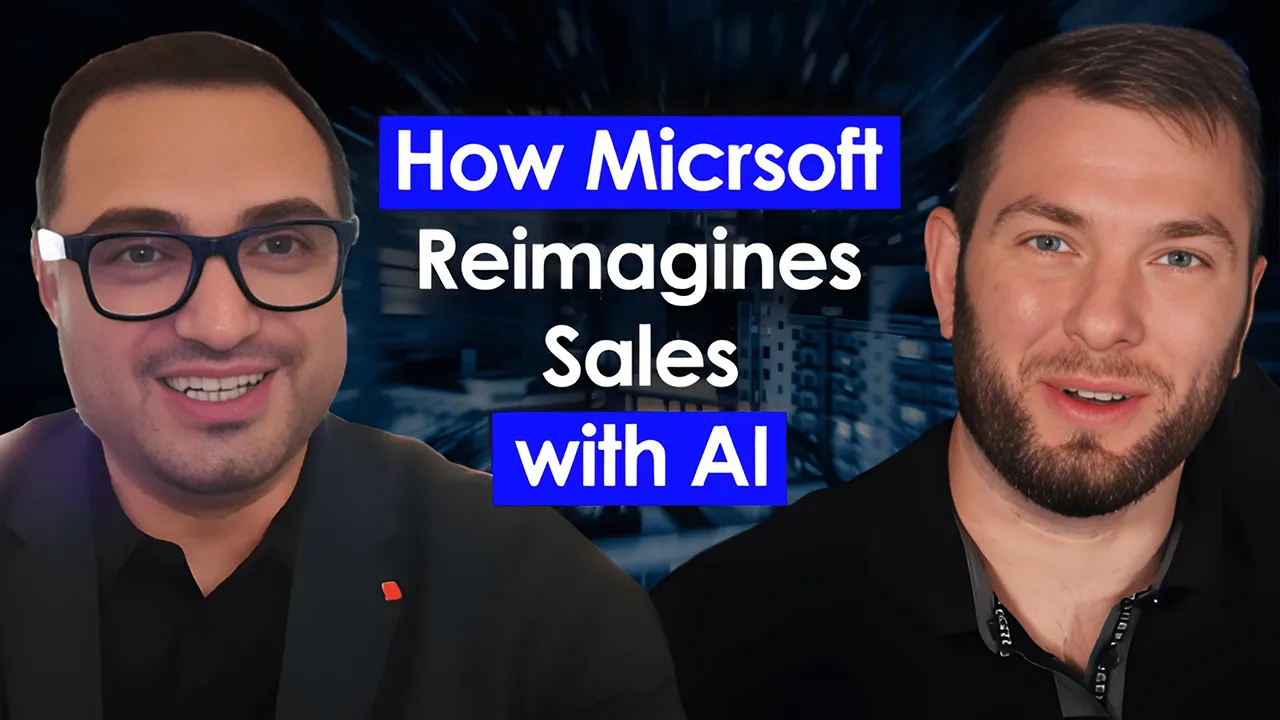
Inside Microsoft Canada: Becoming a Frontier Sales Firm with AI

Show Notes
Everyone’s talking about AI in sales. But what does it actually look like to lead a modern sales organization that runs on it? Ehsan Youssef, Lead of Small and Medium Enterprise & Channel Sales at Microsoft Canada, has spent 20 years helping teams adapt to constant change — and now he’s transforming how his organization sells in the age of AI.
In this episode, Ehsan breaks down what it means to operate as a frontier firm — one that infuses AI into every process, from planning and prospecting to customer engagement. He shares how his team measures the “ROI of time,” how they’re building trust in AI across hundreds of sellers, and why every leader needs to lead by example and use the tools themselves.
Key Takeaways
- What it means to operate as a frontier sales firm and why it’s critical
- How to measure the “ROI of time” instead of just traditional ROI
- The three phases of AI strategy: AI companion, agents behind the companion, people running agents
- Why the biggest barrier to AI adoption is culture, not technology
- Building trust in AI through education, celebration, and hands-on experience
- Real examples: from planning automation to agent-built customer follow-ups
Resources
Hello, Ehsan. Thank you so much for joining us on The AI Frontier Playbook today. Ehsan, you've been at Microsoft for 20 years. You currently are the lead of SME & Channel Canada. Can you please introduce yourself and tell us a bit more about your journey at Microsoft before we start?
Ehsan Youssef
Hey, good day, Samuel. It's great to be here. Thanks for having me. Yeah, my journey — listen, I started off at the company as an engineer, as a field engineer at the time, assigned to some of the biggest banks in Canada. I spent quite a bit of time there for four or five years before I became what I would refer to as overhead management. And I've been in leadership and management at the company for the last 15-plus years. I've got the distinct honour to lead the small and medium enterprise and channel team here in Canada, an incredible team focused on serving our medium enterprise customers coast to coast. I have a distinct vantage point of learning as a student of the company, as the company continues to evolve and how Microsoft wants to be a frontier firm first and foremost. Then also from our customers — we see some of the most innovative, agile customers across Canada doing everything they can to maximise technology so that they can better serve their boards, their stakeholders, their shareholders and so on. It's an incredible moment as well. We've been in Microsoft Canada for 40 years. So practically half that time I've been with the company — it's been quite the journey to see how much it has evolved, and glad to be here.
Samuel
So you're basically running a sales organisation and you just mentioned it, Microsoft being a frontier firm. You're now running a frontier firm sales organisation. So I'll assume that a lot has changed in the past couple of years — two, three years with Copilot coming into play, with, you know, GenAI being part of every business process. I just want to define quickly what a frontier firm is. I had this discussion with Erin Chappell in my latest podcast — she is our CVP of commercial solution areas — and she defined a frontier firm as one that empowers its workforce using AI, reinvents customer engagement using AI, transforms its business processes as well, and bends the innovation curve to accelerate innovation in the company's core domain. That being said, what does it mean to operate as a frontier firm in sales, and why is that so critical — being that frontier firm in today's market?
Ehsan Youssef
I love it. It's a great question. And let me start with the why. At the core, we're seeing quite a bit of change across the industry. The pace of change has never been faster. And at the same time, since really COVID, the pace of work has also quite rapidly evolved. Then as you can imagine, in a world like this, where we're in a pole position when it comes to AI technologies, the expectations of our customers are also sky high. So when you combine a few of these things together, you realise things have to be very different to serve our customers in the right way. So that's where I believe being frontier — which is infusing AI in everything we do — is the only way we can step up to the expectations of the market and our roles, and spend more time where it matters most, which is with our customers. That is a fundamental element of the pillars of success in frontier. One of them is reinventing customer engagement. When I think about that, I think about, you know, what we're doing to make sure that we reduce the burden on our people on things like tracking and other things that are significant to our business, while increasing what I would refer to as customer time, external time.
Samuel
So like you mentioned, things are changing fast. There's more work. Our motto at Microsoft is do more with less. So I think it reflects on that. Customer expectations are higher than they ever were. I think it doesn't only apply to Microsoft — it applies to all industries, whether you're in retail or in manufacturing. Customers are expecting more, and reducing the burden on employees so they can achieve more — again, with less. So how does being a frontier firm shape the way you integrate AI into your sales strategy, your go-to-market, not necessarily just at Microsoft but generally speaking? How do you make sure that AI is part of building that strategy?
Ehsan Youssef
100%. It's a great question, and one that I would always say is anchored on the business strategy of the company. Now let's think about this. You know, at the end of the day, leading a sales organisation, your business outcome and your business promise to the company is around revenue — that's not how we anchor. You know, our AI-infused strategy, the way we think about AI in enabling us to deliver that business outcome, is: what is the leading indicator that will help us get there? And that to us is customer time. If we can do more and more so that our people can spend more time deeply understanding our customers, deeply building relationships, and tailoring the customer experience to what they want to get out of the relationship, I think that's winning. That is essentially success in our eyes. So we do a baseline of customer time. Then from there, as we kind of decide on the highest-impact work that needs to be done from an AI tools and technology strategy, we expect to continuously see this customer time go up while people do the type of work that they love versus doing some of the burdensome work that they might not. So that's at the core. Let me give you this example: the reality is we're not necessarily new to AI in that sense. Obviously, GenAI has been part of our strategy for a couple of years now. Before that, we had AI in the context of machine learning where, as our customers researched our technology and product capabilities, we were then able to have visibility into that when allowed and permitted by the customer. Then from there, we were able to go and engage with them to make sure that we answered their questions and helped them get to the outcome they wanted to achieve, essentially. So that's been there for quite some time, but a lot of human interaction was still needed based on the signals that kept bubbling up. Now you overlay this recommendation engine with GenAI capabilities that streamline the customer engagement in that moment — from the beautifully crafted email message to how to respond with the right set of assets and information. All of that is now available to us to make that process more end-to-end: a great employee experience, coupled with a great customer experience. So that's just one example of how we think about our business strategy and how our AI strategy is anchored to support this — for our people and for our customers.
Samuel
I'll take that example and I think you made an important distinction. When we're talking about AI, a lot of people refer to GenAI, but GenAI is not all of AI — it's one type of AI, right? In machine learning, specifically in sales, you learn from all your past opportunities, you learn from signals from the customer — do they open a document, do they open an email, et cetera. It's a very important part of a sales strategy when it comes to AI. It's not just GenAI. However, personally, as a technical seller, I can tell you that leveraging tools like the Researcher agent, for instance, that do deep research for me, save me a tremendous amount of time. So it comes to your point where you need to align on revenue, on customer time as well. It's really important to use those tools to save time where we don't necessarily bring value. What I mean by that is that as Samuel Boulanger, I'm not bringing that much value in doing deep research, searching everywhere on the website, reading the general report of a customer, while AI can summarise it for me. And then I can do my job, which is being in front of the customer and helping them or explaining how the technology works. This is a really good example. Now, I think the core of what you've explained is that you need to align your strategy to your core mission, right? Which in a sales organisation is bringing revenue. Now, how do you decide where in the sales process AI will create the most value? How do you prioritise it first? I understand it's around revenue generation, but more than that, how do you pinpoint which process you want to address first?
Ehsan Youssef
It's such a powerful question — and, more importantly, there are multiple facets to that question, right? Because we're still part of a large enterprise company. So there are what we call AI COEs within the company that essentially step in when the use case of value for us is more complex and requires access to multiple systems that have various levels of governance and whatnot. Our mandate is to make sure that we are feeding the AI COE, essentially — to look at what is the customer journey we bring customers on and at every step of the way, what is the burden on the employee? May it be like the example you gave around research for the customer before you actually get in front of them? And then make sure that the plumbing is built for something like this. Imagine — for the Researcher agent to do what it does, which is deep reasoning and pulling a lot of different sources for the customer, it also pulls a bunch of sources internally through various systems, including our Dynamics CRM platform and so on. But that plumbing needs to exist for it to do that. So number one, where we see the highest level of friction that is tied to many of our enterprise systems, are we bubbling up those kinds of asks so that it can be built for us? But we don't stand there idly waiting for someone else to build capabilities for us. This is the power of enterprise-led solutions as well as citizen-led solutions. So when you really think about that, this is where, as a leadership team, we've talked through this quite deeply. We think about: how do we make sure our sales force has a mindset around the ROI of time? So whenever there's friction in steps that they have to take, how do they go and feel empowered to go solve it? This is significant. Think about something as simple as — you know — in your role, you're a subject matter expert in modern work, AI workforce, Copilot capabilities. And yet when you have conversations with customers, you know, sometimes you want to be able to follow up with an email and references. So one of the team members kind of realised he did this two to three times a day. And that follow-up — from hanging up with a customer and drafting an email — took him at least half an hour every time: making sure the right links are there and all of that. Then he created a little agent, right, that essentially took in the transcript from the call. Then every subject that was brought up went and got the reference external link and built the email to be sent to the customer. Now that 30-minute post-call task is five minutes, still as effective. Heck, it's even richer than the emails he or she would have sent by themselves. It's thorough and it's all there. That's an example of something that no one will solve in a central body — the front line will know that there are gaps and challenges in the way they do their work. As a result, they're empowered because, you know, you've got the technical competency and so on to go and solve it. That's just an example of how we think about this. But at the core, one of the things we've learned is to really empower that mindset shift required in the sales workforce — and that is the ROI of time.
Samuel
I like it and I like the example you gave. Honestly, I don't know how I was doing it before GenAI, to be sure. Like all the research, all those long emails you have to craft. Now I do have one agent of this kind where I can simply drop the transcript and then it will bring me back the proper resources so I can share with the customer. I know at first when Copilot was released, people were perceiving this as cheating. I did — I got that comment from some customers — but at the end of the day, like I told them, it's still the right sources, right? Whether it's me searching for it or Copilot, I can tell you I'm double-validating everything because you need to double-validate anything coming out of an AI. But still, it's the same sources, yet it didn't take me an hour — it took me five or ten minutes. So it's very, very powerful. You mentioned COE — what does that stand for?
Ehsan Youssef
Absolutely. Absolutely. Centre of excellence.
Samuel
Centre of excellence, okay.
Ehsan Youssef
AI Transformation Office — there are different terms for it — but what we like to anchor on externally, where we see an acceleration in AI value back to the business, is when companies make a distinct investment in that AI centre of excellence for themselves.
Samuel
Good — I think we have resources on the website on the COE4AI, so I'll share the link in the show notes. How do you calculate this ROI of time? I mean, I'm pretty sure it is not a simple formula, but how do you identify that a task might have some ROI on time, and where do you want to apply AI?
Ehsan Youssef
Absolutely. And it just goes back to my comment earlier that the value is not necessarily in just that task, right? Even though a lot of people will have ideas — and, you know, we're running a hackathon right now within the organisation to come up with all the use cases that have the broadest impact for people, so that we can scale that impact as quickly as we can. But the core is not how much time we save per use case that we light up. The outcome is: does this serve at scale? Do organisations then spend more time externally? Then and only then I know that the aggregate of the sums is really what gets us to what we aspire to be.
Samuel
And once you've identified those use cases that you want to apply, how does a frontier firm differ from a traditional sales organisation? Like, what do you do differently today than what you did, let's say, three years ago? What new processes have you decided to redesign? Because I suppose that a lot of the processes need to be fully redesigned, right? It's not just...
Ehsan Youssef
100%.
Samuel
Sprinkling AI magic on top of old processes — you need to rethink them. So how do you do that?
Ehsan Youssef
100%. To be a frontier firm is to think AI-first. And so whenever you've got an opportunity or a business problem and a business process of some kind, the first question you should ask is: how can GenAI help me reimagine this in totality? That has allowed us to reimagine some of our business processes quite effectively. Take planning as an example. Planning means that essentially we want to be more intentional with the right set of customers as we move forward. This process, because of the customer research element, would require hours for our account teams — now we're in this situation where it does not take that enormous amount of time. When the prompts and everything are built, they're scaled and shared with others so that they can use the same methodology to prepare for their plan readouts, and so that they can focus more on strategy than on just building up slide decks with information. So that is just one of the many examples — when you think frontier and you think with an AI-first mindset, you're able to unlock different components. You start by pillars, right? At the end of the day, it's very difficult to kind of completely redo the entire process end-to-end, especially a company of our size, but we know that every process flow has major components to it. In each one of those phases or stages, what are the distinct activities that need to occur, and how do we reimagine those before we kind of reimagine the whole thing? Then when you start to think about GenAI as your work buddy, your digital work buddy, how do you make sure that you're leveraging it every time? I'll tell you, two years ago, that didn't come naturally. Why? Because we all had a huge number of established habits. So now we're in this situation where we consistently have to think about how we leverage our AI agents and AI capabilities more intentionally. Hopefully that kind of gives you a little bit of context.
Samuel
I think it's a really good segue to my next question. You mentioned it was hard building these habits at first — like, two years ago, it wasn't necessarily natural for everyone to start using those tools. So how do you build that trust in AI within our team? Because I know for a fact, working with our customers and working internally with my colleagues, that there's some pushback, there's some concern that people have around AI. People — I mean, I think human beings in general tend to go back to what they know, which is the old habit. So how do you create those new habits and how do you make sure that people trust AI enough to make it their work buddy?
Ehsan Youssef
Yeah, when I think about that in particular, I think trust is built with the right level of transparency. And at the core, when people don't know about something that well, it's easy not to trust and it's easy not to believe, right, what it can and cannot do. I think one of the biggest things that we've been able to do is really continuously educate the team and provide various assets for people to get educated on it. Then we celebrate the moments where people have been able to leverage the AI capabilities — their digital work buddy — to help them achieve certain things, to kind of show what is possible. And like I mentioned, there are work trends out there that kind of make it very difficult for us to keep doing things the way we used to. As a result, we want to make sure that people are well educated, that they know that a lot of our systems have the right level of governance and that we take our approach to responsible AI and ethics extremely seriously. And as such, it's through that knowledge build and practice that eventually the level of trust gets built. The reality is that just hearing about it doesn't get you there. But when you get hands on and you start to leverage it — that is the only moment that your education will keep up with the changing pace of AI. I always give this example to folks: over the last few years, as Erin mentioned, we used to ship products every three years. Then we went to the SaaS model for a lot of technologies, and the SaaS model releases two to three times a year. Now with AI, that accelerated innovation pace is actually maybe 10 times a year. So there's no real way of learning it without hands-on experience with it. I feel like that at the core is what builds the trust and comfort with the platform and the capabilities. There are undercurrents, right? There are undercurrents about how does this affect my job, and how does this affect the workforce in general? But one statement I feel continues to be true — and that is at the end of the day, you won't get replaced by AI, especially in a critical function like sales and whatnot, but you may get replaced over time by someone who knows how to leverage the AI tools to their maximum. Because the productivity of that certain someone is multifold compared to the person who does not use AI.
Samuel
I can confirm.
Ehsan Youssef
Yeah, it makes a big difference, and I can confirm from my own experience as well — what I can keep up with these days compared to maybe a few years ago, I wouldn't have come anywhere close to.
Samuel
People are asking me how I can have a podcast, my job at Microsoft, be active on LinkedIn — I have a newsletter. It's easy. It's AI. Like, it's my own content — don't get me wrong — but with the help of AI, I can do things so much faster. So I can only agree with this statement. You mentioned education, and that's pretty much what I'm telling all my customers. Like, when we're talking about adoption, just start with educating your people. I'm always surprised that people are still in general — the general population is still at the basics of generative AI. Doesn't necessarily know how to create a good prompt. Are not aware of enterprise data protection, which comes with Copilot. Like, weekly I have this discussion about enterprise data protection — for me it's a given, but it's a main concern for a lot of organisations. Is my data secure? Can I upload an Excel spreadsheet inside Copilot with sensitive information without being worried it will train the model? So just to drive home that people need to educate themselves on the tools as a whole — you don't have to be up to date because it's going so fast, but at least, I think, you need to have a basic understanding of what it does, what it can bring you, what our limitations are, and what the possibilities are.
Ehsan Youssef
You know, 100%. I see this within a lot of our customers. They sometimes get frozen a little bit by their own data security posture. Because I always say this to our customers: your security posture does not change with AI or without AI. The discoverability of that security posture changes. At the end of the day, you do have a mandate to solve the underlying data security and governance strategy for the company — because that's the core of AI for years to come — and we've obviously made a considerable investment in our Microsoft Purview tools to help our customers get to a secure posture with greater agility. Number one, our commitment for our tools is always: your data is your data. Your data is never used to train the models. More importantly, we strive to adhere to each and every compliance, privacy, and security regulation out there across the world. That puts us in a very unique position to serve our customers on the foundation of trust.
Samuel
Switching gears a bit. What leadership lessons have you learned from turning your organisation into a frontier sales organisation? GPT-3.5 was released in November 2022, so it's not that long ago and it's going extremely fast. What challenges have you faced, or which missteps have shaped the way you lead today versus three years ago?
Ehsan Youssef
It's a great question on change management, right? People think that just because we're part of Microsoft, the standard employee here has a higher level of adaptability — yet it's still a lot of change in a short amount of time. To me, one is: how do we anchor on the right mindset, an AI-first mindset that essentially considers the ROI of time? I think about how do we make sure that we've got the right executive sponsorship, but also grassroots engagement — because one or the other alone won't get you there. It's not top-down and it's not bottoms-up; it's a combination of both. How do you balance that within the organisation with the right level of celebration and recognition? Your question around trust — that's the one that is top of mind for me. I don't believe we've done enough to actually carve out dedicated time per week for learning, for experimentation. That to me is an area that I will emphasise more deeply this year so that we have the space to go do it. A lot of people might think, these are the tools we work with and we share insights with our customers, so it's natural. But can you imagine the acceleration of that when there is dedicated space to do learning that is meaningful to you?
Samuel
I'm monitoring the space very intensively and I can tell you there's a new update every single day that I haven't heard about, or we're announcing something that is coming. It's very hard for our customers, obviously, but internally as well, to try to embed this in our workflow. So I agree — if you don't have dedicated time to keep up to date, or at least to keep your basic skills up to date and adapted to your work, it's very hard to stay ahead of the curve. That's a super good point. Do you have a success story that will illustrate what it looks like to sell as a frontier firm, and the lesson you took away from that experience?
Ehsan Youssef
I mean, we look at things in aggregate, and from a data perspective we've been able to see that the more someone uses the AI tools, the metrics that matter — like how much pipeline they've generated — go up, and their time to closing deals goes down. So those are things that at an aggregate level we see. But to me, it's about how you leverage all of that to create peak experiences for our customers. When you're deeply researched and you deeply understand the customer, you can really help them achieve things that they wouldn't have thought achievable before. That to me is super powerful. There are many customers out there — I'll be very blunt — what they say is: you don't join Microsoft to be cool. Case in point, after 20 years: you join Microsoft to see others — customers and partners — be cool, right? I have to say, it's been extremely rewarding to see customers in the public sector, like the City of Kelowna or the City of Burlington and others, take advantage of technology in a way that improves outcomes like time to permitting. Then you've got customers like Gay Lea Foods.
Samuel
Mm-hmm.
Ehsan Youssef
And others that have really streamlined their operations to be that much more insightful about the health of their organisation. And you've got healthcare organisations like Peterborough Regional Health Centre — a hospital that is not the largest of the large, but has essentially been able to really establish an enterprise-wide data platform and make themselves AI-ready for what is to come. It will enable greater outcomes for patients as well as physicians and other health practitioners. To me, those are the outcomes that matter the most, right? So I'm extremely proud to be part of an organisation that gets to unlock that every day with very cool customers.
Samuel
Well, you have a lot of customer stories on our website as well. If people want to take a look, I've been part of Kelowna, I've been part of Burlington. I think Kelowna is just accelerating the time to respond to a citizen — this has a tremendous impact on society because if I can remove the burden from my customer service agent and at the same time accelerate and improve the satisfaction of my citizens, I mean, it's a win-win situation. Or, like you said, Burlington — I've been part of that one as well — where they're using a chatbot to analyse the permit and to accelerate the time to deliver that permit. Again, it's a lot of money saved at the end of the day. It's a lot of time. It's a lot of frustration saved at the end of the day. And healthcare, et cetera. There are so many great customer stories out there.
Ehsan Youssef
Absolutely.
Samuel
If I'm a leader listening to you right now — from any industry — and I want to move forward with AI, I want to become a frontier firm, what advice would you give me on where I should start and how to build on the momentum? Because there is definitely momentum right now, at the beginning of this curve.
Ehsan Youssef
Yeah, I would say, you know, from our strategy we look at three phases of the frontier firm. There are frontier firms that start with giving every human an AI companion — which in our world is either Microsoft 365 Copilot or Copilot Chat that comes free with the licensing that our customers have — to make sure that you're in a secure way giving the right AI tools to your employees to experiment, learn, and not fall behind. And to do that, there are a few things that need to be done, but you start with a decent-sized pilot that includes both technology constituents as well as non-technology or business users in this process — so that at the same time you can also make sure that your data security posture is well managed and secured. But you do that in that initial pilot so that you can learn. What can you really unlock? The use cases that people can imagine — I tell you, give some of these tools in the right hands and the ideation that comes out is absolutely incredible. And then you have to think about how do you build on this roadmap of use cases and ideas that will empower your business — and this is where the AI COE and other things come into play. But then you go from that phase — employees with an AI companion — to employees with agents. So behind the AI companion, you will start to build agents that essentially unlock use cases for you. May it be on the front line where someone needs answers to certain things when they are taking care of someone — like a nurse visiting a patient — or may it be a technician solving a boiler problem. Are you able to give them the information they need rapidly and at their fingertips? Then you get into phase three over time, which is really where you have people who run agents — they have multiple agents every day that do the core of the work, and they make sure that things are done right because humans are always in the loop. Now imagine this in a sales organisation where you've got an agent that does the prospecting and an agent that builds your pipeline and then there's an agent that does other things. Now every time I complain about pipeline hygiene, somebody will blame their agent or another. You know, it's their fault, not mine — the agent did it! So that's the pattern we see, right? And everybody will be in a different phase based on their maturity level in the organisation. But my best advice is: start — and start by leading by example. The reality is you cannot be a leader in the era of AI and not use it. Even personally, I'll share a story. Every year, I would have to send my receipts and a bunch of paperwork to my accountant. My accountant for tax purposes would pull it all together, charge me a decent amount of money, do my filings and everything. And I thought to myself, this costs a few hundred bucks every year. Now the tools have changed. This burden that I didn't want to take on because it would take hours — I'm like, let me try this thing. I sat down one weekend, you know, educating myself, learning through a lot of YouTube videos — I would say some of your YouTube videos, by the way. Then I built this agent that scans all my scanned receipts and documents, categorises them, and builds a beautiful spreadsheet as a result. And I would send that to my accountant and save myself hundreds of dollars. But there was a personal benefit to that, right? And at the same time, there was a learning element to that so that I could be more credible in front of really smart people like you who dabble in and work on these things. If you're a leader in any company, in any organisation, my number one advice is: dive in yourself and be your own role model for what you want the organisation to move towards. If you don't do that, everybody will sense that it is just lip service and they will not gravitate towards it in the same way. So that, for me, would be the advice that I would share.
Samuel
This is a great example — using it for extracting your receipt data and categorising it. I think that's actually how I learned AI myself. I found use cases that would make my life easier. I just try stuff — sometimes it works, sometimes it doesn't, but at the end I always learn something new that I could apply and then build on top of that to try another use case. Then I became more productive and now I am where I am in terms of knowledge. We're almost at the end of our time. I have my two last signature questions I want to ask you. The first one is: if you only had one tip to share that helps you be more productive every day with AI, what would it be?
Ehsan Youssef
One tip — that's a really hard question. But I have to say, in my role, one of my biggest mandates is communication: communication with clarity, so that it can inspire action and whatnot. In the past, I would dwell over emails to the organisation or LinkedIn messages and whatnot. The reality is, now I have an AI companion — my Copilot — that helps me be a thought partner on the content we're putting together. I'm not kidding in that sense. So I would ask it: how will this be perceived? Is there a better way to get the right tone on some of this? And that has helped me reduce the amount of time I spend on communication while the quality of it, I feel, has gone up quite a bit. As any leader will tell you, communication is one of the core mandates of the job. So how do we get that much better? I feel like we don't always use our AI companions or Copilots as thought partners. We use it to generate content or whatever, but what if it can help you see a perspective that you couldn't see before, right? And with the right prompts.
Samuel
So you ask it for feedback — you don't ask it to do the job for you, right?
Ehsan Youssef
Exactly, exactly. That has been a really big game-changer for me. It's helped me with some of my poor habits — let's just say, in some of my communication.
Samuel
Yeah, likewise. I'm using it like this a lot. I don't get it to write the content for me, but I ask for feedback. I refine it with the help of AI — at the end of the day, it made me learn a lot, and it actually made me better at what I'm doing. The last one is a hard question. Looking ahead, do you see AI reshaping the way we live and the way we work, specifically over the next 10 years?
Ehsan Youssef
Wow, 10 years — my God, I can barely predict two years with the pace at which things are moving.
Samuel
Yeah.
Ehsan Youssef
I'm an optimist. And although I'm not completely naive or unrealistic about the harm that exists with AI as well — but it exists with practically every tool that is out there, has ever been out there — I do believe that we live in a society where AI can play a very big, significant role for good. We've got massive challenges for the world — from, you know, sustainability and healthcare scenarios, and others. I feel like AI can really help us get there much faster. One of the pillars of being a frontier firm, one of the success pillars, is bending the curve on innovation, no matter what type of organisation you are in. Today there are massive time constraints on just being able to think, to reflect, to do the research necessary to think differently, because we're so bogged down with just the pace. So I'm extremely optimistic that when we get it right over time and there's extreme value delivered to every individual and every organisation and every team, we're going to bend that curve on innovation and great things are going to come out. So I'm an optimist and I feel like the world does need AI today, with the right guardrails on privacy and everything else. Yet the work will change. I feel that's a world where, if you can reduce the burden of things that are of lower value — really lift that burden off people — and spend more of that time creating human connection and quality time, so that people have a level of work-life balance that they can be proud of: all of those things I think could be really good positive outcomes from AI. Imagine the four-day work week — can you imagine that? I'd like that.
Samuel
I can imagine a two-day work week. Actually, I'd be bored.
Ehsan Youssef
We didn't go that extreme, but hey, somebody's got to look after all these agents, you know?
Samuel
I asked this question to a couple of people so far and you're not the first to mention getting more time to create human connections. I feel that people — I don't know if it's only in tech, but I think people in general are craving more time with their loved ones, more time with other human beings. And that's the goal of using or developing AI. If this podcast is still running in 10 years, I'll do a retrospective episode on it.
Ehsan Youssef
I'll hold you to that.
Samuel
Who got their prediction right? Anyway, thanks a lot, Ehsan, for your time. It was a transparent and genuine conversation. I think sales leaders listening to us will get tremendous value out of it. So thanks a lot for your time. Thanks a lot for your leadership, and have a great day.
Ehsan Youssef
Fair enough. Thank you for having me, Samuel. Thank you for your leadership and for making sure people out there hear what's possible with AI. I really appreciate having you on the team and what you do for every one of our customers and partners. Thank you.
Samuel
A pleasure. Thank you.
Related Episodes
You might also enjoy
Stay in the Loop
Never miss an episode.
Get new episodes and AI insights delivered to your inbox.