Episode 19
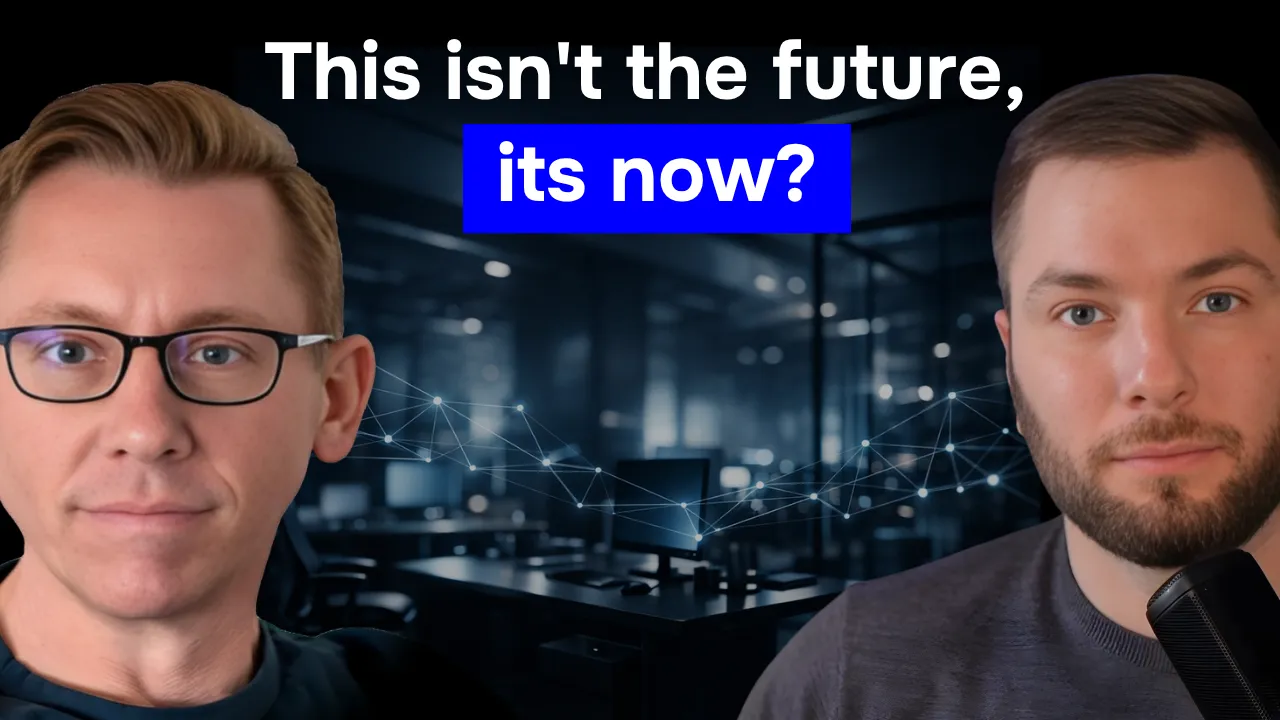
Hands-On or Left behind : The new reality of AI fluency | Steve Gustavson, Microsoft CVP
Hands-On or Left Behind: The New Reality of AI Fluency
Steve Gustavson, CVP of Design and Research at Microsoft
What if the biggest obstacle to AI in your business isn’t the technology, but the organizational structures built for humans to be the bottleneck?
In this episode of the AI Frontier Playbook, I sit down with Steve Gustavson, CVP of Design and Research at Microsoft, leading the Business Apps and Agents division with a 350-person team spanning design, research, and content. We explore how organizational transformation, AI agents, and user experience converge to reshape how companies build and run their business processes.
Steve brings 20+ years of experience from Adobe, ServiceNow, and now Microsoft, where he leads the design thinking behind Copilot Studio, Agent 365, and the broader agentic ecosystem. What makes this conversation different is how concrete it gets. We go deep on why rigid org charts become liabilities when AI teammates start handling workflows at scale, what it actually takes to evaluate agents beyond technical accuracy, and why generative UX is forcing a complete rethink of how business applications get built. If you want to understand where the future of work is heading across agent ecosystems, this is the conversation.
You’ll Learn
- Why organizational structures designed for human decision-making become liabilities in an AI-enabled workplace.
- How generative agents are shifting Dynamics 365 and business applications from rigid tools to flexible, adaptive systems.
- What it means to evaluate AI systems beyond technical accuracy to include human qualities like empathy and voice authenticity.
- How the future of work requires flatter organizations with fluid project-based team assignments rather than static org charts.
- Why user researchers and design leaders are becoming the primary voices defining what makes AI assistance trustworthy and effective.
- What the ethical and transparency challenges are when deploying AI agents in organizations alongside human teams.
- How to balance using cutting-edge AI tools daily while maintaining security and ethical boundaries around sensitive data.
- Why the next generation of agents will be customizable by end users, PMs, and other non-engineers using plain-language markdown specifications.
Whether you are an enterprise leader grappling with legacy systems or a designer thinking about human-centered AI, this episode challenges conventional thinking about how technology and people will work together.
Sponsor
This episode is brought to you by Talan. Thank you to Talan for sponsoring The AI Frontier Playbook. Learn more about Talan’s AI Commerce Agent for B2B Buyers: https://bit.ly/4kZRDTj
Listen and Watch
Resources and Links
Enjoyed This Episode?
- Subscribe to the AI Frontier Playbook Newsletter: https://samuelboulangerai.substack.com/
- Connect with me on LinkedIn: https://www.linkedin.com/in/samuelboulanger/
- Visit my website: https://samuelboulanger.com
CHAPTER 1: Who is Steve Gustavson?
═══════════════════════════════════════
Samuel
Steve, welcome to the show. Thanks for making the time. I really appreciate it. Before we jump in, anyone in the audience who doesn't know you yet, can you just give us a quick intro, who you are, what you lead at Microsoft as CVP of design and research, and what that scope actually covers day to day?
Steve Gustavson
Yeah, of course. Yeah, thanks for having me, first of all. So I joined Microsoft just about a year ago at this point. And I am in our Business Apps and Agents division. So think about anything that's business application oriented, business process agents that are coming to life in M365. And there's many, many other things too. Agent making, Copilot Studio, all of those things are part of my portfolio. So I oversee the design, research, and learn content teams for that part of the world. So it's about a 350 person group.
About 50 people are on the learn side and the rest are all designers and user researchers. So it's been a really exciting first year for me. I came from ServiceNow, which is sort of in a similar space. And then I spent the first, gosh, 17, 18 years of my career at Adobe before then. So I spent 20 plus years now in high tech and I'm just happy to be here. So again, thanks for having me.
═══════════════════════════════════════
CHAPTER 2: The biggest shifts reshaping how organizations operate
═══════════════════════════════════════
Samuel
That's great experience and that's a really broad scope. So from your vantage point, I suppose you're seeing a lot of what's happening across AI right now, right?
Steve Gustavson
I am. It's literally all I think about seven days a week.
Honestly, I think that's what it takes to stay current. Just given the speed of what's happening. Yes.
Samuel
When you zoom out, what are the two or three shifts you think will most reshape how organizations operate over the next few years?
Steve Gustavson
Yeah, I mean, we spend so much of our time, especially in the division of Microsoft that I'm in, thinking about the role of AI teammates as we're sort of considering them right now, coworkers, there's many terms that people are using, but think about agents that will work either together as part of a network or with humans to actually solve business processes. So a lot of people think about, you know, you talk to ChatGPT or you talk to Copilot or...
Maybe it's Claude, I use all of those all the time for various things, sort of personal and professional. But when I think about the role that is going to change the most, it's gonna be that idea of those autonomous agents that are linked together solving complex business processes. Which isn't to say they're gonna replace people, I know that's one of the big topics that everyone is thinking about. And of course we think about that all day long, like what's the impact on the world and how do we think about that ethically and design for...
inclusiveness and think about how humans need to experience interacting and collaborating with AI too. But I do think there's so many things that are so complicated and so manual today, they're going to be completely automated in the next, let's call it a year. I don't think this is like five years away. I think this is on our doorstep right now. I was thinking about these concepts three years ago.
And, you know, Microsoft is just a big company. It's taking us time to sort of move as fast as we want in some of these directions. But just think about any process in sales, service, finance, operations, maybe you're running a small business, maybe you're running your own marketing team. Agents are going to be able to solve a lot of the sort of tactical, automatable type of efforts that are happening there. So trying to think through like, how do you design a system around there where the human stays in the loop and in sort of control as the orchestrator? But.
You are introducing a bunch of basically capabilities under the hood. And so whether they manifest as a, you know, sort of an anthropomorphized agent of some sort, and some brands are going in that direction, I think that in a lot of cases will actually sort of be the opposite where it's, they are just automations under the hood. You have a team of 10 agents that are all coordinating and collaborating with one another to solve really complex systems things that used to require.
different software systems and hundreds of consultants to be able to solve those things. I think we're going to end up automating a lot of that and hopefully doing it in a way that's really elegant and also opaque where we can.
═══════════════════════════════════════
CHAPTER 3: What leaders are underestimating about the agent era
═══════════════════════════════════════
Samuel
So yeah, agents will be the next big shift in working. Like you said, you mentioned human in the loop and I like that because it's not replacing, right? It's like enhancing what people are already doing with agents, but still the human is in the loop. And what do you think most leaders are underestimating right now? I think a lot of organizations right now are still getting used to using basic Copilot or ChatGPT or, you know, LLMs in general.
Steve Gustavson
Yeah, for sure.
Samuel
So what are they underestimating with this new agents world coming in the next few years?
Steve Gustavson
Yeah, I think people are underestimating how fast the transition has taken. It's already here. The average person I don't think had been comfortable with using a command line interface or a CLI. Most people didn't use those. I didn't, frankly. I used to do some web development, but I'm a designer by trade. And I wasn't really comfortable using those types of tools and interfaces until the last couple of months.
But then suddenly I started using Claude Code in a terminal inside of VS Code. So I'm talking to a command line interface, which is I'm just talking to a coding agent as a somewhat, I'm more technical than like your average person off the street, but compared to the, you know, 8,000 person engineering org that I sit in, I'm on the lower end of the technical spectrum of that, especially on the leadership side. And yet I become incredibly comfortable with using those types of tools immediately. So whether it's that.
You know, a visual IDE like Lovable. We use Figma, of course, all day long, many other tools that are sort of part of our sort of toolkit and our workflow. But we're all getting really comfortable with using those tools really quickly, which I think is going to have a direct and rapid impact on just software systems and what people are comfortable using at work, which was unthinkable six months ago. And I think it's already here.
═══════════════════════════════════════
CHAPTER 4: Why leaders need to be hands-on with AI tools
═══════════════════════════════════════
Samuel
Based on what you say, would you say that leaders need to put their hands to it if they want to understand at which pace it's going right now? If you are, just myself only played with GitHub Copilot recently, and I was amazed at what it can do. And I don't think you can realize where we're going if you don't use those tools. What's your take on it?
Steve Gustavson
I think it's totally true. And
that is the shift too that we're seeing in Microsoft and it's being driven from the top down that we cannot in this moment of AI be professional managers. And I say this to every level of, I have some cases, right, two or three levels of managers on my team, no professional managers. Like we can't afford as an organization to be just managing people and sort of not having our hands really into the tools.
So, and that's true of everyone. From Satya, the CEO on down, like we're expecting that people are really becoming comfortable and getting more hands-on again with these tools. And back to my point around using, I've used GitHub Copilot of course, and then started experimenting with Claude Code and VS Code and that CLI. I really don't think you can understand how powerful it is unless you use it. Even an academic explanation or listening to a podcast like this, there is no substitute for it.
And it was not until I actually jumped into those tools and started to physically put hours in that I realized, oh my gosh, this has changed my workflow entirely. As a design leader, as somebody who builds lightweight apps like we all do for our work, we all wear multiple hats. Maybe my day job and expertise is designing software and doing user research to validate that we're building the right things. But I'm also a knowledge worker. I still.
do presentations and I create content and I edit things all day long too. So I think all of us are gonna have to get really comfortable immediately. This isn't again, you don't have six or 12 months to learn these things. It has to be happening right now, get in there and realize that like the game has changed already. And this is true, I think, yes, it's true of leaders and I think people inside of Microsoft, but I have friends who I used to work with in the past too, who were general project managers and they were in marketing and they did sort of more sort of departmental work. They're already doing.
deeply technical now too. They're building their own sophisticated automations using a CLI. And these are not people from engineering backgrounds. These are people from generalist marketing backgrounds who maybe used a little bit of like MarTech tools, who now are stitching together three or four complex systems. And now with what we're seeing with some of these coding agents, you can build any system as a lay person who doesn't have any understanding of computer science. You don't need it at this point in order to use these tools. So I think that's been the biggest transformation for me is
you have to throw yourself into it, all in. And then with that, you're gonna learn a lot about what you don't understand, but it's honestly, it's changing philosophically the way I think about product making, which I would never have imagined, you know, even two months ago at this point.
═══════════════════════════════════════
CHAPTER 5: The non-negotiables for designing intuitive agent experiences
═══════════════════════════════════════
Samuel
Yeah, two months ago. That's powerful. Only two months ago. It's going so fast. I think that GitHub Copilot is one end of the spectrum. On the other hand, you have lightweight building agents and we're putting at Microsoft agent building in the hands of everyday users. So people that might be less technical and less comfortable going all in with tools like Claude Code or GitHub Copilot.
Steve Gustavson
Mm-hmm.
Samuel
When you design and build your own agent experience, what are the non-negotiables that make it feel intuitive and empowering for us as Microsoft creating those products for those end users?
Steve Gustavson
Yeah, there's two major ecosystems that at least are part of my world. And I'll talk about the simpler one first, then we'll talk about the more complex one. The simpler one is just Agent Builder, which is a feature of M365 Copilot. So for the 50, 60 million monthly active users that use Copilot, and we do have a tremendous base of people that are in there every day, they're often doing content creation. I think that's one of the number one tasks that we see. They're writing and editing with Copilot all day long.
They're generating long form content in Word, they're producing PowerPoints, they're doing lightweight sort of analysis, finance work, right? There's a bunch of sort of generalist capabilities within Copilot. And then my team actually works on the sales, the service, and the finance agents. So imagine you're chatting about, you're in a finance generalist role and you've got a question about something. Like we offer an agent connected to proprietary data sources that allows you to do some lightweight financial analysis in Copilot.
But for many people, what we've also seen is that they want to be able to build their own agents for very, very bespoke reasons. So maybe they use one of our first party agents, like I mentioned, the sales or service or finance agents. We have another one called Workflows too. If you have a complicated thing that you want to run every single day, you want to trigger it based on something, connect it to a source, have it do a generative summary for you, and then have that in your inbox every day. We have something called the Workflows agent that we rolled out in September, October, I think at this point. So we're building a lot of those first party tools. And then of course, there's third parties too. I mentioned I came from ServiceNow. I worked on the design of that agent. If you have an IT service request as an employee, that's of course what we use. Workday, Adobe, there's many, many others that are great partners of ours too. So there's all of those that are sort of prepackaged ones that are very bespoke, that are designed to solve a particular task.
But what we see in the data is a lot of knowledge workers just want to build an agent because they have a very, very specific task or automation that's very bespoke to them. So you can imagine 50 million people are going to have 50 million different ways of doing their work. And so we've seen tremendous success with Agent Builder. And you basically go into the agent section and you just say, right, create a new agent. It's a very lightweight workflow that you go through. And you can pretty much just declare what it is that you want the agent to do.
You connect it to very simple things, very, very simple tools, knowledge sources like SharePoint. There's others, you know, capabilities that are in there too. And that is wildly successful. One of the interesting things that we found as part of that is they actually treat agents in some cases almost like an ephemeral entity. So imagine how you or I might make like an Excel file. This is a great example that we talk about a lot.
There's a big review coming up. I'm doing promo calibrations for hundreds of people, whatever the use case might be. I might make a spreadsheet that's incredibly valuable for a month. And then I never touch it ever again. And that doesn't mean that that Excel sheet or that PowerPoint or that Word document or a Loop, a video, whatever it might be, aren't incredibly valuable artifacts, but they're very ephemeral.
And they solve a need in that time and then I move on. We're seeing similar behavior with agents too, where someone will create a very specific agent because they do a task in a very specific, very personal way. And they build that and they run it for a while and maybe they come back and use it every day and maybe they don't. But success is very, very different than what we thought. We assumed they would build one agent and it would be perfect.
and they would use only that agent to do their work for the next year. And that's just not how humans are sort of behaving. So it's fascinating to also see just the diversity in agent use cases and how people use them, and then the ways in which they build them. So that's on more of, again, sort of the information worker side where they're in Copilot, right? This is the many, many tens of millions of people that are using it this way too. So very successful.
The product market fit there is really great. So we've been very enthusiastic about how people are using that.
═══════════════════════════════════════
CHAPTER 6: Safety, guardrails, and Agent 365
═══════════════════════════════════════
Samuel
And where do you place guardrails about everything safety, data boundaries, permission, trust? You were mentioning a first party agent that has access to finance information, services, marketing. People are creating their own agents. So you need to put some guardrails in place to make sure that it's safe.
Steve Gustavson
Yeah, yeah.
Yeah, I think it's one of the honestly the big benefits of a company like Microsoft that takes safety so seriously. You may have also heard, I don't know if your audience has heard about Agent 365 that also came out of my part of the world. I forget that we also do that big thing, which the idea is that you can actually take an agent, you can embody it and give it a sense of identity. So imagine you have an agent that you want to share with your group. In some cases that my agent is personal and it just has access to what I have access to.
In other cases, it's like, I want to share it. I want Sam and I to be able to have the exact same agent where you and I can both ask it a question in the Teams chat, and it has a shared context between both of us. Well, the minute you do that, of course, the potential for risk goes up. And so part of why we designed and built Agent 365 is so that you can take that agent, you can wrap it with Entra to give it a sense of identity, but also be protected by
all of our security products. So maybe Entra is how you give it an identity, but there's also Defender and there's Purview. So whether you're in security ops or sort of a more reactive security posture type of a role, that you can have observability into what that agent is doing. You want to know what systems it has access to, what pieces of data it's learning from, the ability to go back and observe the entire chain of how it thought, who it communicated with, what it said.
Why it said what it did. And there are very few companies, I think, on the planet thinking about the agent ecosystem with the sort of expanse that we are. So we are thinking about that entire lifecycle because we do realize that security is so critical. It's part of why we hope that people bet on Microsoft to do this too, because you can bring it in here. We have some of the world's best security products for an enterprise.
And we have the tools to onboard agents. And we have the Microsoft Admin Center, which falls into my world too, where an admin can say, great, I do want to enable this. Again, I'll just keep using an example that's very close to my heart and past. We want to roll out the ServiceNow agent to all of our employees so that when they have an IT request, their VPN has gone down, they've got a question about Wi-Fi, they need to do, what are the classic use cases? I need to order a new phone or a new laptop of some sort.
You can do it, and you can decide exactly who gets that in your organization, and you have analysis and insights into who's using that. So we're thinking about it as a holistic thing, because we realize how important it's going to be to do that. I know we're not going to have to get into every nook and cranny here, but maybe these are some assets we can share too, maybe as a companion to this. We, of course, are making sure that in the agent building process, in the interface, that we're really clear on what are you connecting things to.
And you can't just bring in rogue pieces of data. You can't just connect it to some outside model like we have workflows that make sure that you are being safe and inclusive through the entire building process. We don't offer, at least in Copilot Studio, an agent builder the ability to do anything that's outside of our ecosystem. It's all about designing agents for the Microsoft platform, so Copilot and Teams.
═══════════════════════════════════════
CHAPTER 7: How to know an AI experience is actually working for users
═══════════════════════════════════════
Samuel
You mentioned different, you know, first party, like Builder, Workflows, service, marketing, and et cetera. So that's a lot of AI experiences, right? And you're in charge of designing those experiences. So what signals will tell you that an AI experience is working for users?
Steve Gustavson
Yeah, I'm sure you've talked with many guests about evals. And again, evals is one of those things, evaluations, evals is just sort of the colloquial Silicon Valley term that's sort of taken off for everyone. But this was just the classic tests. Like if you're building an experience that's really wrapped around a model, the models are inherently stochastic or probabilistic, meaning that you and I may be using the exact same agent and ask it the same question, but word it slightly different.
You and I are going to have slight differences in our dialect and sort of word choices. And every unique variable that goes into a model is going to return a slightly different response to it too. So part of how we think about that is overall, what is the drift of when you've designed an agent and then you've run the same basic query and test over and over and over again? And what's the first answer you get? And what's the answer you get when you've asked it the same question 100 times?
So we think a lot about evals, and even internally, we have multiple people building very similar agents. And it's sort of by design that we're allowing ourselves to do this, because there is no one perfect way. When the system is inherently going to give you different results, like we want to be testing different architectures, ways of wrapping the same model, different ways of having the same harness, but introducing different models, and then doing constant evaluations against
the technical accuracy, and then from my perspective too is the actual user task success. So I'll leave more of the technical evals to other guests that you'll have on the show. But when I think about it from a user perspective, like I have UX researchers who are literally writing UX evaluations at this point. So the point being, let me give you a sort of a very meta example, somebody who's using Copilot Studio to build an agent. Well, we've done UX benchmarks on specific tasks that they want to do.
Their ability to connect it to a knowledge source, to make sure that the agent has a sense of identity. And then there's a whole bunch of very specific tasks, call them jobs to be done, but help me build an agent that can allow me to pull together a summary from these three different data sources and email me the same thing every single Tuesday morning in preparation for a big meeting.
Like you can imagine every enterprise is going to have their very own sort of specific task they need to do. So we sort of wrap it in jobs to be done. And then we think about that from the user's ability to complete those things. And then we write evals against it and then we test against those. And basically that's how I determine as a design leader is the experience that we've designed actually leading to that user's ability to solve the task. And it would be so easy and this happens in most engineering centric companies.
For people to get very fascinated about the technical accuracy of whether or not the model connected to the right data system and pulled out the right record, or is it technically accurate? Is it performant? That is just like the under the hood step. For these AI products to actually be usable, they have to actually work on a real world task success too. So I think it's like, there are layers of this that you have to stack on top of each other. So one of the biggest things I have to push for is the design leaders to say,
Great, right? Applied scientists, thank you for doing the brilliant work of connecting these systems together. But it doesn't actually add value or utility to Microsoft's ecosystem and users unless they actually can effectively solve the thing they need to solve. So we're running evals now at sort of multiple levels. And you can imagine just the organizational change it takes to get everybody on the same page. Let me give you another example. Think about the Dynamics products, which are very sort of workflow centric.
Let's take customer service as an example. You didn't select the software. You are a person who's maybe a service professional, who's great at answering, you know, questions. Maybe you work for a retailer or maybe you work for a big call center or some sort. You didn't select us versus somebody else. Like that's the software you use. And so you sit down every day and you have to trust that this system is going to be smart enough to give you great insights.
So its ability to do generative case summarization, to give you sort of prefab communications that you can send back to a customer, like the bar there from an experience perspective is really, really high. And I've been pushing since I started to say like, it has to be incredibly high, especially in the world where AI is generating a summary, right? If you're a sales or a service professional, you've probably spent 10 or 20 years in some cases. I saw this on the IT service management side at ServiceNow for sure.
The ability to write that summary and close a case and create a piece of content in a knowledge base and then wrap a case with a user, that is somebody's craft. They've spent decades perfecting that. So the bar for how good the AI content is is incredibly high, because these are humans. They're professionals communicating with other humans too. So to make a point clear, it's not just about
did Copilot and the model under the hood successfully pull the right Dataverse piece of data from the person's account. That's insufficient. It's necessary, but insufficient to be able to do that. So when I see the, the, you know, the engineers doing evaluations, I always say, okay, but now show me the communication. Because if I'm somebody and I'm expecting Copilot is going to write something for me and I'm going to send that on behalf of myself and my voice, the bar for it, has to sound like me. It has to sound human.
It has to sound empathetic. And most engineers are not doing evaluations of that level. Hence where I think UX researchers have a new sort of lens on the world. And I want them to be the ones basically writing the success criteria of what makes for a great communication. And it's all of those things. It's the technical accuracy. It's the timeliness.
It's the transparency around where the data and content sources are coming from, and then the humanity in the communication too, to make sure that somebody is actually going to be comfortable sending these things. So you can imagine sales, service, finance, like there are nuances across every vertical or department, but the bar for that is incredibly high. And I think in this AI world, design and user research are only more critical than they've ever been before too. So for me, it's a really exciting time to be here in this space.
═══════════════════════════════════════
CHAPTER 8: Will agents become the primary way companies build and run processes?
═══════════════════════════════════════
Samuel
Building on that, you mentioned D365, which used in the last decades to manage organization processes. You believe agents will become a primary way companies will build and run processes. You mentioned it like case summarization, knowledge base creation, et cetera.
Steve Gustavson
Mm-hmm.
I think.
I think so. And again, I think it's been happening in the industry for three years. I've been working on this for a number of years now, thinking about the same problems. Yes. And I think we're sort of in a transitionary stage where we're just trying to introduce like what are the top three or maybe five.
Agent or agentic capabilities in any Dynamics. Again, any Dynamics could be on the ERP side, could be on the CRM side. Then we're introducing into that sort of customer base that really helps to supercharge their workflows. And I mentioned some things like case summary. That was always a use case I used to use in the IT sort of landscape. That's critical. Like the ability to understand whether or not you've solved the case and be able to summarize it, uncover what the problem is, close it.
Create a new knowledge source and then build a new agentic capability on top of that new knowledge. Like that's a whole workflow that had to be sorted out that didn't exist three years ago.
So I think it's happening again every day in sales, we're seeing different things, we're getting much deeper into like contact center on the service side. Those are high volume, very sort of voice centric type of experiences that, agents have to be part of the solution. Like the scale of which that needs to happen is gonna require that we think about how we design experiences differently. So.
I think agents are the core of it. And I think today we have Dynamics. It's right. It's a great business we have. And there's people who've been using it for 20 years in some cases, as I understand it. But many of those things, I think we're going to deconstruct them and frankly be able to rebuild them either in a custom UX, which we see many customers are like great. I love Dataverse and the Microsoft Graph and everything that you have available. But my business is so bespoke, like I'm going to build my own like thin veneer of UX on top of it.
Or of course, we hope that Copilot M365, Copilot more and more people will spend their time doing all of their work in there. So they can do their knowledge work and they can create content and they can also fill their finance, sales, service, marketing. Imagine the department we are working on a solution for any of those things right now too. So I think it's gonna be much more around
the moat is the data, the decades that we have of intelligence on either of those ERP or CRM systems. And then it's really, what is the right agent to help to automate a piece of the workflow? And then I think the UX is going to be where a lot of the negotiations will happen. So again, I think it's a really great time to be in the role that I'm in because it's a complete renaissance for UX. Like, what does it mean? I don't think you need to be, you know, pushing pixels on the exact same lockdown interface for 5,000 customers.
There are too many different use cases. So I think what we're thinking about is like, how do I do generative UX where the model is feeding into it, the user either in natural language or through voice. It's gonna be very multimodal because if you're on the go on your phone and then you sit down at your desktop, like your patterns of interacting with software are very different if you're like me, right? I would never do something on my phone that I would do sitting here on my computer like this. So as a designer, we have to think through all of those things.
Which I think is a really, really fun problem to solve. And so I think we're only gonna put more and more design thinking and sort of product making sense into every single experience that we come up with now. So I think it's gonna be really fun. Maybe we can check back in a year and see how far we've gotten, but I've seen a lot of stuff just in this first year in that space.
═══════════════════════════════════════
CHAPTER 9: Will work shift from systems to the prompt window?
═══════════════════════════════════════
Samuel
I've been doing business applications for 14 years now and the way it evolves is just crazy. What took hours to create, like creating tables and fields in the new D365 for instance, now taking me minutes using AI. So we're already seeing it and I think a lot of people are worried of, what will be this new reality? How will we interact with those systems? Would you say that it will be more in the prompt window than in the systems themselves?
Steve Gustavson
I think it'd be a mixture. I mean, I think there's still going to be a lot of value and utility to people who understand systems. So if you listen to all of the same podcasts that I do, I think that's one of the biggest prevailing sentiments right now is like, look, coding agents could do a lot of code. Like, I don't think people are going to be writing it. This is a Steve statement broadly about the industry, not a Microsoft strategic point necessarily, but.
I don't think a year from now, the average software engineer is writing code by hand. Like if you've played with Opus 4.6 or you've played with Codex or I'm sure there's many others too, GitHub Copilot of course, which we've had for quite some time. Like you can basically write entire functions just by assigning and delegating to agents. So imagine the work you're going to be able to do now on a legacy code base. So again, Dynamics is a great business, but it's been around for two decades in some cases.
Imagine just the complexity and the debt of those systems and what a single engineer or a small team of engineers can do now with an army of coding agents at their disposal. I won't share all of the examples I've seen, but our engineers are sending just mind-blowing examples of
in-depth investigations they're doing, the debt they're able to sort of crack away at. We're basically saying now, Charles Lamanna, who's my manager and myself, to anyone in any one of our product spaces to say, the idea that engineering is not going to prioritize UX improvements, those days are over. Because you can literally delegate to agents and train them using markdown files that designers write the specs for to go and fix UI and craft and quality bugs.
So the pace also of how we're thinking about not just building new products or not just fixing code bases under the hood, but like even the UX of Copilot Studio, for example, there's no, I have no patience left for saying, we'll get to it in six months. It's like the world's going to move too quickly. So great news. Like you have access to all of these tools. Go get your army of, you know, front end engineering agents spun up.
Collaborate with designers in new ways and get to work on solving this stuff. I now, many of our most progressive areas of our product space, I have designers in the code, vibe coding front end engineering changes with developers, not in a Figma file, not handing off like the redlines and specs that were happening even a year ago, we were still operating that way. For one of the biggest projects we're working on right now, like they're in there.
So it's designers, they're doing product strategy work, they're doing end to end sort of experience design, and they're doing the last mile for the fit and finish. We have people working in our FDE departments. So forward deployed engineers where we're with customers working on sort of the frontier. Designers are in there doing all of these jobs together.
So I think it's just been a completely, you know, transformational way of thinking about a software development life cycle. It's not the waterfall anymore where, PMs gather customer requirements and write a PRD and then they throw it over the fence, design works on it for weeks. They throw it back to the PMs. At some point it makes its way to engineering. Like those days are over. It's already gone. Like whether or not people understand it. So we're seeing those things happen in real time in multiple parts of our business every single day.
And that's just a really exciting place to be able to use agents to do things that are not displacing the work of design, they're actually supercharging the work.
═══════════════════════════════════════
CHAPTER 10: Teams of agents coordinating on real work
═══════════════════════════════════════
Samuel
And can you picture multiple agents coordinating on work like what your teams are doing today? You know, I've seen the statement from Mustafa Suleyman, who is our CEO of AI who mentioned that in 12 to 18 months, most of the, you know, knowledge worker jobs might be done by an agent.
Steve Gustavson
Yeah, yeah.
Yeah, I won't make a declaration quite that broad, but I definitely do think there'll be teams of agents. So again, teams of coding agents, I see it in real time. Again, I go back to some of my very brightest engineering counterparts. They have entire systems in their heads. They have the human experience and understanding of Dynamics or Copilot Studio or the Microsoft Admin Center. These are very complex systems.
That somebody has to understand because you have to be able to set up and guide a team of agents that's doing something. So whether they're agents that are doing automation, like again, a piece of departmental workflow for service, or it's a team of agents doing coding tasks, either way, you need a human there who understands, at least for now, and again, the world will continue to evolve, but this is sort of just a snapshot of what I'm sort of observing in my lived experience in just the last couple of weeks here. You need someone who understands that entire thing. But we're building products by
sitting together as engineers and designers and determining like what the experience needs to be, looking at what the model is outputting, in this case, with this new agent we're building. And then at night when we realize, okay, here's the 10 things that need to happen, the engineers are literally assigning it to a number of agents. So imagine 10 engineers, each managing 10 coding agents. They assign tasks at night. We go to sleep because we have to sleep. The agents just crank through stuff all night long. And sometimes it's deep technical issues.
Security issues that want it to go and explore something we need to patch. Or it's, hey, we've updated all of this design language and we've thrown a dozen UI examples in there and we want it to think through the design system. We literally handed that off overnight and by the next morning it had rebuilt an entire interface. So something that I had prototyped in an AI creation tool. We hand it to the agents, the agent built the thing by the next morning. So.
What does that mean for the future product? I don't know. But I think at the very least, it's going to mean that the scale and velocity of which a current team can produce is going to be exponential. And I think you see this when you think about smaller teams or smaller companies, right? You look at the Lovables and the Midjourneys. I was an early, early Midjourney person back when it was in Discord, right? It was like a very much in the corner of the internet in late 22. I was playing with that pretty heavily.
Those are teams of a couple dozen people who build products that are being used by millions. So it's just showing like that is what AI native products look like. You're using AI to build AI and it allows teams to scale. And so as we think about our work, which is relatively large, like the expectation is not to reduce the size of the org. It's that this org can now do 10X. So we talk about the 10X designer or the 10X engineer.
It's just given us superpowers in either of those two disciplines. I think PM, you know, every company is slightly different. They play a role. I think they're going to be maybe more senior, more strategic, more customer and business oriented. That's where I think PM is going to go. But as far as makers and builders, like it's the golden era for us now too. So, you know, it makes some people nervous, but I'm like, that's why I say you just got to jump in and use it.
You know, I went from being nervous, like, what does this mean for my job? I'm, you know, sort of mid to late career at this point. But I had many employees who were a couple of years out of college and they have a love of design. That's why they got into this business. And they're wondering like, well, what does this mean for me? And I went from sharing in sort of the, you know, the nervousness of what that could mean to being a huge proponent of these now, because I realized it allowed me to go in and use one of these tools.
To build, Lovable was one I've been playing with recently, I was able to build a complete, high fidelity, nearly working piece of software end to end by myself in a weekend. So once that, I realized that I'm like, and now imagine the experts on my team who are, you know, much more elastic thinkers who can still learn these tools much more quickly than I can.
They have superpowers. So far beyond what we thought from a, again, I came from Adobe, right? I worked on, I remember designing apps and websites in Photoshop and then it became XD and then it became Figma. And now we have all these AI tools too. So I don't know. So I have a very bullish perspective if that's, hopefully that's coming through on the.
Value and the superpowers that this is going to give to designers and to engineers. So I'm going to lean into that. It's a very hopeful message that I'm hoping to see, but I'm seeing the impact this had on my team again, like just in the last two months, like it has been an exponential transformation of the way that we think about product making.
═══════════════════════════════════════
CHAPTER 11: How organizations should rethink roles, team structures, and hiring
═══════════════════════════════════════
Samuel
So building on that, if the direction is that every employee will end up with a set of AI coworkers, how should organizations rethink roles like the team structures, the skills that are required when you're hiring, all of it will need to change, right?
Steve Gustavson
I think so. And I think, again, it's happening rapidly. I mean, I think one trend in the industry that we're seeing a lot is that some teams are getting flatter. Microsoft went through some of that too, right? The idea of having teams of managers managing two or three people like those days, like it's moving too quickly. An organization cannot handle the pace of change. Just think about the communication overhead if your organization is very, very deep with many, many small teams.
I just don't think that's going to be the future. I think the teams are going to get flatter and flatter and flatter. And I think that the very nature of teams are going to be sort of reconstructed based on a project by project basis too. So again, most people, I've been in this business for over 20 years in high tech at this point. I love a good org chart. I love thinking about sort of the organizational structure, but those org charts that we used to spend all of our time as leaders sort of worrying about.
That's a detriment now to the way that we need to work. And so I don't want it to be the point where it's so rigid that only this team under this manager can work on this project. Only this team, if they're perfectly aligned to that engineering group can work together. I think it's going to be much more fluid. There's going to be some products where it's like, this is all about just spinning up a really, really powerful large language model and getting the model right. That is going to be a heavily engineering led effort.
But you're gonna want probably a user researcher and a content designer as part of that. Cause it's all about the under the hood system and the directly responsible individual. We talk about DRIs here a lot. Like that might be the applied scientist manager in that case, because they're the one, you know, trying to craft that part of the product experience. Others are completely UX centric. And so I can imagine a world too, in which like the design director is the one leading the project, being supported by maybe a PM and a handful of engineers and some designers too. So I think that's part of what I'm, that's the
transformation organizationally, I'm trying to push on my team too, is to say let's get and stay as flat as possible because assignments can come and go. The joke I make is assignments come and go but managers should be forever. I think people have just been reorganizing too often and I want to make sure that especially early in career people have stability and they're learning from the same manager for at least two years. That's sort of my goal for the team.
But then projects can come in, like whatever assignment, like it's gonna change in three months. We can't possibly predict where the org and where the product landscape will be in a year. So don't try to design an organization that's gonna have that sort of staying power because there's just no way it's gonna happen. So I think that's on the human side. And then your question was also around agents. And I think everyone's gonna have agents too. Like we're already spinning up a design agent, which is again, defined almost entirely in a markdown file by designers who are
Again, it's like we're regressing to the point where we're just writing in prose and thinking and structure rather than in like a visual design system. We're defining how the agent should think and it's designers who are the ones that are doing that. And then we're going to spin up coding agents that can basically do design work. So that if a designer is in a code base and goes, oh my gosh, we've refreshed the visual language and yet this part of the application still looks like 2019, we're very guilty of that everywhere across the company.
Designers will be able to deploy their own design coding agent to go and solve those problems for them. So I think it's going to change in every direction. I think every discipline is going to evolve as part of this. I can imagine a PM building a customer insight and sentiment agent that could go work on behalf like.
Agent go and write research, everything that's happening in the industry around customer service. Look at all of our customer briefings that we've had, you know, look at all of our case studies, pull what you can externally and like bring me back fresh insights every single week into how I can boost NPS. Like I think everyone is going to start to think through and those use cases are going to emerge really quickly here. So I think it's, I think it's gonna be really interesting. And I think another thing you and I had maybe one of the questions we had thought about leading up to this too was
There's new ethical considerations as part of that as well. If you're going to start to introduce an AI teammate into your organization, well, there's a big user experience and sort of responsible AI component of that too, which again, another perfect place for UX to sort of play a role because I need to know if you and I are using the same agent, like what access does it have?
Samuel
Yeah.
Steve Gustavson
I talked about that a little bit a while ago, but if it's pulling from like my HR system, I need to know whether or not it can tell you those same things. So that's going to change the way that we think about designing for these systems too. So imagine, right, you're in, if you use Teams or Outlook, there's often like an org chart that you can view in there too. Our idea is that if you have an agent that is part of your sort of virtual team and you've given it access to things, it needs to show up in there.
So that when I end up interacting with that agent in Teams maybe, and I wonder, well, gosh, like who owns this thing? I can click on it and it shows me, well, this is Samuel's agent that you built for some particular reason. So I think it's all of the things. There's tremendous benefits of what agents can do that humans can't.
They don't get tired. They don't get angry with you. You can put them to work 24/7. Yeah, there's a cost and a COGS consideration for that. But they can do things that, frankly, we would never ask a human to do. But also, we have to think about how do humans want to engage with an AI teammate? And we've done a ton of UX research that's come out of my team around the very language.
Is it a coworker? Is it a teammate? Is it a digital worker? Like our customers have been very clear with us that like AI teammate is the thing. They want to declare that it's an AI, but then also it's a teammate. It's a thing that works beside you, not replacing your job, but a thing that you can use at your disposal to scale the parts of your organization or your role that you want to. So, yeah, it's a UX question. I think every single one of these questions that you've had is like, it's great. It's a UX problem now too.
They're showing up everywhere, and we have to be very responsible about disclosing when it's an agent and when it's an AI and what does it have access to and how do I go observe it if it's done something I don't like. That's why you can imagine the end user experience in Copilot and Teams, the agent building process, whether that's in Copilot Studio, we also have Foundry for developers in a different part of the organization. And then Agent 365, that's a complete end-to-end lifecycle and ecosystem.
So we're thinking in those terms, because I think to be successful, that's sort of the grandiose scope that we have to be working through.
═══════════════════════════════════════
CHAPTER 12: Interoperability across agent ecosystems
═══════════════════════════════════════
Samuel
So considering we will have multiple agents working with us to accomplish our work and considering that obviously people don't all work on Microsoft or in the Microsoft ecosystem and interoperability is becoming a bigger topic. I think as more agent ecosystems will show up across the industry, I'm just thinking about Salesforce, ServiceNow, and other vendors out there. So how important
is it that agents can work across tools and platforms and communicate together and collaborate together.
Steve Gustavson
Yeah, and honestly, that was another sort of core requirement for our Agent 365 is that some people are going to build an agent. Maybe they're building an Agentforce. Maybe they're building it in Gemini. Again, third parties, the Adobes, Workdays, ServiceNow, as I'm sure there's many others too. We want them to be able to bring their agents into the Microsoft ecosystem. So we've designed Agent 365 so that they can do that.
So you can say, great, I'm going to onboard this custom agent that I built in Agentforce because I happen to use Salesforce for their CRM. Great, like bring it. Like that's the whole philosophy is like you can bring it in and we can secure it just like we would a first party agent or a custom agent that somebody builds. So absolutely there. And again, we're very much like a platforms and an ecosystem type of a company. So of course we want people to be.
building things and use them within our ecosystem. So I spend more of my time there. But I do think interoperability is critical no matter what. Whether it's between Microsoft products or people bringing in agents. Imagine if you built an agent in a different ecosystem, it's using a different model. The harness that it's using is probably different. The knowledge sources that it's pulling from are certainly going to be different too. So we sort of want to be agnostic from an agent platform perspective to say like,
look, you can use agents we built for you. You can build your own on our platform. You can bring in the third parties. Get end to end vision, is what we're sort of hoping to gain there. So I don't have a really strong perspective on like how would an agent that we build work in someone else's ecosystem. But we have a very strong point of view about being the most inclusive, most secure platform for bringing agents to work.
═══════════════════════════════════════
CHAPTER 13: One practical tip for being more productive with AI
═══════════════════════════════════════
Samuel
I can't wait to see what the future will bring us. Well, almost at the end of our time together, I have my two last questions, which are my signature questions. First one being, if you had to share one practical tip that helps you be more productive with AI every day, what would it be? Like something you personally find durable and repeatable.
Steve Gustavson
Yeah, I mean, the first tip which we talked about was you have to use it first of all, right? You can't design for AI products if you don't use AI products all day long, every day. So I basically, my tip is keep work at work and keep personal at personal, right? In sort of different spaces too. And we know that it's happening, right? People are taking complex, you know, sensitive data and putting it into ChatGPT and
vice versa. So as someone who works in a large organization, like I try to be very disciplined about it. I use all of these tools because I want to be well versed in how all these tools work. But, you know, I use the non-Microsoft things for my personal work and whether that's personal finance planning, tax season's upon us, like there's great tools and I love working with those there. And then for work, I make sure that I use Copilot for everything that I'm doing because it's sensitive and I want to be, you know, thoughtful and secure and ethical in the way that I'm doing things.
So I think the first tip is you just have to use them all day long. And you have to also learn how to use these systems. That is another thing that as a design leader, gosh, I wish the systems were intuitive enough that you didn't have to learn how to work with AI, but you really do at this point. Like a probabilistic system is such that you don't understand how to work with it unless you've simply had experience learning how to work with it. How you prompt is really important.
Like what you put in is what you're going to get out, garbage in garbage out. That's sort of that old adage. It's more true for AI than maybe any other type of technology or experience. So I think there's doing that, but learn how to use it and learn how to use it for sort of supercharging your productivity. I use it for editing all the time. Sometimes I'm like, I've got this very specific argument that I'm trying to put together for something.
But I know my own mind and I sort of write in circular patterns and I know this about myself. And so I'll go to Copilot and say, okay, here's my structured argument. I think I've got this figured out, but please pull other sources together that I haven't considered and to like challenge me on my logic. And it's a back and forth process. And honestly, the communications I send are always better because of it too. But that's sort of my first tip is you just have to.
You have to dig into it. Each system is slightly different. The nature of the work you're doing with each of those is slightly different too, and all of them just take practice and experience.
Samuel
So experience, how to use it and be conscious of the danger of using some of these models or products with sensitive data.
Steve Gustavson
For sure.
That's for sure.
═══════════════════════════════════════
CHAPTER 14: Looking ahead 10 years and choosing hope
═══════════════════════════════════════
Samuel
Last question, looking ahead 10 years, how do you see AI reshaping how we live and work? What will change in how work will get organized, how decisions get made and how people maintain agency as AI becomes more embedded?
Steve Gustavson
I think the things that make us human are going to be more important than ever before, not less. So I started, who knows what's going to work. I honestly, knowing how much the world has changed just since January 10th of this year, 10 years from now, I could not tell you.
But what I do get excited by is as somebody who comes from like a fine arts degree and I was a musician growing up, it's gonna be a renaissance for a lot of those things too, because you'll be able to automate all of the, you know, the technical work and the idea of sitting down at a computer and, you know, typing fields into forms as a human. Like we already know that those days are over. So it's how do we reconnect as people and, you know, guide our kids towards new career paths. Like that's the stuff that gets me really excited that I want to spend my energy on.
Will my role change? Do I put myself out of a job in a couple of years? Like, I'm okay if that happens. But I'm excited about the, you know, I want to be a humanist at my core. So I'm going to choose hope and choose optimism for all of them.
Samuel
I love that, the renaissance of the information worker, new way of working together and collaborating. Love this. Steve, thank you. This was a really strong conversation. I think we covered a lot, but what I keep coming back to is like agents are only useful as the experience around them. So if people don't understand and don't trust what they're getting, understand what's happening and feel in control, they won't rely on it.
And that's, I think where design and research stop being a nice to have and become the things that will determine whether AI succeeds.
Steve Gustavson
Yeah, because it's not a technology question anymore. The tech exists. You don't have to question whether the tech can do the thing you want to do. It is about the business need, it's the user need, it's the customer experience. And that's it. The tech is there. So that's why I think it's an interesting time. It's no longer about the technology. It's so much more powerful than any customer that we have right now can even take advantage of. So it goes back to the foundations of humans and users.
You know, research, ethics, like those are the really interesting things for us to spend our time talking about.
Samuel
Thanks again for coming, Steve. I wish you a wonderful day. Thanks.
Steve Gustavson
Awesome. Thanks Samuel.
Related Episodes
You might also enjoy

Stay in the Loop
Never miss an episode.
Get new episodes and AI insights delivered to your inbox.