Episode 10
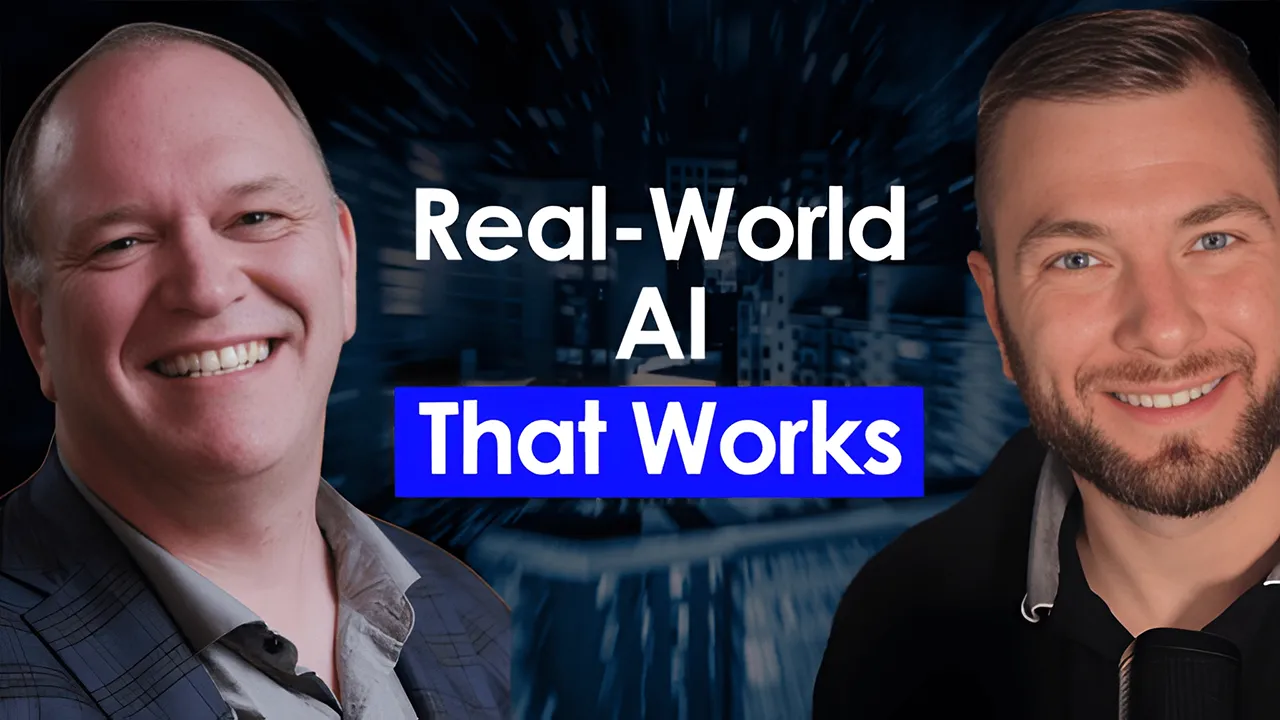
Real-World AI Use Cases You Can Deploy Today

Show Notes
Ben Vollmer has spent 30+ years helping organizations answer the question of where to start with AI — leading product teams at Microsoft, IFS, and now RSM, where he drives AI and Power Platform strategy for some of the largest businesses in the US.
In this episode, Ben breaks down what’s actually working on the ground: from AI agents processing invoices and summarizing shift reports, to how edge AI and micro-vertical models are quietly reshaping operations. They also talk about the biggest blockers to adoption (hint: it’s not the tech), how to roll out AI without overwhelming your teams, and why most companies are still underestimating the power of data readiness.
Key Takeaways
- Real-world AI use cases delivering ROI today: invoice processing, shift summaries, contract analysis
- The Gartner adoption timeframe: what’s available now vs. what’s coming in 2-5 years
- Computer vision and document intelligence as the top value drivers
- Why adoption is like going from paper maps to GPS — you need to build trust gradually
- Edge AI, micro-vertical models, and SLMs as the future of enterprise AI
- The three buckets of value: personal productivity, team automation, enterprise transformation
Resources
I'm really excited to have you on the show, Ben. Welcome.
Ben Vollmer
Thanks for having me, Sam. It's gonna be fun.
Samuel
So I'm curious, what's Power Factory, actually?
Ben Vollmer
So Power Factory is, if you think about it, it's our low-code, no-code offering inside of RSM. So RSM is the fifth-largest tax, audit, consultancy firm in the world. In the U.S., we've got 20,000-plus employees. We're prolific, actually are one of the biggest Dynamics 365 consultancies in the world. Power Factory is our offering just to do Power Apps, Power Automate, Copilot Studio, all of the Dynamics 365-adjacent products, the rest of BizApps' platform that's not D365.
Samuel
And AI is now embedded inside everything: Power Platform, everything Dynamics, right? It's just basically everywhere. And you're on the field, right? You're working with the customers, you're working with some of the biggest customers in the U.S. And so from the field, what I've heard is that there's a lot of noise right now created by the whole tech market, and it's hard for leaders to know what's truly available versus what's just hype. Pretty sure you hear about it as well. So from your perspective in the field, what should organizations start implementing today and what belongs more in a one- or five-year horizon?
Ben Vollmer
For me, at least, there's two axes here. Let's think about this from two axes. There is the technological axis, which is: is this technology ready for me to actually adopt and do something with? A lot of stuff is changing very, very quickly. Is this ready to adopt? The second part of this, though, is: what's my organizational readiness to do this? I've seen some projects where we've had this phenomenal ROI, but the organization wasn't ready to adopt that area of technology. And so what I'd say is I would look at implementing what's both technologically available and technologically sound for your use case, as well as what your organization is actually ready to adopt and actually ready to consume. Now, I'm talking about an organizational level, not a personal productivity level here, Sam.
Samuel
It made me think of the BXT framework, the framework I'm using at Microsoft. I'm pretty sure you're familiar with it, you know, business, experience, and technology. So which one of these two you mentioned, so technology or the readiness, are you seeing where most of the companies are on?
Ben Vollmer
Most companies I've seen, I think there's a few things I've seen. I've seen skunkworks projects where we take something in a corner and we try to build something in an innovation lab and we try to push it out to the rest of the company. That gets you a cool factor, that gets you some learnings, but that's not truly an enterprise deployment. That's kind of a, let's go see if this thing works or not, and let's kind of go kick the tires. I think that's a deployment we see. Then I see kind of personal productivity, how to make myself better. You see that in M365 Copilot: summarize all of the Teams chats I missed yesterday, give me a list of all the appointments that are upcoming today and who they're with. That's about making me better. And then you kind of have the team productivity, team automation. We've been doing a lot of stuff in the team realm, actually. So the team realm has, for me, been where our customers see the most amount of value. Invoice processing. We have an agent, actually, that handles accounts receivable for a large customer where the supplier actually emails in, asks a question about, where's my payment in this invoice app? Instead of going to a human to look it up, find the invoice, anything else, the agent actually reads the emails, goes and looks in the accounting system, and replies back with the status of that invoice automatically. And that is, I think, where we see customers seeing a ton of value, is in the team level. But underpinning all this is the data. We talk about the Microsoft Graph, we talk about making sure your data is clean, make sure your data is ready. So I see customers starting to get my data ready, is step one; get my team ready or get my people ready. You've got to pick which one of those three, or which one of those three you want to blend into.
Samuel
Interesting, because I think data is pretty much the foundation of everything AI right now, which you just described with the invoice processing. It's basically agentic AI.
Ben Vollmer
Well, agentic AI by itself, it is agentic AI, but it's agentic AI blended with other things in the AI family. So OCR, like the invoice comes in, we recognize the invoice, we're doing, you know, I think one of the unsung heroes of the Microsoft ecosystem, you've seen that cartoon with the building with the one open-source project supporting the entire building, or the world financial system with Excel supporting it. To me, AI Builder is that thing for Microsoft that's the unsung hero of the product suite.
Samuel
The link on that, on adoption, you shared with me the Gartner adoption timeframe. I found it really interesting, on seeing what's on the, what should be on the horizon, what is really available today, what will be in five years, and where should organizations focus. So can you walk us through their findings and how you see that in practice with customers? Are you using this with customers?
Ben Vollmer
I use it with customers every day. AI is a little bit of a, there's a lot of magic being sold, not grounded in reality. There's a lot of, we're doing this, everybody's doing it. It's not just one person, everybody's doing it. I go back to the humanoid agent robots that were shown one time, and it turns out there was a bunch of people in a back room actually controlling them. But you see a lot of that kind of, don't look at the man behind the curtain type stuff. So when I talk to customers, where is the adoption value at? Where's the adoption? So computer vision, for example, I guess, has been around for a long time. Think about the power of being able to take a picture and describe the picture. We've done it for a volunteer organization where we wanted to understand how full the truck was after every donation pickup. How would you, so computer vision, we take a picture of the back of the truck and say, how full is this truck? You have approximately 14 feet left in this truck.
Samuel
Is it accurate?
Ben Vollmer
Yes. It's surprisingly way more accurate than I expected. How's that? I wouldn't do it where I need feet, inches, millimeters, centimeters. I wouldn't do it where I needed exact measures. But to get your volume, it's a pretty good thing. Edge AI, think about all the video that's in the world. How much video have we seen in the world? You'll be able to use video, for example, on the edge is a huge thing. I think we're seeing some big benefits there. I would say, honestly, computer vision and document intelligence and documents has probably been the number one area where my customers see value.
Samuel
If I go back to the Gartner adoption timeframe, like if you can explain the whole timeframe. I'll say, okay, so at the beginning of the adoption, we have, okay, computer vision, document intelligence. What's on the two-, three-, four-, five-year horizon?
Ben Vollmer
But you're going to see composite AIs. I mean, we're seeing it right now with MCP servers, A2A, where you have robots talking to robots. One of my favorite jokes right now is I swear to God, most of the RFPs I see right now are generated by AI, LLM. And then most of the answers given to RFPs now are given by LLMs. So how soon before those two just talk to each other and negotiate things and tell us how much we should charge for deploying something?
Samuel
Just for our audience, so A2A stands for agent to agent. So basically agents talking together. And MCP is for Model Context Protocol, which is kind of the USB-C of AI, like letting your software connect with agentic AI. Am I right?
Ben Vollmer
Exactly. Basically, think about Power Automate on steroids. Instead of having to build a system that encompasses everything, you can hand it off, let it do its thing, it returns the results. It's more of a macro service than a microservice for agents.
Samuel
So on a close horizon, we have document intelligence, computer vision. In the, let's say two, three years, we're looking at agent to agent, MCP servers that will take more place.
Ben Vollmer
I think we'll see them in more places. I mean, we're seeing them come up pretty quickly. We're seeing them come out. But again, the protocols are changing. The use cases for them are changing. I've seen some use cases for them, but it hasn't been broad spectrum yet. It's been very kind of segmented. I think you're starting to see more intelligent applications. I mean, James Phillips, who headed up BizApps for a long time, used to say, we have forms over data. That's been the context since computers began. How about when I start filling the form out, it goes, yeah, hey, dummy, here's the data. We're pre-filling the form for you, or we're changing the design of the form based on what you're putting in here. You can do that today via coded applications, but you can't really do that today via free-form intelligent application. I'm excited to see that. You're starting to see some decision intelligence come out, like should I do X or Y, should I do A or B? Like, what should I do here? Help me, guide me. Researcher, for example, is a great tool for that. It's helping provide decision intelligence. But we're still, I think, we're a couple of years away from people actually looking at data, trusting that data, understanding that.
Samuel
Yes. When you refer to Researcher, you refer to Microsoft 365 Researcher, which is the deep reasoning model. Am I right?
Ben Vollmer
Correct. There's also one in Claude, there's one in Gemini, there's one in Copilot. I mean, there's a whole bunch of them out there. The Microsoft one, I think, is really, really good. I've actually had pretty good luck with the Gemini one too, believe it or not, especially around more product management functions. I think Gemini was created by product managers for their product management team. And so it does some product management stuff really, really well that I enjoy using it for.
Samuel
Yes. It's okay.
Ben Vollmer
But those are things, though, even generative applications, like generative pages just came out in Power Apps. You've got things like Lovable. People like vibe coding. I'm not sure if vibe coding was a word two years ago. Those are things that are going to change the outlook and the view of the world, I think, as we see it.
Samuel
I totally agree. So we have our one-year horizon, two-, three-year horizon. So what's on the five-year horizon? Like, what should people start looking at, but not necessarily investing heavily right now? Because I think MCP and agent to agent, you should start exploring it. But then there's those other tech that are promising a lot that will probably be there in five years. You should just start maybe looking at it, but not investing in it.
Ben Vollmer
If I think about five years out, we're going to be in a world where there's going to be two types of AI. There's going to be very broad general AI. I'll put M365 Copilot as a broad general AI. It's going to be very broad, very wide, and then you're going to have very micro-niche, micro-vertical, very targeted AIs for doing very targeted things. Like if I want to track the number of weather storms in North America, there's going to be an AI that's going to do that. Like, there's going to be some very micro-niche AI. So when we think about the models going forward, I think the foundational model is going to be kind of broad horizontal and then very, very small micro-vertical. And so I think as an organization, you've got to prepare for how do you make what you make broad horizontal, be able to snap in micro-verticals as you need them across your business. And so those foundational models of, here's my foundational model for my warehousing team. Here's my foundational model for my law team. Here's my foundational model for my supply chain team. Here's my foundational model for my FP&A team.
Samuel
That's an interesting concept because right now most foundational models are generalist, right? And do you think those models will run on the edge, meaning that they will run on your device instead of needing the cloud?
Ben Vollmer
Mm-hmm. I think I'm interested to see what happens with SLMs, small language models. Okay, so instead of large language models, give me some small language models. I want to see what happens when we can run an entire AI, LLM, on my phone. And so I think those will be a big part of it.
Samuel
What is that, SLM? Yes, okay.
Ben Vollmer
LLMs are only a part of what people look at. There are things like machine learning. For me, most of what we call AI is actually ML. But how do you get an ML model that does exactly what I have to do? And so that could run on the edge. That could run on your device. That could run in the cloud. I don't think that's really a big, it just should be transparent to the end user where it sits.
Samuel
Yes, right now everybody referring to AI is almost always referring to a large language model. So GPTs, to make that simple. But the truth is there's other models out there. There's very powerful. We talked about document intelligence, computer vision, machine learning model, right? It's not LLMs. It's not input to output text. I think personally that a whole complete system will use a bit of everything, an LLM and other machine learning models.
Ben Vollmer
Well, if I look at the projects we've done to date that have been the most successful, they've been a combination of models. We never use just an LLM. We use ML and an LLM in conjunction with each other, or vice versa. You have a set of checks and balances. This thing does it, and this thing goes, yeah, that looks right. Or this thing doesn't. I go, yeah, that looks right. But those foundational models are really going to be critical, Sam, to figure out. I'm most excited to see the micro-vertical side of things. Like, where does ChatGPT for financial services institutions that are B2C-focused in Canada, where does that model come from?
Samuel
Interesting. Will there be enough training data to train those models? How do you see this specialization of those models happening?
Ben Vollmer
I see that happening because there's, think about it, there are software companies. I mean, again, you work at Microsoft, been there for a little while. Microsoft's massive, right? You know, like Microsoft is a big fish in multiple big ponds.
Samuel
Yes.
Ben Vollmer
There's a ton of medium fish in medium ponds and small fish in small pond applications out there. One of my friends runs an EAM firm that does almost exclusively nuclear power generation plants. It doesn't get much smaller than that. But if you think about even the Microsoft ecosystem, there's partners like RSM, for example. We have a food vertical we go after. We go after dairy producers and fruit producers and production co-ops. If I said production co-ops, the average Microsoft employee, they'd go, huh? And so moving from the vertical view to the micro-vertical view gets lost sometimes. But there's a ton of money and a ton of software being developed in those small micro-verticals. I think that's where those models are going to come from.
Samuel
Speaking of all those kind of areas where AI can be applied, where do you see leaders that are actually realizing measurable value right now? Like not in two, three, four years, like right now with AI. And I'll say AI agents, but let's say a mix of the different type of AI.
Ben Vollmer
So agents for me is, so I don't think we've gotten to the view yet of fully autonomous agents. Like we're not there. Like even when we build systems, I want to put a human somewhere in the loop to validate data. We're just not there yet. If somebody shows you an autonomous robot, I'd love it, but I haven't seen it yet. So what we've generally done for our agents is put a human somewhere in the process to check it. What I look at, if we look at where can we do something that reduces the amount of human effort to do a project? And so if I look at it from a value lens and say, how is it we can deliver something that makes sense? And when we deliver something, it's generally a combination of OCR. The amount of paper in this world still shocks me. Like, the amount of paper produced in this world still absolutely probably shocks me. So we're seeing value out of taking paper, converting it into documentation, into items, and passing it on. I'm seeing a lot of value from our customers around. Right now, most of the Copilot Studio stuff we're seeing on the public side is from B2C. We're seeing a lot of internal employee value. I'm running Jira, I'm running ServiceNow, I'm running an ITSM solution. How do I open up a ticket? Like, how do I make that process easier for my teams? But I think the number one thing we see value with our customers right now is doing documents, either incoming or outgoing, and some form of that data, summarization of data. We just did a project last week where we summarized shift data. So when shift one finishes their job, they have to tell shift two what happened during their shift.
Samuel
Oh, that's great.
Ben Vollmer
Okay, so we summarize what happened during shift one. So shift two doesn't go through and read 900 reports. Like, those are some great use cases. But the biggest thing I think we see value is helping our customers determine, is this personal productivity? Does this make Sam better? Does this make the solution engineering team at Microsoft better? Or does this make all of Microsoft better? And so kind of breaking up into which one of those three buckets do you want to go down? Because there's value in all three of them, but you've got to. People see ChatGPT, for example, when it came out, and they go, I love it. I want to deploy this for my whole organization. Yeah, but you're doing personal productivity. For organization, you should really think of how do you automate the roles? How do you automate the task inside that organization? So there's a lot of things we're seeing value in. I think the value I've seen has really been around handling things that are human-intensive. I mean, think about how much work it takes for, I get a document in the mail and I've got to go open it up and I've got to go read it and I've got to go flip through it, or I've got to match this invoice to that invoice. So I've got to find, like, that's the kind of stuff that just, it's mind-numbing work. It's kind of, I don't know how you are, but I don't know anybody who does it who's like, my God, this is the best thing I've ever done in my life. But it's there.
Samuel
So what's the top three departments where you see fast ROI adopting AI solutions? Now, I'll suppose that finance department is one based on what you've just said, using OCR for invoices, et cetera.
Ben Vollmer
I'm always kind of a little bit reticent to say which department, because it's one of those things where it depends. Every customer is going to depend. Because what we could call a finance function actually sits in a field operations role. But I think the ability to look at large pieces of data and guide somebody to a conclusion is the biggest ROI in the department. I think that anytime I can help somebody, the project we're doing right now is actually reading contracts and creating work order tasks from contracts. That's a boring job. I don't know how you are, but reading contracts is not exactly my favorite thing to do in the world. But then how do I then map that to work orders is huge. But I think the biggest areas are going to be a ton of admin work. I think about, I was actually doing some research earlier today, that salespeople, 70-plus percent of a salesperson's time is spent doing administrative tasks.
Samuel
Yes.
Ben Vollmer
And an interesting fact I learned from that was that 99% of salespeople, when they are given more time free from administrative tasks, use that time for more selling. Which means 1% play golf. But that's a huge stat. You can, sales in a lot of organizations, the highest-paid role in some organizations. Can we lift that there? I think any place also where there's a, it's the cost of doing business, like I've got to do this for regulatory reasons, I've got to do this for financial reasons, I've got to do this for a reason, or there's risk. Humans are really bad at the sunk cost fallacy. Sunk cost, think about it. You ever have, you ever, I'm a car guy, Sam. You ever had an old beater, like an old beater, and you keep putting money in the old beater, and you keep putting money in the old beater, and you're like, but I just put seven grand in it, I might as well put another two grand in it to keep the car running. The truth of the matter is the car at that point is shot. Put a bullet in it, move on.
Samuel
That's the sunk cost fallacy.
Ben Vollmer
So the sunk cost fallacy is, I've already put this much money, I'll just do a little more. When you do that, you avoid risk. And risk is a value measure. And so if I can figure out a way to have the AI look and say, hey, this is risky. Like think about a statement of work for a consulting firm. Hey, this is not scoped properly. Think about grants where I didn't meet all the conditions in the grant, so I could lose that grant money. Like, those are all areas where I see AI really helping, is helping provide some guardrails where humans aren't as strong.
Samuel
So there's not necessarily a specific department. It's more, if I rephrase you, where there's a large piece of data that will bring you to take a decision. Like the example you just gave, using it in sales, using it for revalidating scope of work, contracts, et cetera. So you need to look where there's a lot of time spent reviewing data or information that can be technically passed to an AI, an agent or not, like any kind of AI, that will remove the burden of having to do this manually so you can spend more time on something more meaningful.
Ben Vollmer
One of the projects we did is a case on the Microsoft site. They had three or four employees, give or take, who were reviewing records one at a time. They'd been doing it for about 18 months and they got five times their way through the process. The AI did about 95% of the records, they did most of the rest of the records in six weeks. Now, they didn't fire those four people. Those four people now, their jobs were to actually go do the value work of figuring out the rest of the process. So instead of doing this manual, I'm reading records and updating things slowly, we did it much faster.
Samuel
Now, you've talked about it at the beginning. Adoption is, I think, one of the biggest barriers to using AI, getting non-technical people to first trust the AI and bringing it into their daily workflow and finding new ways of working with AI. So how do you see organizations overcoming the challenge? Have you seen a lot in the field? Have you seen a lot of pushback from the end users?
Ben Vollmer
We have an actual, I'll tell you a story. When I was at Microsoft, we developed a tool that people call AI. It's long math, it's a whole different conversation there. It's Dynamics 365, our Resource Scheduling Optimization, RSO. One of the problems we had with RSO was that the dispatcher didn't trust it to make the same decisions it would make. What we did was we provided a simulated function where the dispatcher could see how RSO would model the day out. They could accept it or reject it. Think about yourself right now. I mean, I'm probably a little bit older than you are, Sam. So I remember when the first GPS came out, like the first TomTom you put in your dash, the Garmin unit you put in your dash and hung out. When those first came out, I remember having the planners. I can remember validating what the thing was doing versus where I wanted to go. And then it got to the point where I kind of trusted that thing. And now you pick your phone up, you put in the name of a company, and you click Go, and you blindly follow it.
Samuel
I'm jokingly saying sometimes I don't even know where I am just because I blindly follow the GPS. And actually it's not a joke. I don't know where I am sometimes.
Ben Vollmer
I think generally my parents live next door to me. I have a 22-year-old and 18-year-old boys, and they take grandma and grandpa to some doctor visits, and they're taking them around for stuff. And my mother drives my boys nuts because, like, okay, grandma, we're going. Well, you go down to 14th, you make a left, and you go down the third street and make a right. And my boys are like, no, no, what's the address? She's like, I don't know. And they get this like locked horns, or they kind of stalemate each other, because my boys want an address and my mom doesn't know the address. She only knows how to get there. And so if I think about how we bridge that organizationally, think about this for a second. When Garmin first came out and TomTom first came out, you monitored those results, didn't you? You monitored that GPS, you tracked that GPS, you looked where that GPS was going and said, do I want to go there or not? Right? Now you hop in the car and you blindly follow the GPS. When Waze tells me to go do something, I'm like, that's the stupidest thing I've ever heard. And every time I don't follow it, I get stuck in a traffic jam. And so I think it's more about showing how this is going to empower them. I think there's some fear around how this is going to replace jobs. This isn't about replacing jobs. This is going to be about replacing jobs where people don't use AI in those jobs. The battle is not between AI and humans. It's between humans that use AI and humans who don't use AI. That's where the battle is going to be.
Samuel
So this will come with time and people not choosing it will probably fall behind. That's what you're saying, right?
Ben Vollmer
You've got to kind of ease them into it. Like, think about the GPSs. You didn't go from paper-based maps to no maps overnight. When you think about it, that augmentation process in your brain of moving from a paper map to trusting a GPS to just blindly following a GPS took you a couple years. What we have to do is the same thing with humans. We can't just blindly replace. Can the computer do a job? Do I trust the computer to do a contract review better than I trust a human? Yes. But does that user do that? No. They still think they know better. When it comes to RSO, we talked about earlier, if you have 10 technicians with 10 appointments per day, I forgot the exact number, but it's $14 trillion to the 10th. My wife and I can't decide when we go to dinner one night. That's one decision, let alone 14 million decisions. So you have to show the humans why this is a better choice.
Samuel
Do you have a specific framework you're using with customers?
Ben Vollmer
We have a readiness framework we use. Again, RSM is interesting, much like Microsoft. Microsoft is not an 800-pound gorilla, they're 801-pound gorillas. RSM is 800 quarter-pound gorillas. We have an office of change management that has a framework. If you're a new change manager, here's how you do change management. We have an office of risk management, but here's how you handle risk management. We have a deployment team that has security-oriented deployment. We talk about the methodologies. It's going to depend on where the customer is in their journey. The methodology my team uses is really around organizational readiness. It's around ROI and value. And it's around the technology being able to support the decision the customer made. Those three things, we actually have a numeric value we add up, and those three things drive how the projects get done.
Samuel
To help people adopt AI, I suppose empowering them will be helpful. Letting them experiment, like I'll preach my church, giving them M365 Copilot, for instance, to start experimenting, letting them create agents, agents by themselves, will help them experiment and see the value. And then comes to this point of, I was using paper map and now I'm starting using the GPS. Have you seen real-world examples where this democratization of AI, using like low-code platform or out-of-the-box products like M365, Agent Builder, et cetera, actually, it's been renamed to Copilot Studio Lite, it's not Agent Builder anymore, had a tangible impact on the productivity and innovation? I'm pretty sure you have. So can you share some?
Ben Vollmer
We have. I think a few things I've seen happen here. One is getting them to trust the data sources. I think people fear the unknown. Like, if there's a black box of data that comes in and goes out, people don't know how it does it, they get a little scared of it. So I think the first thing we would do is really help people understand what happens and how you got from here to there. That's critical for most people, is understanding how I got from here to how I got to there. And that really helps people. And then also, as far as the agents go, I mean, we had a lot of people, again, from a consulting perspective, let's flip to consulting for a second. Consulting has been flipped on its head. It really has. Most of what my team does now is enablement. We are enablement and basically backlog as a service. I hate that, that's a horrible term to use, but we do enablement to help the customers understand how to do this themselves. Like, what they want from us is, how do we go build these things ourselves? Think about it for a second, if you've ever gone fishing, sometimes you get a fish on the line, it's too big for you to bring in yourself. So what do you do? You bring a bunch of people over to help drag that fish in the boat with you. And so we have these things where the sort of backlog is that we need, we need these 52 things that we have got a product that's live, come help us deploy that project. So it's gone very differently from how you used to, as a consultant, I come in and say, so Sam, what do you want to see and how do you want to see it? We would do all the discovery up front, and then we would deploy it in a waterfall fashion and give you a project. Now what we're doing is we're coming and saying, okay, Sam, here's how you make yourself better. Here's how you build with these tools. Here's the right tool for the right job. Don't use Power Pages for this case. Don't use canvas apps for that case. Don't use model-driven for that case. Don't use generative pages. Here's the right tool for the right job. Go custom build for this. But then it's about how do we make sure we enable you to be able to build that backlog up and use that backlog properly.
Samuel
I think that this default belief that, because of the way it's marketed, that it's so easy to create a website using Power Pages, it's so easy to create an agent using Copilot Studio. The truth is, I think it still requires very specific skills and knowledge, and specifically at the speed at which things are evolving. Do you see that? Do you see customers being able to manage all this by themselves without the help of RSM?
Ben Vollmer
I have customers who do it by themselves without the help of RSM. My goal is to work myself out of a job with my customers. I want them to be able to do this themselves. A self-sufficient customer is a happy customer. But I think a lot of times, you've got to find the right people in the organization that do it and that can follow it. Think about Microsoft Excel. I go back to COVID. You remember the UK? Their COVID tracking system broke one day. Somebody figured out that they had used up the last row in their Excel spreadsheet for COVID tracking. The reason their COVID tracking broke was because they were using Excel as their backend database. I'll find the use case somewhere. I just remember laughing because somebody looked at the number and they said, that number is the largest number of rows you can have in Excel 32-bit before it falls apart. I just about died laughing.
Samuel
No, that's.
Ben Vollmer
Some of it is about giving the customers, your end users, the right tools. Like, how many times have you seen Excel misused? Because it's the only tool somebody has. IT only gives you Excel, so guess what you do? You do bad things in Excel. So how do you give the, some of this is an IT enablement and an end-user enablement to make sure that the right things happen at the right times, and I'm really kind of excited by those things.
Samuel
I am as well. It's really changing the whole way we're working. I was a consultant for most of my career, and I would have liked to have all those tools available to me. But like you mentioned, the delivery of the project would have been completely different. You just mentioned that in some cases you're just more enabling customers, but what's the biggest misconception you see that companies have around implementing AI agents or implementing AI in general?
Ben Vollmer
I'll tell you, my dad's an architect, okay? And I told my dad that he had no problems with, A, he's retired, but A, AI would never take your job. And he goes, why not? Because what you do is based on the questions you ask. Your questions are based on experience. You know how to ask the right question to the customer to drive the right decision. Most people suck at asking questions. And when you think about what you're doing with prompt engineering, it's really asking the right question. So I think the biggest misconception, actually, I was on a call yesterday with somebody, I thought the shorter my prompt was, the better my response would be. I'm like, no, no, no, it's the exact opposite. Write your freaking War and Peace in your prompt and see what happens. And I also think that sometimes people think the hallucination of public AI versus the hallucination of private AI are two different things. Like, you think about, and I know the names, Microsoft 365 Copilot is not Microsoft Bing Copilot. There we go, I think is what they call it. Like, it reads the public internet for its data. So God knows what you're gonna get for a response. Whereas M365 Copilot much more heavily grounds on the knowledge graph than it does on public data. And then when you have Copilot Studio, I just built an agent the other day that.
Samuel
Mm.
Ben Vollmer
Is grounded strictly in two documents. Do not look outside these two documents for your knowledge. So I think people, misconceptions, when they expose it, it's gonna look everywhere and everything. And scoping it down is pretty hard to do.
Samuel
I totally agree with it. Like, that's what I'm seeing as well. Customers reaching out, hey, I have these 10,000 documents in a SharePoint folder. I want to plug an agent on top of it, and I'm expecting it to do the job of the whole department. Okay. That's not how it works, unfortunately.
Ben Vollmer
But I think, though, helping them say, look, we can make your department better. We can get you better quality of answers. I've been playing with Copilot Studio Lite just for fun. We have it enabled here internally. We use D365. We use all the M365 suites here at RSM. So I'm using it here internally just for fun. And so I've built a couple of kind of light agents. And I'm actually impressed, again, because I have the Copilot Studio background. I've been in Copilot Studio. So doing those light agents, it's funny how far you can get with those things with the right prompt. And so I think the misconception people think about is that they just haven't, they see, I would kind of laugh, like you see it running out of the box, you're like, why doesn't this work the way I want it to? Again, you move into a house, what's the first thing you do? You put pictures on the wall, you put your TV up, you put your stereo in, or you build your own house, you make things yours. And people see AI and they go, well, this doesn't work the way I want it to. Well, GIGO: you're putting garbage in, you're getting garbage out. Let's put some good stuff in and see what happens on the outside.
Samuel
I like the fact you're mentioning this example of this customer who thought that the shorter the prompt was, the more effective the output will be. And to your analogy of going from the map to a GPS, I think it's the same. We've all learned to use Google, where we were told use as less keywords as you can, the more specific keywords, and you get a good output. Now it's the other way around. I use full sentences, give a lot of context, explain what you're trying to achieve, but we've been taught for the past, what, 20, 25 years, no, only use keywords. And now we have to relearn a bit, like going from the map to the GPS.
Ben Vollmer
I mean, when ChatGPT first came out, the ability to personalize it and put things in there was actually kind of funny because a buddy of mine, I personalized mine very heavily and he didn't. And we reviewed the results, and the results couldn't have been more like, you know, Venus and Mars. They were so very different. It wasn't funny. And that personalization was what drove that difference. And so I personalized it. Make it yours.
Samuel
If you have to pick one use case, you said you started playing with Copilot Studio, building all those agents. There's a lot of use cases, so much that customers just don't know where to start. So if you have to pick one case that's under hype today, but that will have a huge, huge potential for the next 12 months, what would it be? Like, just one. You mentioned, you talked about OCR, you talked about computer use. Which one is the most powerful, I think?
Ben Vollmer
So I think it depends on where you work, Sam. If I am a desk worker, document summarization, generation, document information and analytics is the number one use case. If I am in the field, I am a field service tech, I'm an oil and gas worker, I'm a deskless worker.
Samuel
Yeah.
Ben Vollmer
Then I think, I really think the computer vision and the SLMs are gonna be the thing that's gonna drive forward over the next 12 to 18 months.
Samuel
It's mostly always acting on documentation better than or faster than a human being will.
Ben Vollmer
Yeah, but it's like, we as humans, you're gonna have a small number of connections. Think about how many people, if you went through your frequently contacted in your phone list, it's gonna be your spouse, your children maybe, your siblings, maybe your parents, one or two close friends, and that's about it. Like, you've got 10 or 12, right? And at work, even, I mean, your team you work at work might feel big, but if you actually look at it, under 100 people. If I look at how, like computer vision, if I can take a picture of anything and say, what's wrong with this object? And it can look across 2,000 or 3,000 technicians and all of their work orders and all of their pictures from those work orders and be able to come back and say, hey, dummy, Sam saw this last week and he fixed it by doing that. It's about harnessing the power of the entire organization or the entire team to enable me to be better as a human being.
Samuel
Ben, we're almost at the end of our time together. I'm always ending with two questions, one about a personal tip and one about your vision. This one is a hard one, you'll see. So let's start with the first question. What's your number one productivity tip using AI in your own work? Like one you can't live without.
Ben Vollmer
I'll tell you one I can't live without. I made an agent in M365 Copilot called the Louis Litt Agent. Ever watch the TV show Suits? I created an agent that was called the Louis Litt Agent. And I have the RSM 5Cs in there. And I have a touch of sarcasm because I'm a little sarcastic. And when I get an email that I'm like, I know what I want to say, I just don't want to respond to this, my response is like two words.
Samuel
Yes.
Ben Vollmer
I can't say on YouTube. I paste in what I want to say and the Louis Litt Agent turns it into something I can reply back with that sounds really good. That's my number one productivity tip, is I actually created an agent, and it's as much for my own enjoyment, by the way, just so, it makes me giggle every time I do it. And so I would suggest doing something like that. Anybody, because it gives you a little sense of serotonin, happiness, and joy when you do it with somebody.
Samuel
Can you share those instructions? I totally want to use the agent. That's a good idea.
Ben Vollmer
I don't know what... It's my favorite agent so far.
Samuel
My last: looking ahead 10 years, how do you think AI will change the way we live and work?
Ben Vollmer
I really pray from the bottom of my heart that AI learns how to do laundry. I've got an AI vacuum cleaner that runs around my house and vacuums my house every day. I'm happy with that. But I wish AI would learn how to do my dishes and my laundry. My 10-year goal is to more AI-infuse my life. But I think the bigger thing is really using it as a way to enhance my abilities. I think what I want people to think about, for me the vision here is, get, get, get, this is an ability enhancer. Go use it as an ability enhancer.
Samuel
Love it. And I love to have an AI doing my laundry as well, and my dishes.
Ben Vollmer
Yeah.
Samuel
Awesome. Thank you so much for your time, Ben. Today was fun. It was insightful. So thanks a lot.
Ben Vollmer
Yes. Thanks for having me on, Sam. It's been much fun.
Samuel
Have a great rest of your day.
Ben Vollmer
Thank you.
Stay in the Loop
Never miss an episode.
Get new episodes and AI insights delivered to your inbox.